For years the answer to where to put the television was one word: entertainment center. The big wooden cabinet with an opening for a tube TV, shelves for a VCR and doors for the videotapes was the center of the room. Flat screens changed all of this. A 55 inch panel is only an inch or two thick and wider than the opening of many old units, and the tall cabinet that was built around a deep box now seems out of proportion to the screen it holds.
Today you have two real choices, a tall unit with storage on both sides and above, or a low console that supports a TV or sits beneath one on a wall. This guide compares them on the points that decide a living room: storage, the limits on TV size, ventilation, visual weight, safety and how each fits a room of a given size. It does not say that one is better in every case, only which kind of room each serves.
What the two terms mean now
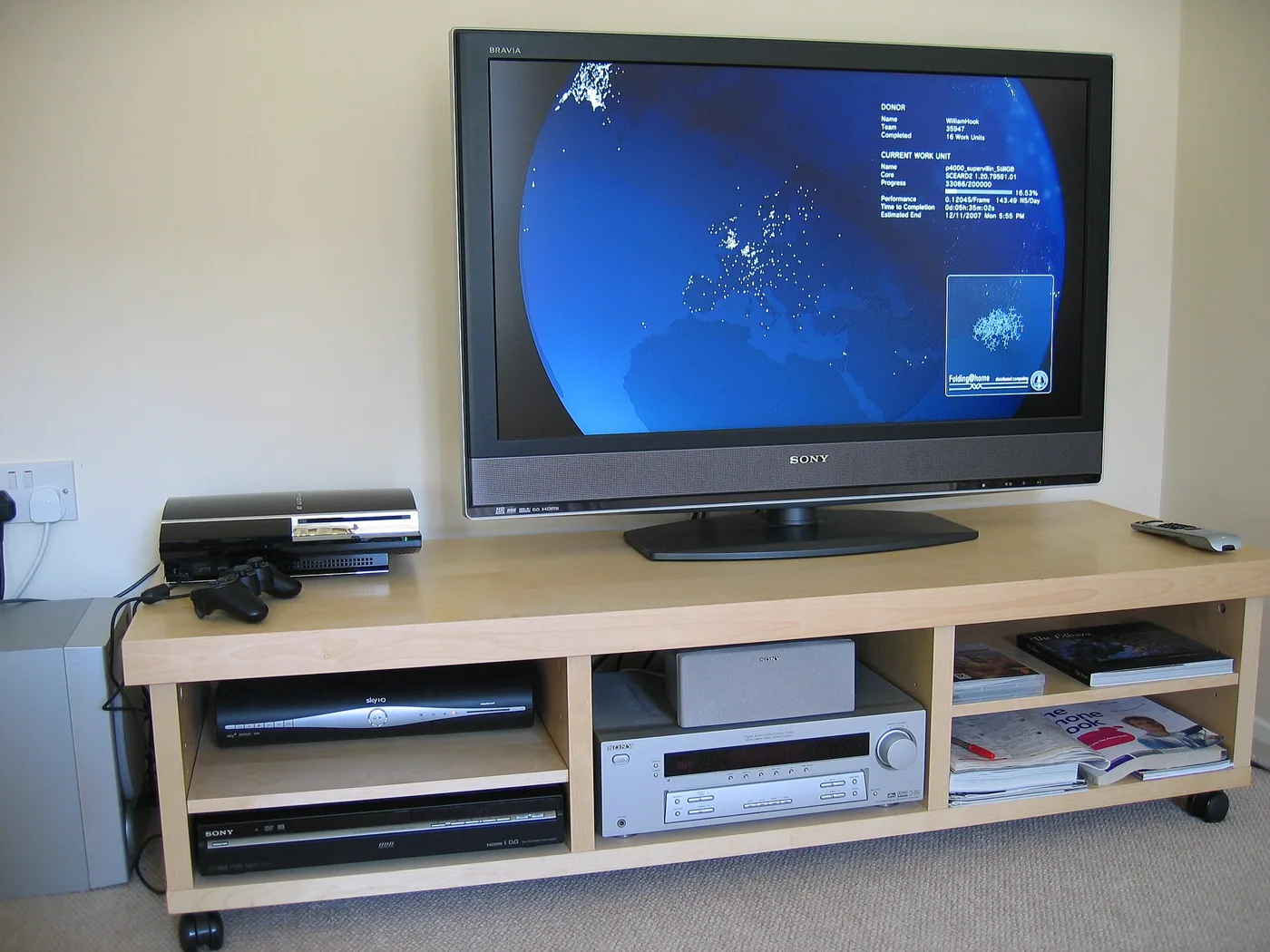
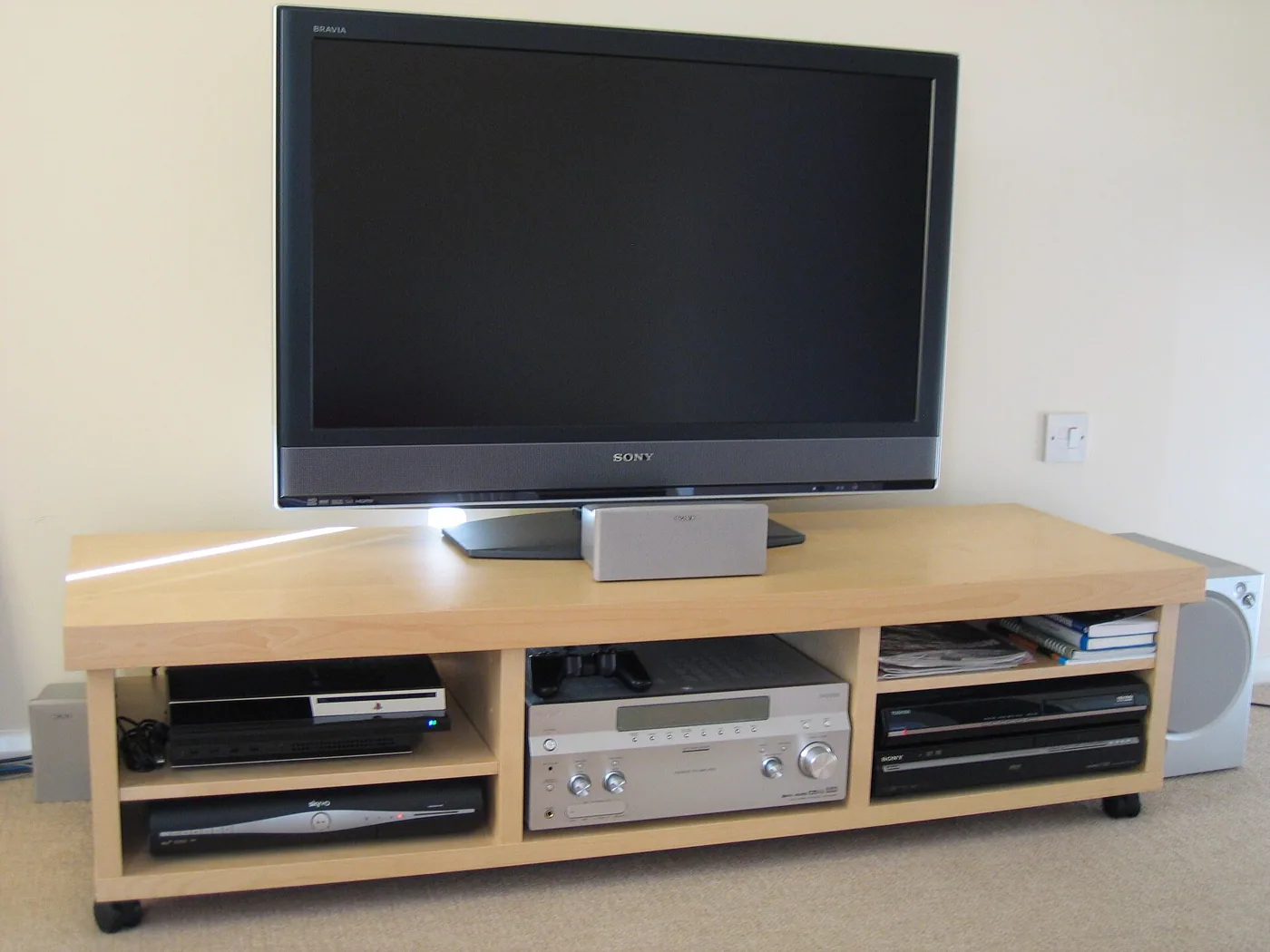
A TV stand is a low piece of furniture, usually 16 to 30 inches tall, that supports a TV on its top and offers shelves, drawers or doors below. A console is a similar piece, often longer and lower, with a modern look. A media console and a TV stand are effectively the same thing, with the difference in the names.
An entertainment center is a taller unit, commonly 60 to 80 inches high, that holds the TV in an opening or on a lower platform, with shelves, cabinets and sometimes drawers on either side and above. A wall unit is a larger, modular version that can stretch across the whole wall, and a hutch style has a tall cabinet or a glass front. Many modern wall units are designed to hold a wall-mounted TV with storage around it, which blurs the line between them.
The difference that matters is what the unit does to the room. A low stand adds a thin line along the bottom of the wall. An entertainment center turns the wall into furniture, with the TV one element in it. That is a decision about how much of the wall you want to commit.
Storage: how much do you need to hide
Count the things that must live near the TV. A soundbar, a streaming box, a game console, a few controllers, discs and cables fit easily in a low console with two or three shelves and a drawer. If you also store board games, books, throw blankets, photo albums and children's toys in the same room, you need more. An entertainment center offers 3 to 5 times the storage volume of a console, much of it at eye level or above.
Closed storage hides clutter, which matters in a living room where visual noise adds up. Doors with solid fronts give the calmest look, while open shelves invite display. A mix of closed lower cabinets and open upper shelves is the most flexible. Be honest about what you will actually keep tidy. An open unit is attractive only if the shelves are styled, a skill covered in how to style bookshelves, and a clutter-prone household might prefer doors.
For small rooms where storage is short, a tall unit uses vertical space that a low console wastes. See small living room storage ideas for other ways to stack storage upward. If storage is not the issue, a console and a wall shelf will give the same capacity with less bulk.
TV size limits and the opening
Many entertainment centers are built with a fixed opening for the TV, and that opening decides what you can buy. Older units may have an opening 30 to 36 inches wide, while a modern 55 inch TV is about 48 inches wide and a 65 inch is about 57. Always measure the opening width, height and depth, and compare to the TV's panel and stand dimensions. The depth should leave 3 to 4 inches behind the TV for air, and the opening height should allow the stand and the panel without touching the top shelf.
If you plan to upgrade the TV, choose a unit with a generous opening or one that allows a wall mount through a back panel. A hutch with a recessed niche is a poor choice for a screen larger than the niche, because a TV that sticks out of its alcove looks odd and may cover the doors. A low console, in contrast, supports a TV of any size within its width, and the TV can be changed without changing the furniture. For help sizing the stand width to the TV, read the TV stand size guide.
| Question | Low TV stand | Entertainment center |
|---|---|---|
| Storage volume | Moderate, 1 to 2 cubic yards of shelves at most | High, with cabinets and shelves above and beside |
| TV size flexibility | Any size within the width | Limited by the opening |
| Wall space used | Bottom 2 feet | Whole wall, up to the ceiling |
| Visual weight | Light | Heavy |
| Moving house | Easy | Often multiple pieces and wall fixings |
Ventilation and heat
Electronics produce heat, and a closed cabinet traps it. A streaming box and a soundbar produce little heat, but a game console, an AV receiver and a cable box can warm a closed space by several degrees. Heat shortens the life of components and can cause a console to throttle or shut down. A well-designed entertainment center has vent holes or open backs behind the equipment bay. A cabinet with solid doors and a closed back needs a gap at the back or the doors left open when devices are on.
Look for a perforated or open back panel, a gap of at least an inch around each device and a fan kit if you plan a dense setup. Do not stack hot devices directly on each other, and leave a few inches above the receiver. A glass door passes infrared remote signals, but a solid door blocks them, so you may need an infrared extender if you want the doors closed. If the cabinet design is tight, an open shelf for the console is a simple answer.
Room size and wall space
A tall unit works best in a larger room, or where the TV wall has no windows or doors. In a small living room under about 12 by 12 feet, a floor-to-ceiling cabinet can make the room feel smaller and darker. A low console leaves the upper wall free, which lets the eye travel and lets you hang a mirror or art. A white or light-colored unit that blends with the wall reduces the visual weight, and glass doors lighten the look.
Ceiling height is another factor. A unit that stops a few inches short of the ceiling collects dust on the top and looks unfinished, while one that touches the ceiling looks built-in. If the unit stops short, style the top with a few light objects or leave a clear gap of at least 12 inches. For a rented home, a freestanding console is easier to move and requires no fixings, whereas a tall wall unit should be anchored for safety, a topic covered in anchoring furniture to the wall.
Doors and drawers need clearance. A cabinet with swing doors needs 16 to 24 inches of free space in front, and a sofa that sits too close blocks them. Sliding doors and drawers save space but give access to only part of the interior at one time.
The hybrid: wall-mounted TV with a low console
The most popular modern arrangement is a TV on the wall with a long, low console below, and perhaps a pair of shelves above. This keeps the wall light, offers a surface for decor and lets you hide devices in drawers. It combines the clean look of a console with the TV size flexibility of a wall mount. The cables go behind the wall, as explained in hiding TV wires, and the screen height follows the guidance in the mounting height guide.
If you like the storage of a tall unit but not its bulk, a pair of low cabinets with a wall-mounted TV between them and open shelves above is a good middle path. It uses vertical space for storage while leaving the center clear for the TV. This also suits a rental, since the cabinets are separate pieces and the TV mount is the only wall fixing.
Styling, lighting and the look of the wall
A tall unit is as much a display wall as a storage piece, and it rewards a plan. Keep the TV opening free of clutter, group books and objects in odd numbers on the open shelves and leave about a third of each shelf empty so the unit does not look stuffed. Dark woods and heavy mouldings make a unit look larger, while white or pale finishes and simple fronts reduce its weight. If the unit has glass doors, interior lighting makes a difference, and a small LED strip along the inside edge of a shelf adds glow without cords across the room, a technique described in the LED strip lights guide.
A low console offers a different canvas. The surface at either side of the TV carries a lamp, a plant or a stack of books, and the wall above has room for art or a mirror. Keep the scale balanced: objects on the console should be lower than the bottom of the screen, or placed at the ends, so they do not block the picture. A pair of lamps on a console beside the TV soften the contrast between a bright screen and a dark room, a point that matters for eye comfort during evening viewing.
Common regrets after buying
The first regret is buying a hutch with an opening that is just a few inches too narrow for the new TV, and having to leave the doors permanently open or return the set. The second is buying a low console that is too short for the wall, so it looks lost and the TV hangs over its edges. The third is storing a hot console in a sealed cabinet, which leads to a shutdown in the middle of a film. The fourth, in rental homes, is a wall unit that cannot be taken down without leaving holes.
Avoid all four by measuring the TV, the opening, the wall and the doorways before ordering, by checking the ventilation, and by choosing furniture that can be taken apart. A tape outline of the unit on the floor and wall helps you see how much room it takes before it arrives.
Safety, cost and moving
Tall units carry a tip-over risk, and if the unit holds a heavy TV on a shelf at height, the risk grows. Anchor any unit over about 30 inches tall to the wall, as explained in the furniture anchoring guide. Low consoles are stable but still benefit from a strap on the TV. Check the weight rating of the shelf or platform that holds the TV, and avoid placing a heavy TV on a shelf designed for books.
Cost and effort differ too. A low console is usually less expensive and arrives as one or two boxes. An entertainment center is a multi-piece project that takes hours to assemble and often needs two people. If you move often, a modular unit that breaks down into pieces is practical, and a solid hutch that is hard to move becomes a burden. Resale and lifetime matter less, since both types sell easily in the used market if they are in good shape.
A simple way to decide
Answer three questions. How much do you store near the TV? If it fits on three shelves, choose a console. How much wall can you give up? If the wall is the only free space in a small room, choose the console. How often do you change the TV? If you upgrade every few years, avoid a unit with a fixed opening.
Choose an entertainment center when you have the wall, the storage need and a TV that fits the opening, and when you like the traditional or built-in look. Choose a console in all other cases, since it is the more flexible and lighter choice for a modern living room.
Frequently asked questions
Is an entertainment center outdated?
The traditional deep cabinet is, but wall units that hold a flat screen with storage around it are common. The question is whether you need the storage and the wall space, not whether the style is current.
Can I put a big TV in an entertainment center?
Only if the opening is wide enough. Measure the opening and the TV, including the stand, and leave 3 to 4 inches behind for ventilation. Many older units cannot take a TV over 50 inches.
Do closed cabinets overheat electronics?
They can. A game console and a receiver warm the space, so choose a unit with open or perforated backs or leave the doors open while using them.
What is better for a small living room?
A low console, ideally with the TV on the wall. It keeps the upper wall free and the room feels bigger. Add a tall bookcase elsewhere if you need more storage.
Should I anchor an entertainment center?
Yes, any tall unit should be fixed to a wall stud with a strap or bracket, particularly if children or pets live in the home.
Bottom line
Pick a low TV stand or console for most modern living rooms, especially with a wall-mounted TV. Pick an entertainment center when the room has wall space to spare and you need the storage, and measure the opening against the TV first.
Whichever you choose, plan for ventilation, check the weight rating and anchor anything tall. The best unit is the one that holds what you actually have without dominating the room.