Amazon affiliate links - we earn a commission.Affiliate disclosure
Guide·12 min read

LED Strip Lights in the Living Room: Where They Work and Why They Fail

Bias lighting behind a TV, cove and shelf strips, diffusers versus dots, CRI, adhesive failure and power runs: how to install LED strips that last.

By Elena Hart · Updated 2026-11-20

Quick answer

LED strips work best as indirect light: behind a TV for bias lighting, in a cove aimed at the ceiling, or under a shelf edge. Choose a high CRI of 90 or more, a warm 2700K to 3000K tone for living areas, and an aluminum channel with a diffuser so the individual diodes do not show as dots. Clean the surface with alcohol before sticking, support long runs mechanically, and keep power runs short or add a second feed to avoid dimming at the far end.

An LED strip looks like the cheapest upgrade in lighting: a roll of adhesive tape, a power plug and a ten minute job. Then the adhesive lets go after two months, the far end of the run glows orange, and the diodes show as a row of harsh dots on the wall. The strips themselves are fine. The failures come from surface preparation, power planning and the choice of what the light is aimed at.

This guide covers the places a strip actually improves a living room, the specifications that matter when buying one, how to hide the diodes, how to stop the glue from failing and how to power a long run without color shift. It assumes ordinary 12 or 24 volt strips, which cover almost every home project.

Where strips work in a living room

A strip is a line source, and line sources are best used indirectly, where you see the glow and not the diodes. Three placements account for most good results. The first is behind a television, where a strip fixed to the back edge casts a soft halo on the wall. This is called bias lighting, and its purpose is to reduce the contrast between a bright screen and a dark room, which lowers eye fatigue during evening viewing. The second is a cove, a shelf or ledge near the ceiling where the strip aims upward and washes the ceiling with a gentle glow. The third is under a shelf, a floating cabinet or the lower edge of a console, where it lights the surface below or creates a floating effect.

Placements that work less well include strips glued directly to a visible wall without a channel, and strips run around a ceiling edge with a bare view of the diodes from the sofa. In both, the viewer sees bright points and the effect reads as a nightclub, not a living room. The rule of thumb is that if you can see the strip from a seated position, it needs a diffuser or a different position.

Bias lighting behind a TV

For bias lighting, the goal is a faint, neutral glow of about 10 percent of the screen's peak brightness. Too much light on the wall behind raises the room's overall level and washes out dark scenes, which defeats the benefit. Choose a strip around 6500K, the standard reference white for video, if the TV is set to that mode, or match the strip to the screen's white point if you can. A strip colored differently from the picture can make the screen look tinted.

Mount it on the back of the TV, inside the edge, about 1 to 2 inches in from the sides so the glow falls onto the wall and not into the room. For a 55 inch screen, you need about 6 to 8 feet of strip, and a 65 inch needs about 8 to 10 feet. Place the power supply or a controller where the TV's own cables can share a hidden route, and see the wire-hiding guide for options. A strip that runs on USB power from the TV's port will switch on and off with the television, which is the most convenient behavior for this use.

A dimmable strip with a remote helps tune the level. On a dark wall the glow is less visible and may need to be stronger. On a white wall, a low setting is enough because the wall reflects a lot of light back toward the viewer.
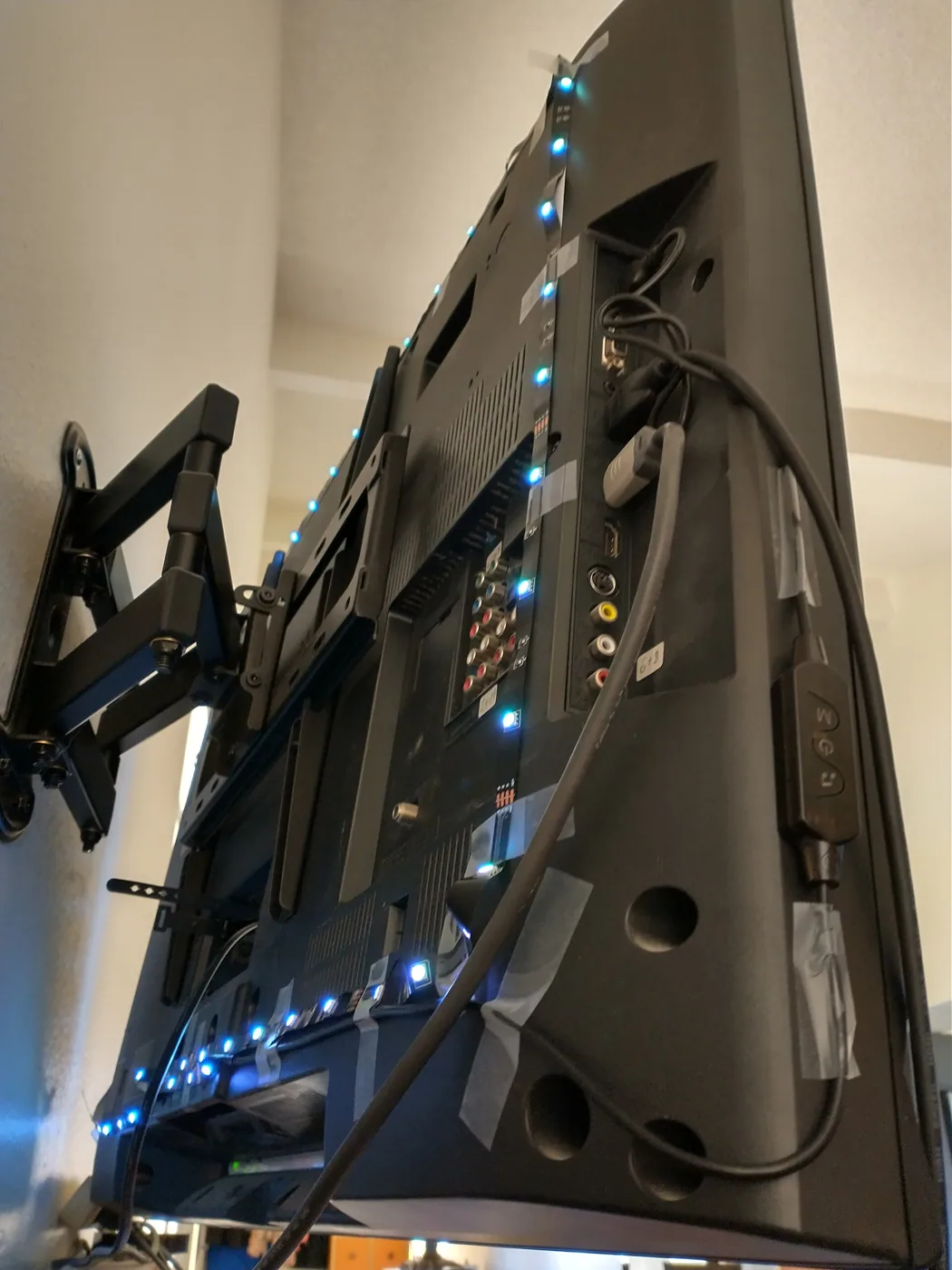
An LED strip fixed along the back edge of a wall-mounted television
A strip fixed inside the back edge of a TV, so only the glow reaches the wall behind.

Specifications that matter when you buy

Marketing pages tout color effects and app control. For a living room, four numbers decide quality. The first is color temperature: choose 2700K or 3000K for cove and shelf lighting, to match your lamps. The second is CRI, color rendering index. A cheap strip may sit at CRI 70 to 80 and make wood and fabric look dull, while CRI 90 or more shows them naturally. The third is LED density, measured in diodes per meter, with 120 or more per meter giving a smoother line than 60. The fourth is lumens per foot, with 200 to 400 lumens per foot suiting accent use.

SpecLiving room targetWhy
Color temperature2700K to 3000K, 6500K for biasMatches lamps, or the video reference white
CRI90 or moreNatural wood, fabric and skin tones
Density120 or more per meterSmoother line, fewer visible dots
Voltage24V for long runs, 12V for shortLess voltage drop on 24V
Output200 to 400 lumens per footAccent, not task light

Be careful with RGB strips. The red, green and blue diodes in a basic RGB strip make white by mixing, which gives a low CRI white that looks bluish and flat. If you want both colors and a good white, look for RGBW or RGBCCT strips, which include a dedicated white diode.

Diffusers, channels and hiding the dots

Visible diodes are the clearest sign of a cheap installation. The fix is a diffuser, which spreads each point into a continuous line. The most reliable way is an aluminum channel with a frosted cover, available in lengths of 1 meter or 2 meters. The channel also acts as a heat sink, which extends the life of the strip, and it makes the installation rigid so the strip does not sag. For hidden positions where nobody sees the light source directly, a plain strip is fine.

The distance between the strip and the surface it lights also matters. Light thrown at a wall from a close distance produces a scalloped pattern of bright spots with dark gaps between. Moving the strip 2 to 3 inches back from the surface, or using a diffuser with a deeper channel, blends the pattern into a smooth wash. In a shelf or cove, a lip that hides the strip from view in the seating area should be at least as tall as the strip's housing plus a small margin.

Why the adhesive fails and how to prevent it

Most strips come with a foam tape backing, and it fails for three reasons. The surface is dusty or oily, so the adhesive grips the dust, not the wall. The surface is textured or painted with a flat paint that sheds a powdery layer, so the tape peels off with the paint. Or the strip is heavy and the glue is slowly pulled by gravity, or by heat from the diodes that softens the adhesive over weeks.

Clean the surface with isopropyl alcohol and a lint-free cloth, let it dry fully, and press the strip firmly for 30 seconds along its length. For painted walls, make sure the paint is cured, which usually takes a few weeks, and test a small piece first. For extra security, use clips or a channel with screws every 12 to 18 inches, and run any slack on a mounting clip. Heat accelerates failure, so do not run high-output strips inside a closed foam channel without aluminum.

Be careful about removal as well. A strong tape on a flat paint will take the paint with it. Warm the strip with a hair dryer and peel slowly at a low angle. In a rental, apply the strip to a removable surface, such as a thin strip of wood or the back of furniture, rather than directly to the wall.

Power runs and voltage drop

A strip draws a fixed current per foot, and the thin copper traces on the strip have resistance. Over a long run, the voltage falls toward the far end, which makes the last section dimmer and shifts the color toward amber. This voltage drop is more noticeable on 12 volt strips, which draw twice the current of 24 volt strips for the same power. For runs beyond 10 to 16 feet on 12 volt, or beyond about 16 to 20 feet on 24 volt, feed power at both ends or at the middle, using extra wires.

The power supply, often called a driver, should be rated 20 percent above the strip's total draw. A 16 foot strip drawing 40 watts needs at least a 50 watt supply. An undersized supply overheats and flickers. Place the supply where it can breathe, not buried inside a closed cabinet without ventilation. Keep the low voltage wires short between the supply and the strip, and the mains side tidy, with the plug accessible.

Controls, dimming and smart options

The cheapest controllers use a small infrared remote that must point at a receiver, and the receiver is easy to hide behind the TV and then forget. A better option is a controller with a wall switch, a radio remote or a wireless app. Dimming from the wall is easiest with a low voltage PWM dimmer, not a standard wall dimmer, since the strip's driver is not designed for a triac. Check which control type the driver supports before buying a dimmer, as described in the dimmer switch guide.

For a living room, set a warm white scene as the default, and treat color effects as an occasional feature. A strip in a fixed warm tone adds to layered lighting, a subject covered in the layered lighting guide. If you use smart control, group the strips with a scheduled scene, for example dimmed at night, so you do not have to remember to adjust them.
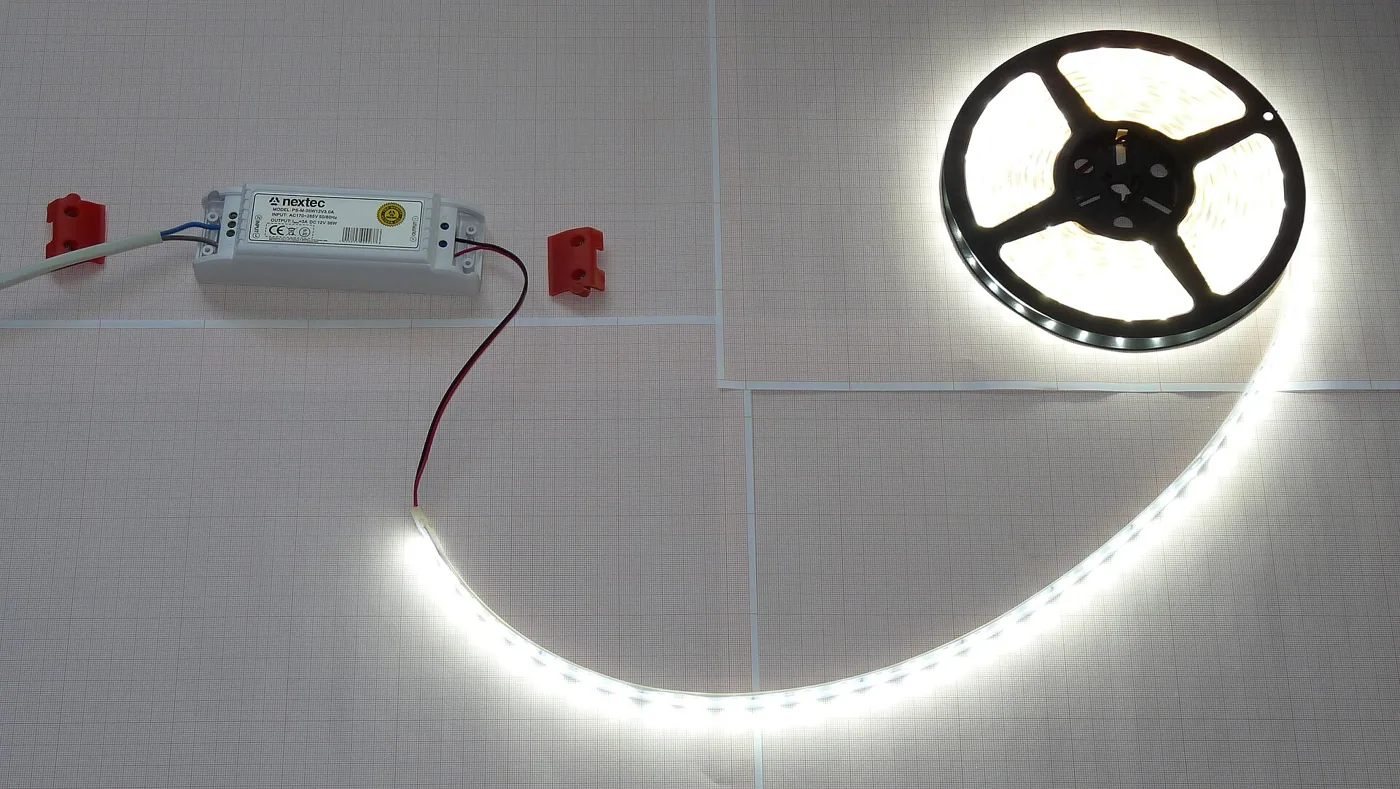
A reel of warm white LED strip connected to a small power supply
A reel of warm white strip and its driver. The driver rating must exceed the strip total draw by about 20 percent.

Shelf and cove lighting in practice

Built-in shelves and alcoves are where a well placed strip makes the biggest visual change. Mount the strip at the front edge of each shelf, on the underside, set back about half an inch from the front so the diodes are hidden by the lip. The light then rakes down across the objects below, which brings out texture on books and ceramics. Keep every shelf at the same color temperature and, where possible, on the same circuit so they dim as one.

For a cove at the top of a wall, the geometry decides success. A ledge of 4 to 6 inches deep, placed at least 12 inches below the ceiling, lets the strip wash the surface above in a smooth gradient. Placing the strip closer than about 8 inches to the ceiling creates hot spots and scallops. A white or light ceiling reflects the glow well, while a dark ceiling absorbs it and may need twice the output for the same effect. Check the finish: a gloss ceiling shows each diode as a reflected dot, so use a flat paint and a diffused strip.

Beyond the seating area, a strip under a console or a low cabinet creates a floating look and doubles as a night light that lets you cross the room without turning on a lamp. A low output of 100 to 150 lumens per foot is enough, and a motion sensor can switch it on only when needed. If you also use a soundbar or speakers on that console, see the soundbar placement guide to keep the strip from blocking a speaker or IR sensor.

Regrets people report after a first installation

The most common regret is buying a color-changing strip and using it only in white, with a result that looks cold and flat. Another is routing the supply cable across a visible wall because no one planned a hidden route, so the neat glow comes with a dangling cord. A third is mounting the strip first and finding that the controller receiver is hidden behind a speaker or a metal frame, so the remote does not work from the sofa.

A final regret is ignoring the room's existing light. A strip should be one layer among several, and a room lit only by strips often feels like a display case. Keep at least one lamp at seating height, and use the strips to fill in the background glow.

Safety and fire considerations

Low voltage strips are safe to touch, but the mains power supply is not, and a poor quality supply is the real hazard. Look for a recognized safety listing on the driver, and avoid unlabelled cheap units. Do not cover a driver with fabric or bury it inside insulation. Do not cut and extend strips with thin wire, as undersized wire heats. If a run is long, use a heavier gauge, around 18 AWG for moderate current. If a strip feels hot to the touch, reduce the load or improve cooling.

Frequently asked questions

Can I cut an LED strip to length?

Yes, at the marked cut points, usually every 2 to 3 inches. Cutting elsewhere leaves a dead section. After cutting you can use a solderless connector or solder wires at the pads to continue the run.

How much strip do I need behind a TV?

Measure the back perimeter of the screen, excluding the bottom if the stand blocks it. A 55 inch TV usually needs 6 to 8 feet and a 65 inch needs 8 to 10 feet. Buy a bit extra for corners and routing.

Do LED strips use a lot of electricity?

No. A typical living room installation of 16 feet at moderate brightness uses 20 to 40 watts, about the same as a single old incandescent bulb. They cost very little to run for hours each day.

Why does the far end of my strip look dimmer or yellower?

That is voltage drop. Use 24 volt strips for long runs, feed power from both ends, and size the wire to carry the current. Splitting the run into two shorter sections each with its own feed also works.

Will an LED strip damage my wall paint?

The adhesive may lift paint on removal, especially on flat finishes. Use a channel or a backing board for permanent installation, and warm the adhesive with a hair dryer before peeling.

Bottom line

Use strips as indirect light and hide the diodes. Choose a CRI of 90 or more, a warm tone for living areas and 6500K behind a TV. Put the strip in an aluminum channel with a diffuser, and clean the surface before you stick anything.

Plan the power before you install. Keep runs short, choose 24 volt for anything long and give the supply room to breathe. With those steps, a strip delivers a soft glow for years instead of peeling off in a month.

Image credits

  • accent-chair-desk-corner.webp: JohnLEE Brothers, CC0, source
  • accent-chair-green-velvet.webp: Shixart1985, CC BY 2.0, source
  • accent-chair-hero.webp: Shixart1985, CC BY 2.0, source
  • anchor-built-in-bookcases-room.webp: Carol M. Highsmith, Public domain, source
  • anchor-small-bookcase-hall.webp: Steven Pavlov, CC BY-SA 4.0, source
  • anchor-white-bookcase-wall.webp: Egilus, CC BY-SA 4.0, source
  • arrange-living-room-hero.webp: Kotivalo, CC BY-SA 4.0, source
  • arrange-living-room-seating-group.webp: Neoclassicism Enthusiast, CC0, source
  • arrange-living-room-sofa-wall.webp: Adele Berenstein, CC BY 2.0, source
  • artsofa-pictures-on-wall-room.webp: Tudor Washington Collins, CC BY 4.0, source
  • artsofa-sofa-corner-mural.webp: G�nter Seggeb�ing, Coesfeld, CC BY-SA 3.0, source
  • artsofa-sofa-mural-wall.webp: G�nter Seggeb�ing, Coesfeld, CC BY-SA 3.0, source
  • blackoutcurtain-floor-length-pair.webp: Ounfs Robmmy 238, CC0, source
  • blackoutcurtain-olive-heavy-fabric.webp: Easysayg, CC BY-SA 4.0, source
  • blackoutcurtain-white-sheer-hotel.webp: HuiDongXLW RMDa, CC0, source
  • ceilingfan-five-blade-light.webp: CommandProMC, CC BY-SA 4.0, source
  • ceilingfan-pull-chain-light.webp: Hans Olav Lien, CC BY-SA 3.0, source
  • clean-fabric-sofa-blanket.webp: Shixart1985, CC BY 2.0, source
  • clean-fabric-sofa-hero.webp: Lear 21, CC BY-SA 4.0, source
  • clean-fabric-sofa-slipcover.webp: Enric, CC BY-SA 4.0, source
  • clean-rug-fringe-pattern.webp: Sununa, CC BY-SA 4.0, source
  • clean-rug-runner-hall.webp: Sununa, CC BY-SA 4.0, source
  • coffeetable-round-yellow-sofa.webp: Vaibhavratnaparkhi, CC BY-SA 4.0, source
  • coffeetable-tan-sofa-dark-table.webp: Shixart1985, CC BY 2.0, source
  • coffeetable-two-wood-tables.webp: Sophia Baboolal, CC0, source
  • color-temp-bright-bulb.webp: Xzantiyamoloy, CC BY 4.0, source
  • color-temp-gu10-spot.webp: Dmitry G, CC BY-SA 3.0, source
  • color-temp-hero.webp: LoMit, CC BY-SA 4.0, source
  • color603010-paint-swatches-wall.webp: Chris Rycroft, CC BY 2.0, source
  • color603010-rainbow-swatch-range.webp: Joyful spherical creature, CC BY 4.0, source
  • color603010-swatch-cards-neutrals.webp: Clean Wal-Mart, CC BY 2.0, source
  • cornertv-1960s-room-tv-window.webp: Kotivalo, CC BY-SA 4.0, source
  • cornertv-budapest-sofa-room.webp: Justin Sch�ler, CC0, source
  • cornertv-white-room-console.webp: Oliur Rahman, CC0, source
  • curtainfabric-heavy-olive-folds.webp: Easysayg, CC BY-SA 4.0, source
  • curtainfabric-hotel-floor-length-pair.webp: Ounfs Robmmy 238, CC0, source
  • curtainfabric-white-light-filtering.webp: HuiDongXLW RMDa, CC0, source
  • curtains-hk-window-stacked-open.webp: YSSKACH WFAMOACSH TUNGA, CC BY-SA 4.0, source
  • curtains-hotel-living-zone-floor-length.webp: Ounfs Robmmy 238, CC0, source
  • cushion-fill-hero.webp: Dalton Scavassa, CC BY-SA 4.0, source
  • cushion-fill-pillows-leather.webp: Aaaatu, CC BY-SA 4.0, source
  • depth-grey-sofa-cushions.webp: Dalton Scavassa, CC BY-SA 4.0, source
  • depth-grey-sofa-hero.webp: Lear 21, CC BY-SA 4.0, source
  • depth-sectional-living-room.webp: Shixart1985, CC BY 2.0, source
  • dimmer-rotary-wall.webp: Paolomarco, CC BY-SA 4.0, source
  • dimmer-slide-wall.webp: BrokenSphere, CC BY-SA 3.0, source
  • dimmer-wiring-box.webp: Kurtkaiser, CC0, source
  • door-hotel-living-room.webp: Adele Berenstein, CC BY 2.0, source
  • door-orange-sofa-hero.webp: Shixart1985, CC BY 2.0, source
  • echo-1960s-room-soft-furnishings.webp: Kotivalo, CC BY-SA 4.0, source
  • echo-fabric-acoustic-panels-wall.webp: 36N63, CC BY-SA 4.0, source
  • echo-panel-mineral-wool-core.webp: JoraK, CC BY-SA 4.0, source
  • entcenter-low-stand-devices.webp: William Hook, CC BY-SA 2.0, source
  • entcenter-old-tv-setup.webp: William Hook, CC BY-SA 2.0, source
  • entcenter-wood-wall-unit-living-room.webp: Casey Fleser, CC BY 2.0, source
  • fabric-green-velvet-hero.webp: Neoclassicism Enthusiast, CC0, source
  • fabric-grey-sofa-cushions.webp: Lear 21, CC BY-SA 4.0, source
  • fabric-sofa-blanket.webp: Shixart1985, CC BY 2.0, source
  • floatshelf-mixed-books-rows.webp: Roman Eisele, CC BY-SA 4.0, source
  • floatshelf-steel-support.webp: Fructibus, CC0, source
  • floatshelf-white-bookcase-wall.webp: Egilus, CC BY-SA 4.0, source
  • floor-lamp-height-hero.webp: Agbarto, CC0, source
  • floor-lamp-height-stained-glass.webp: Louis Comfort Tiffany / Tiffany Studios, CC0, source
  • floor-lamp-height-white-reading-lamp.webp: FASTILY, CC BY-SA 4.0, source
  • frame-black-leather-sofa.webp: www.Pixel.la Free Stock Photos, CC0, source
  • frame-green-velvet-sofa.webp: Neoclassicism Enthusiast, CC0, source
  • frame-grey-sofa-hero.webp: Dalton Scavassa, CC BY-SA 4.0, source
  • gallerywall-frames-bookcase-lamp.webp: Personal Creations, CC BY 2.0, source
  • gallerywall-frames-floor-tape.webp: Personal Creations, CC BY 2.0, source
  • gallerywall-frames-on-wall-home.webp: Personal Creations, CC BY 2.0, source
  • hang-light-hero.webp: Martin Falbisoner, CC BY-SA 4.0, source
  • hang-light-lamp-with-shade.webp: LoMit, CC BY-SA 4.0, source
  • hang-light-red-drum-lamp.webp: Agbarto, CC0, source
  • jute-sisal-combing-fibre.webp: Uncredited for Keystone View Company, Public domain, source
  • jute-sisal-hero.webp: B.navez, CC BY-SA 3.0, source
  • jute-sisal-plantation.webp: Forest & Kim Starr, CC BY 3.0, source
  • knotted-rug-cut-pile-carpet.webp: Daderot, CC0, source
  • knotted-rug-hero.webp: Daderot, CC0, source
  • knotted-rug-prayer-wool.webp: Daderot, CC0, source
  • lampshade-cream-base.webp: LoMit, CC BY-SA 4.0, source
  • lampshade-empire-lamp.webp: J.Dncsn, CC BY-SA 3.0, source
  • lampshade-paper-rect-lamp.webp: Zeitlupe, CC BY-SA 4.0, source
  • layer-rugs-armchairs.webp: PattayaPatrol, CC BY-SA 4.0, source
  • layer-rugs-conversation-pit.webp: Marsh Davis; Indiana Landmarks, CC BY 4.0, source
  • layer-rugs-hero.webp: BusterD, CC BY-SA 4.0, source
  • layered-light-hero.webp: FASTILY, CC BY-SA 4.0, source
  • layered-light-red-shade-lamp.webp: Agbarto, CC0, source
  • layered-light-table-lamp.webp: LoMit, CC BY-SA 4.0, source
  • leather-care-black-sofa.webp: www.Pixel.la Free Stock Photos, CC0, source
  • leather-care-burgundy-set.webp: Dominic's pics, CC BY 2.0, source
  • leather-care-hero.webp: Thomas Quine, CC BY 2.0, source
  • ledstrip-cove-fireplace.webp: Andrey Gvrv, CC BY-SA 3.0, source
  • ledstrip-spool-driver.webp: Dmitry G, CC BY-SA 3.0, source
  • ledstrip-tv-back.webp: Stilfehler, CC BY-SA 4.0, source
  • loveseat-sofa-armchair-room.webp: Adele Berenstein, CC BY 2.0, source
  • loveseat-sofa-hero.webp: Aaaatu, CC BY-SA 4.0, source
  • loveseat-sofa-leather-pair.webp: Dominic's pics, CC BY 2.0, source
  • lowlight-snake-plant-corner-pot.webp: Enzo Rippa, CC BY-SA 4.0, source
  • lowlight-snake-plant-window-table.webp: Martin Olsson, CC BY-SA 3.0, source
  • lowlight-zz-plant-potted.webp: Jamshid Nurkulov, CC BY-SA 4.0, source
  • lumens-bulb-hero.webp: R. Henrik Nilsson, CC BY 4.0, source
  • lumens-led-bulbs-group.webp: Geoffrey.landis at English Wikipedia, CC BY 3.0, source
  • measure-cabin-sofa.webp: Shixart1985, CC BY 2.0, source
  • measure-room-depth.webp: Shixart1985, CC BY 2.0, source
  • measure-sofa-hero.webp: Shixart1985, CC BY 2.0, source
  • mirror-above-mantel-living-room.webp: Tudor Washington Collins, CC BY 4.0, source
  • mirror-round-blue-wall-window.webp: Ciara N� Riain, CC BY-SA 4.0, source
  • mirror-round-over-wood-console.webp: Shixart1985, CC BY 2.0, source
  • mixpatterns-armenian-patterned-pillows.webp: Ararat Trvants, CC BY-SA 4.0, source
  • mixpatterns-couch-pillows-set.webp: Dawid Skalec, CC BY-SA 4.0, source
  • mixpatterns-leather-sofa-pillows.webp: Aaaatu, CC BY-SA 4.0, source
  • no-overhead-hero.webp: Gotogo, CC BY-SA 4.0, source
  • no-overhead-red-shade-lamp.webp: Agbarto, CC0, source
  • no-overhead-white-floor-lamp.webp: FASTILY, CC BY-SA 4.0, source
  • nodrillcurtain-hk-window-open.webp: YSSKACH WFAMOACSH TUNGA, CC BY-SA 4.0, source
  • nodrillcurtain-olive-rail-folds.webp: Easysayg, CC BY-SA 4.0, source
  • nodrillcurtain-white-light-panel.webp: HuiDongXLW RMDa, CC0, source
  • open-plan-rug-armchairs.webp: PattayaPatrol, CC BY-SA 4.0, source
  • open-plan-rug-hero.webp: NPS Photo, Public domain, source
  • open-plan-rug-sunken-living.webp: Marsh Davis; Indiana Landmarks, CC BY 4.0, source
  • ottoman-coffee-table-pair.webp: Sophia Baboolal, CC0, source
  • ottoman-leather-round-pair.webp: Olugold, CC BY-SA 4.0, source
  • ottoman-round-stool-top.webp: Olugold, CC BY-SA 4.0, source
  • paintsheen-open-paint-cans.webp: United Soybean Board, CC BY 2.0, source
  • paintsheen-paint-can-brush.webp: Shixart1985, CC BY 2.0, source
  • paintsheen-swatch-cards-range.webp: Chris Rycroft, CC BY 2.0, source
  • pets-sofa-kitten-cushions.webp: Feliciano Guimar�es from Guimar�es, Portugal, CC BY 2.0, source
  • pets-sofa-slipcover.webp: Enric, CC BY-SA 4.0, source
  • pillows-decorative-couch-set.webp: Dawid Skalec, CC BY-SA 4.0, source
  • pillows-leather-sofa-group.webp: Aaaatu, CC BY-SA 4.0, source
  • pillows-wooden-sofa-red-cushions.webp: Zohasheikh, CC BY-SA 4.0, source
  • readinglamp-adjustable-torchiere.webp: Agbarto, CC0, source
  • readinglamp-armchair-corner-lamp.webp: Kotivalo, CC BY-SA 3.0, source
  • readinglamp-cozy-sunlit-corner.webp: Shixart1985, CC BY 2.0, source
  • recessed-gimbal-trim.webp: Stilfehler, CC BY-SA 4.0, source
  • recessed-housing-display.webp: Stilfehler, CC BY-SA 4.0, source
  • recessed-led-can-trim.webp: Stilfehler, CC BY-SA 4.0, source
  • recliner-buying-armchair-room.webp: Virginia State Parks staff, CC BY 2.0, source
  • recliner-buying-hero.webp: Laura Stoinski, CC0, source
  • recliner-buying-leather-sofa.webp: Aaaatu, CC BY-SA 4.0, source
  • rug-curl-fringe-rug.webp: Sununa, CC BY-SA 4.0, source
  • rug-curl-hero.webp: Sununa, CC BY-SA 4.0, source
  • rug-curl-runner-patterns.webp: Sununa, CC BY-SA 4.0, source
  • rug-dents-hero.webp: ProjectManhattan, CC BY-SA 3.0, source
  • rug-dents-wool-medallion.webp: Daderot, CC0, source
  • rug-on-carpet-armchairs.webp: PattayaPatrol, CC BY-SA 4.0, source
  • rug-on-carpet-flat-weave.webp: Mervat, CC BY 4.0, source
  • rug-on-carpet-hero.webp: NPS Photo, Public domain, source
  • rug-pad-dense-carpet.webp: ProjectManhattan, CC BY-SA 3.0, source
  • rug-pad-hero.webp: Sununa, CC BY-SA 4.0, source
  • rug-pile-flatweave-stack.webp: Mervat, CC BY 4.0, source
  • rug-pile-sarouk-wool.webp: Daderot, CC0, source
  • rug-shedding-pile-closeup.webp: ProjectManhattan, CC BY-SA 3.0, source
  • rug-shedding-wool-rugs.webp: Mervat, CC BY 4.0, source
  • rug-size-armchairs-on-rug.webp: PattayaPatrol, CC BY-SA 4.0, source
  • rug-size-conversation-area.webp: Marsh Davis; Indiana Landmarks, CC BY 4.0, source
  • rug-size-hero.webp: NPS Photo, Public domain, source
  • runner-size-hero.webp: Sununa, CC BY-SA 4.0, source
  • runner-size-red-runner.webp: Sununa, CC BY-SA 4.0, source
  • runner-size-three-runners.webp: Sununa, CC BY-SA 4.0, source
  • sag-cushions-hero.webp: Durova, CC BY-SA 3.0, source
  • sag-cushions-slipcover.webp: Enric, CC BY-SA 4.0, source
  • sag-cushions-sofa-deck.webp: Dalton Scavassa, CC BY-SA 4.0, source
  • sconce-above-tufted-chairs.webp: Jedodo756, CC0, source
  • sconce-brass-opal-shade.webp: unknown (see Commons page), CC BY-SA 4.0, source
  • sconce-wall-lamp-side-table.webp: Atilla Taskiran, CC0, source
  • sectional-dark-hero.webp: Shixart1985, CC BY 2.0, source
  • sectional-room-arrangement.webp: Kotivalo, CC BY-SA 4.0, source
  • sectional-white-corner.webp: GardenKings, CC BY-SA 3.0, source
  • shelfsag-mixed-books-shelf.webp: Roman Eisele, CC BY-SA 4.0, source
  • shelfsag-packed-bookshelf.webp: Csferrie, CC BY-SA 4.0, source
  • shelfsag-wood-shelf-rows.webp: PeaceSeekers, CC BY-SA 4.0, source
  • sidetable-cozy-sofa-room.webp: Breather, CC0, source
  • sidetable-kentwood-sofa.webp: Kari Shea, CC0, source
  • sidetable-round-wall-lamp.webp: Atilla Taskiran, CC0, source
  • sleeper-sofa-bed-made-up.webp: Maniago, Public domain, source
  • sleeper-sofa-open-hero.webp: N509FZ, CC BY-SA 4.0, source
  • sleeper-sofa-sofa-mode.webp: N509FZ, CC BY-SA 4.0, source
  • small-room-slim-arm-sofa.webp: Lear 21, CC BY-SA 4.0, source
  • small-room-sofa-hero.webp: Shixart1985, CC BY 2.0, source
  • small-room-two-seat-layout.webp: Adele Berenstein, CC BY 2.0, source
  • smallbigger-finland-studio-bright.webp: Aaaatu, CC BY-SA 4.0, source
  • smallbigger-hk-curtains-open-window.webp: YSSKACH WFAMOACSH TUNGA, CC BY-SA 4.0, source
  • smallbigger-white-room-console.webp: Oliur Rahman, CC0, source
  • smallstorage-finland-studio-room.webp: Aaaatu, CC BY-SA 4.0, source
  • smallstorage-leather-sofa-shelving.webp: Sabri Tuzcu, CC0, source
  • smallstorage-wall-shelves-books.webp: Roger W, CC BY-SA 2.0, source
  • smart-bulbs-bulb-in-hand.webp: Xzantiyamoloy, CC BY 4.0, source
  • smart-bulbs-led-internals.webp: Loadmaster, Bech, CC BY-SA 4.0, source
  • soundbar-below-lg-tv.webp: Dinkun Chen, CC BY-SA 4.0, source
  • soundbar-philips-front-grille.webp: Philips Communications, CC BY 2.0, source
  • soundbar-samsung-single-bar.webp: Dinkun Chen, CC BY-SA 4.0, source
  • stylebooks-packed-shelf-wall.webp: Csferrie, CC BY-SA 4.0, source
  • stylebooks-philosophers-shelf.webp: Roman Eisele, CC BY-SA 4.0, source
  • stylebooks-wall-shelves-bottles-books.webp: Roger W, CC BY-SA 2.0, source
  • styletable-book-stack-candle.webp: Gabbybratcher, CC BY-SA 4.0, source
  • styletable-two-tables-mugs.webp: Sophia Baboolal, CC0, source
  • styletable-yellow-sofa-cups-flowerpot.webp: Shixart1985, CC BY 2.0, source
  • surround-home-theater-tv-seating.webp: NPat318, CC BY-SA 4.0, source
  • surround-rear-view-seats.webp: NPat318, CC BY-SA 4.0, source
  • surround-sectional-media-room.webp: Derek Jensen (Tysto), Public domain, source
  • table-lamp-size-antique-shade.webp: Amitbalani, CC0, source
  • table-lamp-size-hero.webp: Tess Mattew, CC BY-SA 4.0, source
  • table-lamp-size-measured.webp: Tess Mattew, CC BY-SA 4.0, source
  • throwblanket-blue-throw-kitten.webp: TudorTulok, CC BY-SA 4.0, source
  • throwblanket-striped-couch-cat.webp: Roman Eisele, CC BY-SA 4.0, source
  • throwblanket-yellow-blue-couch.webp: Roman Eisele, CC BY-SA 4.0, source
  • tvheight-flat-panel-wall.webp: BrokenSphere, CC BY-SA 3.0, source
  • tvheight-plasma-wall-room.webp: Pkepneriv, CC BY-SA 3.0, source
  • tvheight-white-living-room.webp: Oliur Rahman, CC0, source
  • tvmount-articulating-arm.webp: Ben Scholzen, CC BY 2.0, source
  • tvmount-vesa-adapter-plate.webp: Tony Webster, CC BY 2.0, source
  • tvmount-wall-panel-room.webp: Pkepneriv, CC BY-SA 3.0, source
  • tvsize-dark-room-big-screen.webp: Christian Collins, CC BY 2.0, source
  • tvsize-media-room-screen.webp: NPat318, CC BY-SA 4.0, source
  • tvsize-tv-on-stand.webp: PhotoPicker13, CC BY-SA 4.0, source
  • tvstand-low-stand-devices.webp: William Hook, CC BY-SA 2.0, source
  • tvstand-wall-unit-living-room.webp: Casey Fleser, CC BY 2.0, source
  • tvwires-cable-box-wires.webp: Tony Webster, CC BY 2.0, source
  • tvwires-hdmi-connectors.webp: Kreuzschnabel, CC BY-SA 3.0, source
  • tvwires-wall-mounted-panel.webp: BrokenSphere, CC BY-SA 3.0, source
  • washable-rugs-flatweave-stack.webp: Mervat, CC BY 4.0, source
  • washable-rugs-hero.webp: Mervat, CC BY 4.0, source
  • washable-rugs-loomed-stripes.webp: Gcarrillog, CC0, source
  • wool-poly-hero.webp: Mervat, CC BY 4.0, source
  • wool-poly-oaxacan-wool.webp: Gcarrillog, CC0, source
  • wool-poly-prayer-rug.webp: Daderot, CC0, source

Related Guides