Track lighting has an unfair reputation. Many people picture the bare ceiling rails of a 1990s kitchen, with heads pointing at random angles. Done well, it is one of the most flexible ways to light a living room: a single run of track can wash a wall of art, spotlight a bookcase and give a soft glow over a seating area, and you can change all of it later by loosening a head and turning it.
This guide explains the three main systems, how to size and space a run for a typical room, how to aim heads so they light the thing you want without glare, and what to know about LEDs, dimmers and ceilings of different heights. It also covers the installation question, since the right system for a renter is rarely the right system for a home owner.
Track, monorail and cable: the three systems
Standard track is a rail fixed to the ceiling, usually 4 or 8 feet in a straight section, that carries power along its length. Heads clip on anywhere along it and can be moved, added or removed without tools. It is the most common and cheapest system, available in line voltage versions that use ordinary bulbs and in low voltage versions that need a transformer. Straight runs can be joined with connectors to form an L or a U shape around a room.
Monorail is a thinner, more designed version. A single rail carries power and holds pendants or heads that slide along it. It looks cleaner, and it can be curved or bent in shapes that standard track cannot, but the heads are specific to that system and the selection is smaller. It tends to cost more, and it suits a room where the lighting is part of the visual design.
Cable systems use two tensioned wires strung between wall anchors, with small heads and pendants clipped to them. They suit open ceilings, high ceilings and spaces where a rail would feel heavy. The wires carry low voltage current, so a transformer is required, and installation needs solid anchor points at each end. Cable systems are visually the lightest but the least forgiving in layout, since the span and the sag need planning.
| System | Best for | Flexibility | Watch out for |
|---|---|---|---|
| Standard track | Most living rooms, art walls, shelves | High: heads move and aim freely | Plain look, mixing heads from different brands |
| Monorail | Design-led rooms, curved layouts | Medium: slides along one rail | Limited head choice, higher cost |
| Cable | High ceilings, open spaces | Medium: clips anywhere on the wires | Needs a transformer and strong anchors |
When track is the right choice
Track earns its place in three situations. The first is a room with no ceiling box in a useful position, such as an older home where the only ceiling light is in the center, because a single feed point can power an entire run. The second is a room with art or books to light, since heads can be aimed at specific objects. The third is a room whose layout will change, because the light moves with the furniture.
It is a poorer choice where the main need is even, soft light over the whole room. A grid of recessed lights or a good ceiling fixture does that better, as covered in our guide to recessed lighting layout. Track tends to light spots and surfaces, not volumes, so people in a track lit room can feel the pooling of light and the shadows between spots.
If your living room has no overhead lighting at all, track is a reasonable answer, and it also pairs well with lamps. The principles in lighting a living room without overhead lighting apply, and a short run of track over a bookcase or a wall of art can fill the role that a fixture would.
Sizing and spacing a run
A common rule is one head for every 2 to 3 feet of track, and a run that is about two thirds the length of the wall you want to light. For a 12 foot wall of art, an 8 foot track with four heads works well, centered along the wall. Place the track parallel to the wall and offset it from the wall by about 30 inches, which is the distance that gives the best angle for lighting vertical surfaces.
Keep heads about 24 to 30 inches apart along a wall you want to wash, so their beams overlap and produce an even field. If heads are too far apart, you will see scallops, repeating arcs of bright and dark on the wall, and these are more visible on glossy or lightly textured paint. Closer spacing or a wider beam smooths them, and so does moving the track slightly farther from the wall.
For general light over seating, center the track above the seating group and use fewer heads at a wider beam, since the goal is a gentle wash and not a focused spot. Keep the heads out of direct view from the sofa. A head that sits directly in front of a seated person's eye line is a glare source, and the fix is to move it or to use a baffle or a snoot that blocks the bare bulb.
Aiming heads without glare
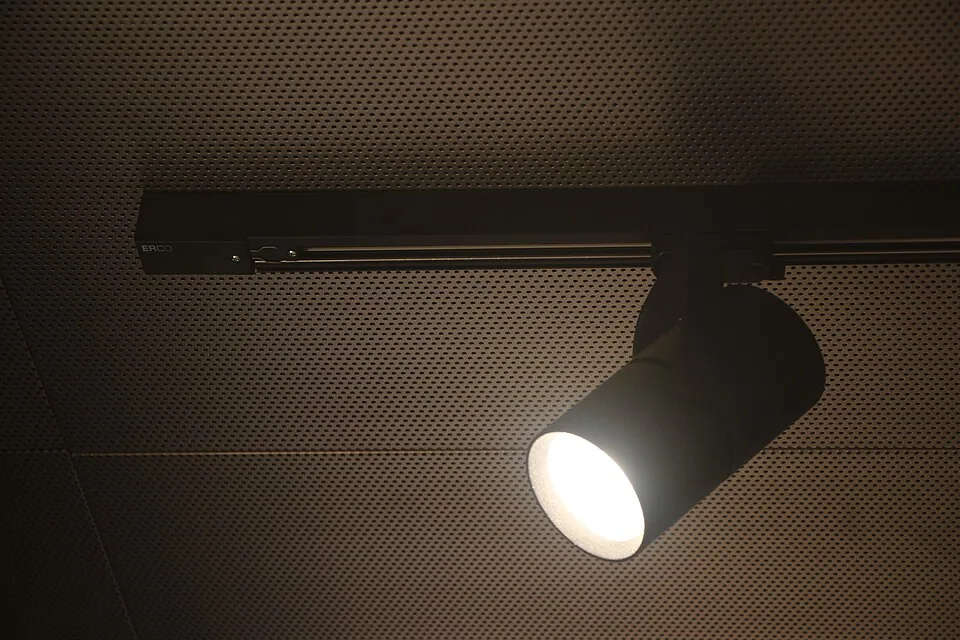
The standard aim for lighting a wall or a picture is about 30 degrees from vertical, which is the angle between the beam and an imaginary line dropping straight down from the head. At a steeper angle the light grazes the wall, raking the texture and creating long shadows under frames. At a shallower angle the beam reflects from the glass of a framed picture back toward the viewer, creating a bright hot spot that hides the art.
To test, stand where you normally look at the artwork and check for reflection on the glass. If you see the bulb's glare, move the head farther from the wall or tilt it so the beam hits the picture at a more oblique angle. A tighter beam, such as 24 degrees, is best for a single piece of art, and a wider one, around 36 to 60 degrees, suits a shelf or a wall of several items.
Aim at the thing, not above or below it. A picture lit mainly on its upper edge looks top heavy, and one lit mostly below its center appears to be sinking. Light should cover the full piece with a gradual falloff at the edges. For more specific advice on lighting art, our guide to picture lights covers heat, UV and beam angle for valuable pieces.
Ceiling height and mounting
An 8 foot ceiling works with a standard track and low profile heads, and the main caution is head height, since a tall head on a low track can be at eye level for tall people. A 9 to 10 foot ceiling gives more freedom, and heads can be aimed at a wider range of points. Above 10 feet, consider a pendant style track or a cable system hung lower, because a beam from a very high ceiling spreads and loses punch before it reaches the wall.
Sloped ceilings need an adapter or a track designed for slopes, which allow the rail to hang level. Not every system supports that, so check the product before ordering. Where the track attaches to a beam or a sloped surface, use the correct hardware, and where the ceiling is plaster, secure the track to the joists or use rated anchors for the weight of the heads.
The power feed can be a ceiling box, a plug-in cord to an outlet, or a hardwired connector. A plug-in track with a cord is a renter option, but the cord must run down a wall to an outlet. For a hardwired install, a licensed electrician should do the connection, and they can also fit a wall dimmer. Make sure the track and the dimmer are compatible, as explained in our guide to dimmer switch types.
Heads, bulbs and color
Heads come in several shapes: cylinders, spotlights, gimbal rings and wall washers. Cylinders are the common choice, with a simple look and a hood that reduces glare. Gimbal heads can tilt and rotate widely and are good for art. Wall washer heads spread light evenly across a surface and suit a long wall. Choose a head style, then keep to it for the whole run, since a mix of designs looks cluttered.
Bulbs for track are usually GU10 on line voltage systems or MR16 on low voltage ones, and PAR or BR shapes on some. Our guide to bulb base types explains how to tell them apart. Choose LEDs at 2700K to 3000K for a living room, with a color rendering score of 90 or more where the heads light art or wood. A narrow spot and a wide flood can be mixed on one run for different jobs.
Look at the system's total load. Track has a maximum wattage rating, but LED heads draw only a few watts each, so the limit is rarely reached. The more relevant limit is the dimmer's minimum load, which can fail with a small number of LED heads. If the heads flicker when dimmed, adding more heads or choosing an LED-rated dimmer usually cures it.
Planning the run and keeping it tidy
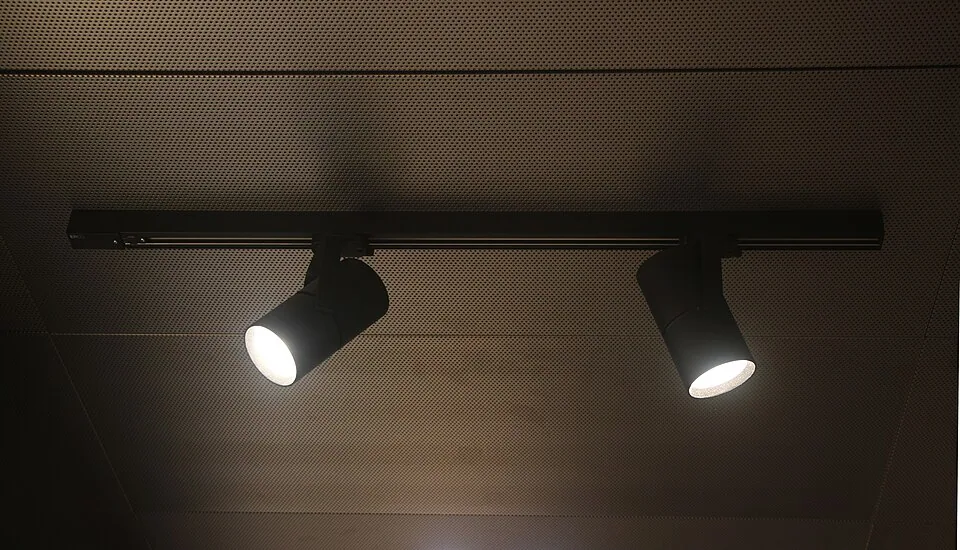
Draw the room on paper before you buy, marking the seating, the art and the outlet or ceiling box that will feed the track. Mark where each head needs to point, then work backward to the rail position and length. It is easy to buy a track that is a foot too short for the wall, or one that places the feed point where a beam of daylight from a window will wash out the heads. A sketch takes ten minutes and prevents a return.
Keep the layout simple. A single straight run, or an L around one corner, is easier to live with than a grid of rails that crosses the ceiling. Align the track with a wall, a beam or the long axis of the room, so it reads as part of the architecture. Paint the track in the ceiling color if you want it to recede, or in black if you want a graphic line.
Upkeep is small but real. Dust collects on the top of the heads and on the rail, and a vacuum with a brush or a dry cloth handles it twice a year. Check that heads are tight on the rail, since a loose head can drift and spoil the aim, and tighten the set screw or the locking collar when you adjust it. If a head flickers, rotate it slightly, because poor contact with the rail is the usual cause and a quarter turn often restores it.
Two problems people discover late
The first is compatibility between track brands. Track systems use several incompatible connection standards, named after their makers, and a head from one system will not fit another. A head that looks identical in a photo may not clip into your rail. Before you buy extra heads, note the system name or the number of rails and the connector type, and match them to the listing.
The second is the direction of the light and the screen glare. A head aimed at a wall behind a television will bounce into the screen, and a head aimed at a glossy surface creates a reflection from the seating position. Walk the room at seated eye level after you aim each head, and sit in each seat to check. Adjust until the room is comfortable from every position, not only the one you used when installing.
Frequently asked questions
Is track lighting out of style?
The heavy chrome rails of earlier decades are, but slim black or white rails with small LED heads fit modern rooms well. Style depends on the head design and how neatly the track is laid out. A clean straight run, painted to match the ceiling, looks intentional.
Can I install track lighting myself?
A plug-in track with a cord is a home project, with the usual screws into the ceiling. A hardwired track involves connecting to the house circuit and should be done by an electrician, or by a competent person in places where the code allows. Turn off the breaker for any ceiling work.
How many lumens should track heads provide?
For accent light on art, 300 to 600 lumens per head is typical. For general light over a seating area, plan on more heads at a wide beam. The total for the room should follow the rules in our guide to how many lumens a living room needs.
Will track lighting damage a rental ceiling?
A plug-in track mounts with a few screws, which leave small holes that are easy to fill. Hardwired track is a modification that needs approval. Ask before you drill, and keep the screws and anchors you remove.
Can I use track lighting with a smart system?
Yes. Many LED heads accept smart bulbs, and some track systems have built-in smart heads. Remember that a smart bulb needs constant power, so avoid a dimmer on the same circuit.
The bottom line
Use standard track in a living room where you want flexible, aimable light on art and shelves, and choose slim LED heads in a color that matches the ceiling. Set the track about 30 inches from the wall, space heads 24 to 30 inches apart and aim at about 30 degrees.
Choose monorail or cable only when the look justifies the extra cost and planning. Whatever you choose, test the aim from every seat, and treat track as one layer of the room rather than the whole plan.