Standing in a store aisle with a dead bulb in your hand, the packaging can look like a code written to confuse. A19, E26, BR30, GU10, G9: they are not model numbers, they are tidy descriptions of how a bulb connects and what shape it has. Once you know the pattern, you can read any bulb in seconds and order the right replacement without taking the old one with you.
This guide separates the two ideas that get tangled together, the base that decides whether it fits the socket and the shape that decides whether it fits the fixture. It also covers the cases that cause the most returns: candelabra sockets, spotlight bases that look similar, enclosed shades and fixtures with a maximum wattage that no longer matters for LEDs but still matters for safety.
Two codes: base and shape
Every bulb description has two parts. The base code tells you the connector at the bottom, and it must match the socket exactly or the bulb will not seat. The shape code tells you the envelope, the glass or plastic body, and it matters for clearance inside a shade, a glass globe or a recessed can. A bulb can have the right base and still fail to fit because its body is too wide for the fixture.
Base codes begin with a letter. E stands for Edison screw, the thread invented for the first household sockets, and the number that follows is the diameter of the thread in millimeters. G stands for a pin base, short for glass or two-pin, and its number is the distance between the pins in millimeters. GU describes a base with a twist and lock design, and the number again gives the pin spacing. Think of the letter as the style of connection and the number as the measurement.
Shape codes use a letter for the form and a number for the maximum diameter in eighths of an inch. An A19 bulb is the classic arbitrary shape, 19 eighths of an inch wide, which is about 2.4 inches. BR30 is a bulged reflector, 30 eighths wide, about 3.75 inches. Once you know the eighths rule you can estimate any code in your head, and tell at a glance whether a bulb will clear a shade opening.
Screw bases: E26, E12 and the others
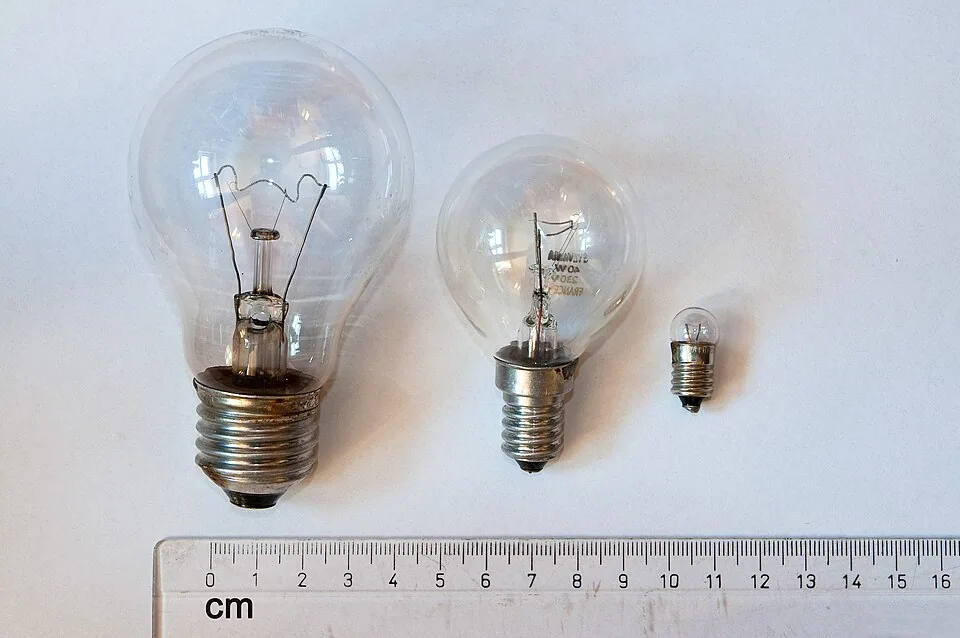
E26 is the standard medium base in North America, 26 millimeters across, used in most table lamps, floor lamps and ceiling fixtures. It is the base for nearly all general-purpose bulbs, so if you own a lamp bought in the US and do not know its socket, E26 is the safe starting assumption. In Europe and many other regions the equivalent is E27, a millimeter wider, and the two are close enough that they sometimes physically fit each other, though you should not mix them without checking voltage and electrical rating.
E12 is the candelabra base, 12 millimeters across. It appears in chandeliers, sconces, wall lights and many decorative lamps, where the flame-shaped bulb called a B10 or CA10 is used. E17 is a slightly larger intermediate base found in microwave lights and some small appliances and fixtures, while E14 is the European small base that is close to E12 in size but not interchangeable. A bulb that looks as if it fits can strip the thread or sit loose if you force it.
Lamps sold in the US occasionally use E26 sockets with an adapter, such as a reducer that converts to E12, but adapters add length and sometimes limit the wattage you may use. Prefer the correct base unless an adapter is the only way to fix an inherited fixture. If you must use one, check that it is rated for the bulb, particularly in a fabric shade where heat builds up close to the socket.
| Base | Type | Size | Typical use |
|---|---|---|---|
| E26 | Medium screw | 26 mm thread | Table and floor lamps, ceiling fixtures |
| E12 | Candelabra screw | 12 mm thread | Chandeliers, sconces, decorative lamps |
| GU10 | Twist and lock pins | 10 mm pin spacing | Track lights, some recessed spots, line voltage |
| G9 | Two-pin loop | 9 mm pin spacing | Small ceiling fittings, display lights |
| MR16 (GU5.3) | Two-pin low voltage | 5.3 mm pin spacing | Older track and recessed spots |
Pin bases: GU10, G9 and MR16
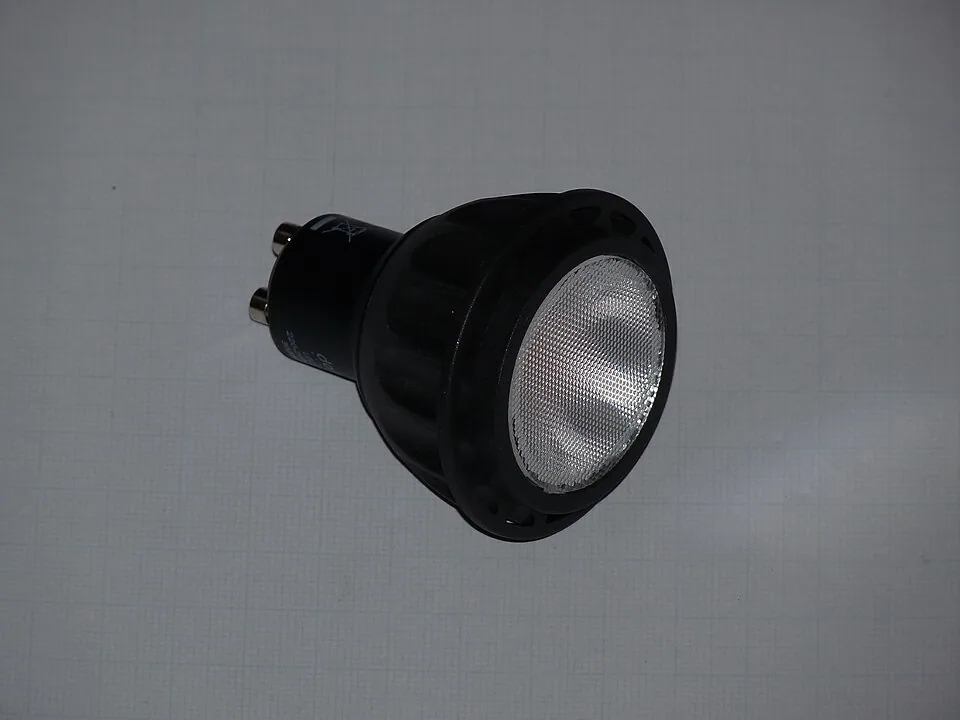
GU10 bulbs are common in track lighting and some recessed spots. They connect with two short thick pins that twist and lock into the socket, and they run on line voltage, the same as the wall outlet. G9 bulbs use two pins on a small loop base, and they appear in compact ceiling fittings and some modern wall lights, usually as a tiny capsule form with a halogen heritage.
The easily confused pair is GU10 and GU5.3, which is the base of MR16 bulbs. They look alike in a photo, since both are small spotlights with two pins, but GU5.3 runs on low voltage, typically 12 volts through a transformer, and GU10 runs on mains voltage. Installing one in the other socket will not work and can damage the transformer or the bulb. Check the base printed on the old bulb, since it is stamped on the metal or the reflector.
When retrofitting from halogen to LED, remember the transformer. A low voltage socket with a magnetic transformer may not drive an LED MR16 properly, causing flicker or failure to start. The simplest fix is either a compatible electronic driver or switching to a line voltage GU10 fixture. This is a good moment to read the guidance in our piece on track lighting for living rooms before choosing an aim and spacing.
Shape codes: A19, BR30, PAR and the rest
The shape code also tells you the beam. A19 and the larger A21 are omnidirectional bulbs that throw light in every direction, so they are best in lamps with shades. Globe shapes such as G25 and G30 are round and suited to bathroom bars and exposed fixtures. B and CA shapes are the small candle forms for E12 sockets, and ST or T shapes, such as the ST19, are the long vintage filament style that show in exposed pendant fixtures.
Reflector shapes are designed to aim light. BR, for bulged reflector, spreads light as a soft flood, and BR30 is the usual choice in six inch recessed cans. PAR, for parabolic aluminized reflector, gives a tighter and more controlled beam, which is better for accenting a wall or artwork. R20 and R30 are older reflector types, still found in some recessed cans. If a ceiling light is a downlight, the reflector family is more important than the base.
Size matters even within one shape family. A bulb that is a hair wider than expected will jam in a tight glass shade, and a long vintage ST bulb can poke above the lip of a short shade, which looks careless and creates glare. Measure the shade opening and the inside height, then compare with the dimensions on the bulb listing, rather than trusting the shape letter alone.
Matching a bulb to a lamp or fixture
The checklist is short. Confirm the base with the old bulb or the socket label, then confirm the shape and clearance, then confirm the output you need in lumens, not watts. A socket that says 60 watt maximum describes the heat the fixture can handle, not the brightness you should buy. An LED that makes 800 lumens, equal to an old 60 watt bulb, draws about 8 to 10 watts, so the limit is not a constraint for LEDs.
Keep the wattage limit in mind only when the label also tells you about heat in a closed fixture. In an enclosed glass globe, an LED that is not rated for enclosed use will run hot, and its driver will fail early. Look for the enclosed fixture note on the box. For lamps with fabric shades, see our lampshade size guide to make sure the bulb and shade work as a pair.
Dimming adds another check. A dimmer can make bulbs hum if the load is wrong, so use the advice in our guide to dimmer switch types. Specialty bulbs such as three-way bulbs also need a matching socket, which is a separate topic covered in the guide to three-way lamps.
A quick map for a living room
Most living rooms use only three or four of these codes. Table and floor lamps are almost always E26, and so are most ceiling fixtures and the screw-in sockets of ceiling fans. Wall sconces and small decorative lamps are the usual home of E12, and a multi-arm chandelier typically takes five or six candelabra bulbs. Track and recessed spotlights, if you have them, are the place to look for GU10 or the older MR16.
The practical habit is to write the code for each lamp somewhere you can find it, for example a note on your phone listing each room, the base and the shape that suits the shade. When a bulb dies at ten at night, you can order the right replacement without disassembling a lamp. It also helps when you buy a set of identical bulbs for a matched pair of lamps, since the two bulbs should come from the same batch and share a color temperature.
Pay attention to anything that looks unusual. A lamp from another country may use an E27 socket or a bayonet base, and a very old fixture may carry a mogul base, the large screw size used in some floor lamps and industrial fittings. If the lamp does not accept a standard E26 bulb, check before you order a pack, because the wrong base is the single most common reason bulbs go back to the shop.
Another detail worth a minute is the socket itself. Sockets for E26 are rated by watts and by the maximum bulb length they will tolerate inside a shade, and replacing an old socket in a lamp is a simple job on a corded lamp but one that needs the plug pulled and the cord handled with care. If a lamp flickers across several different bulbs, the contact tab at the bottom of the socket may have flattened with age. Unplug the lamp and gently lift the tab with a plastic tool, and the connection often comes back. If the socket is cracked or scorched, replace the lamp or the socket instead of living with it.
Two failures people do not expect
The first is the bulb that fits but is wrong. A GU10 bulb will fit a GU10 socket that has a lower rated maximum wattage, or one used with a dimmer. An LED GU10 designed for non-dimmable use looks identical to a dimmable version and will flicker on a dimmer. Always read the dimmable line in the listing, since the base alone tells you nothing about this.
The second is the integrated LED fixture. Many modern sconces and ceiling lights have LEDs built in, with no socket at all. When the driver dies, the fixture is finished. Before you buy a fixture whose life you cannot extend, check the warranty length and consider a socketed alternative, because a standard E26 or E12 socket lets you replace bulbs for decades while an integrated board does not.
Reading a bulb listing without mistakes
Online listings bundle the codes into one long title, and the order is not standard, so read the specification table instead of the headline. Find four things: the base, the shape, the lumens and the stated life. Then look for the small print that matters for a living room: dimmable or not, suitable for enclosed fixtures or not, and the color temperature in Kelvin. A listing that hides the base code or shows only a photo is a reason to look elsewhere, since a wrong base cannot be fixed by returning a single bulb out of a pack of six.
Voltage deserves a glance if you buy from overseas sellers or import a lamp. North American sockets run at about 120 volts, and much of the rest of the world at about 230 volts. A bulb or fixture built for one should not be used on the other, even when the base fits, and a lamp bought abroad may carry an E27 socket and a plug that does not suit your outlets. Bulbs sold for the domestic market are labelled with the voltage range, and a multi voltage driver is usually marked 100 to 240 volts.
Last, compare packs by lumens per bulb and not by the equivalent wattage on the front. A four pack of 800 lumen bulbs and a four pack of 1,100 lumen bulbs both call themselves general purpose, and the difference is visible in a small lamp with a thin shade. If a pack mixes colors of white, check which one you are getting, since the same product line is often sold at 2700K, 3000K and 5000K under near identical packaging.
Frequently asked questions
How do I find out what base my lamp uses?
Take out the old bulb and read the code printed on the base, which is often stamped in tiny letters, or measure the thread diameter across the socket. About 26 millimeters is E26 and about 12 is E12. If the lamp has no bulb, check the label on the socket shell, which usually lists the maximum wattage and sometimes the base.
Can I use an E12 bulb in an E26 socket?
Not directly. The threads are different sizes, so the bulb will not seat. A small adapter, called a reducer, makes it physically possible, but check the rating on the adapter and keep the wattage low. It is usually better to replace the socket or buy a bulb with the right base.
What does the number in A19 mean?
It is the maximum diameter in eighths of an inch. A19 is 19 eighths, about 2.4 inches wide. A21 is about 2.6 inches, and a BR30 is 3.75 inches. The rule works for any shape code, so you can compare a replacement against the opening of a shade before you buy.
Are LED bulbs available in every base?
Almost all common bases now have LED versions, including E26, E12, GU10 and G9. Some unusual or very small bases have fewer choices, and performance varies. Smaller bases leave less room for the driver, so LED candelabra bulbs are often a little dimmer and more limited in dimming than standard bulbs.
Does the base affect the brightness?
Not directly. Brightness is set by the lumens, and any base can host a bright or dim bulb. The base limits the body size and therefore the heat the bulb can dissipate, which indirectly caps lumens in small sizes. A candelabra bulb rarely reaches the output of a standard A19.
The bottom line
Read the base first, because it decides fit. Then check the shape against the space inside the shade or fixture, and then choose lumens and color temperature. When in doubt, take the old bulb to the store or photograph its markings.
For new lamps and fixtures, favor socketed designs on E26 or E12, since these base types will outlast any one bulb technology. Keep a spare in each size you use, and note the codes in your phone so the next replacement takes a minute.