A floating TV stand is a low cabinet or shelf attached to the wall with no legs touching the floor. It has become popular in small and modern living rooms, because the empty space beneath it makes the room feel wider and calmer, and the vacuum or the robot cleaner can pass under it without interruption. The look is light, and the effect in a compact apartment is real.
It also asks for more from the wall than a conventional stand does, and it removes some conveniences. This guide covers the advantages, the load calculation that decides whether your wall can carry one, the right anchors, cable routing, cleaning, safety around children and pets, and the situations where a standard stand is simply the better choice. It finishes with a plan you can follow before you drill.
Why people choose a floating stand
The strongest reason is the sense of space. When the floor continues beneath a piece of furniture, the eye reads more floor, and the room looks larger. In a living room of 10 by 12 feet, taking the bulk off the floor lightens the whole wall. A floating console at 12 to 16 inches deep seems to hover, and it works well with a wall mounted TV above it or a screen on a short stand.
Cleaning is the second reason. A conventional stand leaves a dust collecting gap at the legs and often a space beneath that is too low for a vacuum head. A floating unit leaves an open strip of floor, and a robot cleaner can pass under it if the clearance is above its height, typically 3 to 4 inches. Pet hair and dust have nowhere to hide, which is a real benefit in homes with shedding pets.
The third is cable management. Many floating units are designed with a cable channel or a gap in the back panel, and because they sit at the wall, the wires drop straight down to an outlet hidden behind the unit. When combined with a wall mounted TV, the setup can look as if there are no wires at all, as described in our guide on hiding TV wires.
| Point | Floating stand | Standard stand on legs |
|---|---|---|
| Look | Light, hovering, modern | Traditional, solid |
| Floor cleaning | Easy underneath | Gaps at the legs |
| Load | Limited by wall and fixings | Carried by the floor |
| Installation | Drilling and leveling | Place and level |
| Renter friendly | Rarely | Yes |
| Moves with you | Leaves wall holes | Yes |
The load budget
Everything above the fixings is weight the wall carries: the console itself, the television if it stands on top, the soundbar, the console, the cable box and anything stored in drawers. A 55 inch TV may weigh 30 to 45 pounds, a solid wood cabinet 40 to 70 pounds, and a full drawer of games, books and cables another 20 or 30. Add these and you can reach 100 pounds or more on a single wall mount.
Check the maker's stated load rating for the stand, and the rating of the fixings supplied. These numbers assume a solid fixing into the wall studs, and they are measured with the load centered. Keep the total well under the rating, since the load applies a pulling and a twisting force at the top fixings, because the weight sits away from the wall. A safety margin of two times or more is a prudent rule, and for a unit that holds a TV and heavy items, more still.
Do the sum before you buy. Weigh or look up each item and write the total. If the stand is light, such as a hollow cabinet of particle board, the load may be mostly the contents. If it is a solid wood piece, the cabinet alone may be heavy, and a modest TV pushes it near the limit. If the numbers look uncomfortable, choose a smaller unit, hold less in it, or move the TV to a separate wall mount, and our guide to floating shelf weight capacity explains how the same physics limits shelves.
Fixings: studs, rails and anchors
The reliable method is to fix the unit to wall studs. Many floating consoles come with a mounting rail, a metal bar that screws into two or more studs, onto which the cabinet hooks. The rail spreads the load across several studs, and the cabinet hangs on it like a picture. Find the stud positions with a stud finder, mark them and drive structural screws, typically about 2.5 inches long into the framing. Check that the rail is level before you hang the unit.
If the studs do not line up with the unit, a plywood backer board across two or more studs gives a base for the rail, and its edge can be hidden behind the cabinet. In masonry, use sleeve or wedge anchors with a masonry bit, and avoid the mortar joints. In hollow walls with no studs, toggle bolts may hold a very light unit, but a floating console loaded with a TV is too risky. Our guide to mounting a TV without studs covers fixings in each type of wall.
Level matters more than people expect. A rail that is out by a few millimeters over its length makes the cabinet lean, and the doors drift open or shut. Use a spirit level, mark the line with a pencil and double check before you drill. Leave the unit loaded for a few days, then check the fixings again, since new screws can settle.
Cable routing
A floating stand puts cables in view, since there are no legs to hide them, so plan the route. Look for a unit with a rear gap or a hole in the back panel, and run the cables behind it and down to a wall outlet. For a cleaner result, fit an in-wall power and cable kit behind the unit, so the plug and the cables disappear into the wall. The kit must be rated for the purpose, and a licensed person should wire the outlet.
Where the stand sits above the outlet, a short vertical run of flat cable covered with a paint matched raceway is the least invasive fix. A cabinet that is only 6 to 8 inches above the floor hides outlets well, and one that is higher exposes the cables in the gap. Plan this with the height in mind, and think about the cable box, the console and the router, which all need power and ventilation.
Ventilation is the catch. A closed floating cabinet holds heat, so consider an open design or one with vents, and place the console on the open shelf, not in a drawer. The usual rules for ventilating a TV cabinet apply here, and heat is a more serious issue in a box hung on the wall with little airflow behind it.
Height, depth and clearance
A floating stand can sit at any height, which is both a freedom and a trap. The usual advice is to place the top of the unit at about 12 to 18 inches above the floor, so the TV above it sits at a comfortable height, and the cabinet clears a robot cleaner. A stand that is too high pushes the screen above eye level, and one that is too low loses the floating effect. Check the guidance in our TV stand size guide for widths and depths.
Depth matters for the television. A set on a stand needs a base wider than the feet, or a deep enough shelf to hold it securely. Soundbars and consoles need depth too. A depth of 12 to 16 inches is usual, and anything shallower leaves a TV foot hanging over the edge, which is a tipping risk. If you plan to mount the TV on the wall, the cabinet can be shallow and long, and the screen sits above it.
Leave clearance for what is underneath. A robot vacuum needs about 4 inches, and a vacuum head needs a bit more, so measure the height of your cleaner. If you want to store a box or a speaker beneath, plan for that gap, and think about whether the shadow under the unit will bother you when the room is lit from the front.
Safety with children and pets
A wall mounted unit cannot tip forward in the usual sense, which is a safety advantage over a freestanding cabinet, but it presents its own risks. A child can climb on the front of a cabinet and pull on the doors, and the load on the fixings increases suddenly. If the mounting is weak, the whole unit and its contents can fall. Choose a unit with a rated load that is well above the contents, and fix it to studs with the supplied rail.
Keep heavy items low and near the wall, and avoid putting a large TV on the top of a floating stand if there are small children, since a falling screen is a danger. Mounting the TV on the wall, with its own rated mount, is safer. If you use a freestanding set, anchor it to the stand or the wall as described in our guide to anchoring furniture to the wall.
Pets can cause trouble too. A dog or cat that jumps on a floating unit adds a dynamic load, and a unit that is not rated for that may loosen. If you have an active pet, consider a stand with legs. Check the fixings every few months, and tighten loose screws before they become a hazard.
Styling and proportion
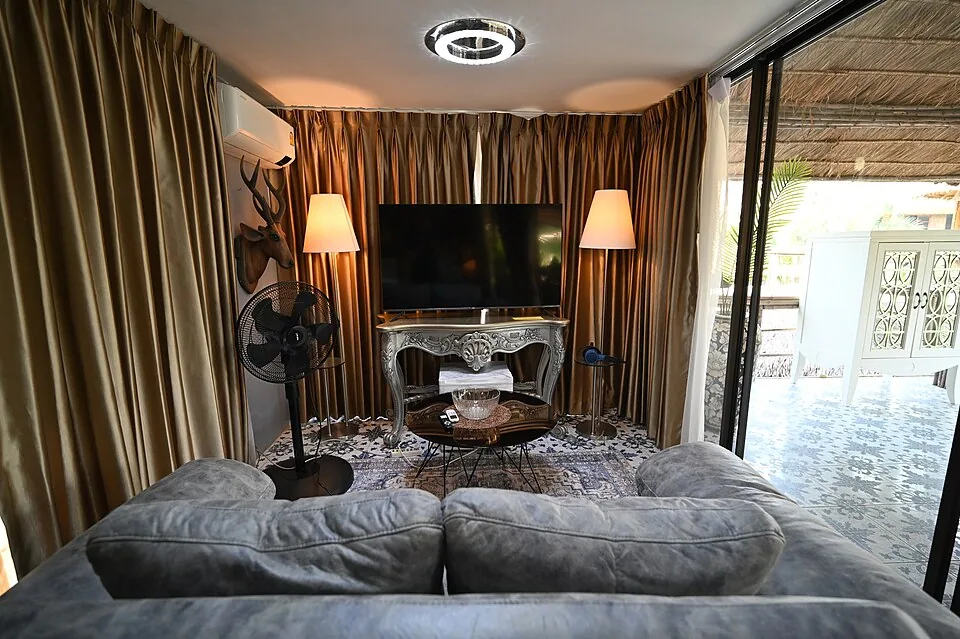
A floating console draws the eye to the line of the wall, so its length and its relation to the TV matter. A unit that is about the width of the TV or slightly wider looks balanced, and one that runs the full length of the wall can look like a built in. Keep the top surface tidy, with a few items at varied heights, rather than a row of objects that overload the shelf and the fixings.
Pay attention to the gap beneath. A shadow line under the cabinet reads as depth, and light strips under it, in a warm white at low output, make the unit hover and double as a night light. Check that the strip is rated for the heat and fixed neatly, with the wire hidden. Wood tones and matte finishes look warmer than high gloss, which shows fingerprints and dust more.
Think about how the unit sits with the rest of the room. A pale floating console against a white wall nearly vanishes, which suits a calm minimal scheme, and a dark one against a pale wall becomes a strong horizontal. Choose to match the seating and the rug, and keep the tops of nearby furniture at a similar height, so the lines in the room agree.
When a floating stand is the wrong choice
Avoid it where the wall is weak, such as thin partition walls, old plaster over lath, or walls with no accessible studs. Avoid it where drilling is not allowed, since a rented wall with a no holes rule is a poor home for one. If you plan to move within a year or two, the wall repairs are an extra chore, and a standard stand is easier.
Avoid it if the load is heavy. A large TV, a heavy console and a full cabinet of media can exceed the safe range, and a stand on the floor carries any weight with ease. Choose a conventional stand if you need a lot of storage, and compare options in our roundup of best TV stands.
Finally, avoid it in a room that you plan to rearrange often. A floating unit fixes the position of the TV, and moving it means filling and patching holes. A freestanding stand can move across the room in minutes, which suits a flexible, changing layout.
Frequently asked questions
How much weight can a floating TV stand hold?
It depends on the stand and the fixings. Many are rated for between 50 and 150 pounds when fixed into studs. Add the TV and the contents, and keep the total comfortably below the rating, using the maker's figure and not a guess.
Can I install a floating stand on drywall without studs?
Only for a very light unit, with heavy toggle bolts and a wide mounting rail. A TV and a loaded cabinet are too heavy for that. Use studs or a backer board whenever you can.
Can a robot vacuum go under a floating stand?
Yes, if the clearance is greater than the height of the robot. Most need around 3 to 4 inches, but check your model. Leave a little extra room for a rug.
Is a floating stand good for a small living room?
Often, yes. It frees visible floor, and the room looks larger. Choose a slim unit, keep the contents light and plan the cables to avoid clutter in the gap.
Can I put a TV on top of a floating stand?
You can, if the stand is deep enough and the load is within the rating. Make sure the feet sit securely and, with children around, secure the TV to the stand or mount it on the wall instead.
The bottom line
Choose a floating stand if you own the wall, can fix it to studs, and want a light look with easy cleaning. Add up the weight, keep it well under the rating and plan the cable route before you drill.
If you rent, have a weak wall, or need heavy storage, choose a stand on legs. For a household with small children, mount the TV on the wall and keep the cabinet for light items. Whichever you pick, check the fixings after a week and every few months.