The shape of a coffee table is usually chosen by taste, a soft curve against a clean rectangle, but shape is also a layout decision with practical consequences. It affects how people walk around the seating, where the knees go, how safe the corners are for children and how well the table relates to the sofa, the rug and the room. A shape that suits one room can be a poor fit in another with the same furniture.
This guide compares round, oval and rectangular coffee tables on sofa proportions, traffic flow, sectionals and chairs, children and corners, surface area and rugs. It is based on common layout practice and plain measurements, and it avoids brand claims. The aim is to give you a way to decide for your own room, not a rule that one shape is better.
Sizing ratios that apply to every shape
Before comparing shapes, fix the dimensions that matter in any case. The table should be about two thirds the length of the sofa, so an 84 inch sofa takes a table of roughly 50 to 56 inches, and an 80 inch sofa takes 36 to 48 inches. A table that is much shorter looks lost, and one that is nearly as long as the sofa blocks the ends and leaves no room to walk.
The gap between the sofa and the table should be 14 to 18 inches, which allows knees and a walking space, and 18 inches is comfortable. Under 12 inches is cramped, and over 20 makes the table hard to reach. The table height should be within about an inch of the seat, typically 16 to 18 inches, and our guide to coffee table height and clearance covers those numbers in detail.
The walkway on the far side of the table matters too, usually at least 30 inches where people pass. These ratios set the limit of what size and shape will fit, and the shape decides how well the table uses the space. A round table of the same width as a rectangular one occupies less floor, and that difference is the root of most of the comparisons that follow.
Rectangular tables: where they win
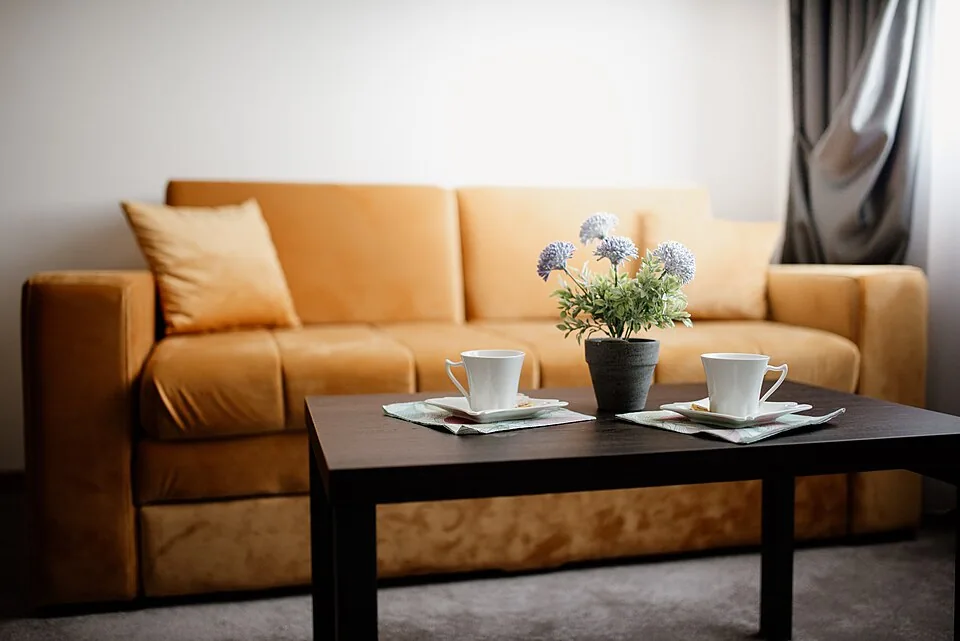
A rectangular table suits a rectangular layout. Placed parallel to a long sofa, with its long side facing the seats, it echoes the line of the sofa and gives a clean, organized look. It provides the most tabletop for its footprint in a row of seating, so it holds a tray, books, a laptop and drinks at once, and everyone on the sofa can reach it.
It also works well with a straight sofa and chairs on either side, where the table has to span the group. In a long, narrow room, a rectangular table can lie along the length of the room and leave walkway on both sides, and a long table pairs with a long sofa. It is easy to fit shelves, drawers and lift-top mechanisms in a rectangular table, so most storage tables are rectangular.
The weaknesses are corners and traffic. Four sharp corners at knee height are a hazard in a busy room or one with small children, and the long edge can narrow a walkway more than a round table of similar size. A rectangle placed at an angle can look awkward, and a rectangular table in a square room can leave odd gaps.
Round and oval tables: where they win
A round table is the better choice where space is tight and traffic is busy. It has no corners to catch a hip, and the curved edge lets people flow around it, so a round table of 36 inches is easier to walk around than a rectangular table of the same width. It suits a small room, a seating group in a corner and a layout where you walk between the sofa and the table.
It is the safer shape for children. Without corners, a child who falls or runs into the table is less likely to be hurt, and parents of toddlers often choose round or oval for that reason. The curve also softens the look of a room full of straight lines, as we discuss in our guide to a round rug in a living room.
Round tables suit conversation groups. Where chairs and a sofa are arranged around a table, a round shape gives everyone similar access, and no seat is at the end of a long side. An oval table is a compromise, with the proportions of a rectangle and the softness of a curve, and it works with a longer sofa while avoiding corners.
The weaknesses are surface and length. A round table has less usable top than a rectangle of the same width, because the corners of a rectangle offer extra surface, and a round table cannot line up with a long sofa. A table that is too small looks lost in front of a large sofa. An oval table is a better match for an 84 inch sofa than a 36 inch circle.
| Situation | Better shape | Why |
|---|---|---|
| Long sofa, straight row | Rectangular or oval | Matches the length, more top |
| Small room, tight walkway | Round | No corners, easier to pass |
| L-shaped sectional | Round or square | Fits the inside of the L, no point to the corner |
| Young children | Round or oval | No sharp corners at head height |
| Two chairs and a loveseat | Round | Equal access from every seat |
| Need storage or lift-top | Rectangular | More shapes with drawers and mechanisms |
| Round rug under the group | Round or oval | Echoes the rug, stays inside the circle |
Traffic flow and walkways
Walkways decide the shape more than any other factor. If people walk between the sofa and the table, which happens when the table sits in the path to a door or a window, a round table makes the passage feel wider, since the corners that would catch a hip are missing. If the walkway runs along the sides of the table, a rectangle has a longer edge to walk around, and a round table gives a shorter path.
Check the paths in your room with painter's tape. Mark the footprint of each shape on the floor and walk through the room, carrying a tray, to see whether the table narrows a route. A gap of 30 inches is comfortable for one person passing, and less than 24 is tight. Our guide to arranging furniture in a living room explains how to plan routes.
Doors and seats also matter. A table that is placed so that the sofa cannot be used by a person at the end, or that blocks the door of a cabinet, is the wrong shape or size, whatever its style. A round table of a smaller diameter often solves a problem that a rectangle of the same visual size creates.
Sectionals, chairs and floating layouts
A sectional has an L or U shape, and the table has to sit in the inside corner without hitting the arms. A round table sits in the angle of the L without a point aiming at a corner, and it keeps equal distances to both legs of the sofa. A square table does the same, and a large rectangle may collide with the chaise. For a U-shaped sectional, a round or square table in the center works best. Our guide to sectionals versus sofas explains the layouts.
With chairs, a round table gives an even distance to each seat, so a group with a sofa and two chairs can reach the table equally. A rectangular table with the chairs at its short ends is also workable, but the chairs are farther from the center. In a floating arrangement, where seating is arranged in the middle of the room, a round table avoids the sense of a front and a back.
If you have two tables, such as a pair of round tables or a round and a square, the group can be flexible. A pair of small round tables in place of one large rectangular one is a way to fit an awkward room, and they can be moved to the side when more space is needed.
Children, corners and safety
Sharp corners at knee or head height are the most common hazard in a living room with small children, and the usual answer is a round or oval table, or a rectangular table with rounded corners. A table with a large radius on the corners reduces the risk in a similar way. Soft corner guards can be added to a rectangle, though they change the look.
Stability is the other matter. A heavy, wide-based table is less likely to tip than a light one with thin legs, and a table with a central pedestal is less stable than one with four legs, particularly if a child leans on the edge. Glass tops are hazardous for young children if they are not tempered, and edges should be smooth. For a toddler, a low, soft ottoman can be a better choice than any hard table, as we discuss in our guide to storage ottomans versus coffee tables.
Pets are less concerned with shape. A rectangular table with a lower shelf can hold a lot of things a pet can reach, and a round pedestal table is easier to vacuum around. The key is stability and a surface that withstands claws and chewing.
Surface area and how you use the table
Think about what the table has to do. A rectangle gives more space for the same footprint in a straight row, since the corners are used, so if you use the table for trays, board games, a laptop or a lot of books, a rectangle is more practical. A round table concentrates its surface in the center, which is good for a vase and a few items and less good for a large tray or a long row of drinks.
A table that must carry a lot of items benefits from a lower shelf, which is easier to add to a rectangle. If your priority is a clean top with a few items, a round table looks good and is easy to style. Our guide to styling a coffee table covers how to arrange a round or a rectangular top.
Also consider whether the table doubles as something else. A rectangular table can serve as a bench for extra seating when it is sturdy and low, and a round table can serve as a footrest or a perch. In a small room, a table that can be moved to the side easily, such as a light round pedestal table, can be more useful than a large rectangle.
Rugs, style and the room
The table should sit mostly on the rug, and the shapes should relate. A rectangular table on a rectangular rug lines up with the edges, and a round table on a round rug sits in the center. A round table on a rectangular rug can look soft against the lines, and a rectangular table on a round rug works if the table is smaller than the rug and the corners do not stick out. Rug sizing follows the usual rule of the front legs on the rug.
Mixing shapes is a deliberate choice. A round table in a room with a rectangular sofa and rug adds contrast and softness, and a rectangular table in a room with round furniture adds structure. The goal is balance: if the room has many curves, such as a round mirror, a round rug and curved chairs, a rectangle can ground it, and if the room is full of straight lines, a curve can relax it.
Finally, look at proportions. A table that is too low, too high or too wide breaks the look, however good the shape. Choose a size with the ratios above, then pick the shape that fits the room and the family.
Frequently asked questions
What size round coffee table for a standard sofa?
For an 84 inch sofa, a round table of 36 to 42 inches in diameter is usual. A round table smaller than about 30 inches looks small, and one larger than 42 inches can crowd the walkway. Keep 14 to 18 inches from the sofa.
Is a round coffee table good for a small room?
Usually yes. The lack of corners makes it easier to pass, and a round table of the same width occupies less floor. Choose a pedestal or a light base to keep the floor open.
Can I use a round table with a sectional?
Yes, it is often the best shape for an L or U sectional, since it fits in the inside corner and gives equal access from both sides. Check that it clears the chaise.
Do rectangular tables suit small children?
They can, with rounded corners and corner guards, but a round or oval table is safer. Choose a heavy, stable table and keep the top clear of items that can fall.
Should my coffee table match my rug shape?
Not necessarily, but the table should sit mostly on the rug, and its corners should not hang over. Matching shapes looks tidy, and contrasting shapes can look deliberate if the sizes are right.
Bottom line
Choose a rectangular table when the sofa is long, the layout is a straight row and you want the most surface, storage or a lift-top. Choose a round or oval table when the room is tight, the layout is a sectional or a group of chairs or you have young children.
Whichever shape you choose, size it at about two thirds of the sofa, keep 14 to 18 inches from the sofa and match the height to the seat. Mark the footprint with tape and walk around it before you buy.