A round rug is a bold shape in a room full of rectangles. The sofa is a rectangle, the television wall is a rectangle, the window and the door are rectangles, and a circle on the floor breaks that pattern and softens the room. It can look sophisticated, or it can look like a mistake, and the difference is rarely the rug itself. It is whether the furniture on top of it agrees with the shape.
This guide explains when a round rug works in a living room, how to size it to the seating, how it pairs with round and rectangular tables, how to use it in corners and open plans and what to do when the layout resists a circle. It is based on how furniture sits on a rug and on common layout practice, and it uses plain measurements. The central point is that a round rug is a good solution for some layouts and a poor one for others.
What a round rug does well
A round rug softens a room. In a space with sharp corners, such as a square living room full of rectangular furniture, a circle introduces a curve that counters the angles, and it makes the layout feel less rigid. It also draws the eye to the center, so it works as a focal point under a table or a group of chairs.
It is a good shape for a conversation group. When chairs and a small sofa are arranged around a central table, in a rough circle or an oval, a round rug echoes the arrangement and ties the pieces together. A swivel chair or a pair of accent chairs facing each other also sit well on a round rug, since each seat points toward the center.
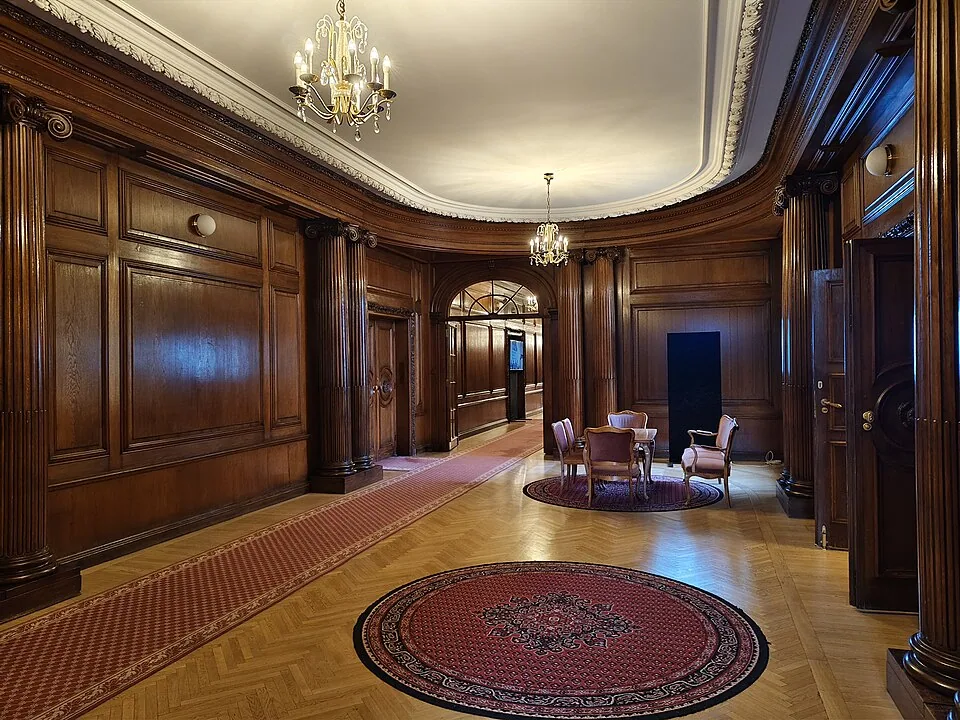
It handles awkward spaces. A round rug fits a corner reading nook, a bay window, the space under a round pedestal table, an entry or a small seating area in a large room. In an open-plan space, it can define a zone without needing a rectangle that would have to be lined up with the walls, as we explain in our guide to rug placement in an open-plan living room.
Finally, it avoids corners that catch feet and furniture. There are no sharp corners to curl or trip over, which is a minor benefit in a busy room and for rugs that tend to lift at the points.
Where a round rug fails
The shape fails where the furniture is rectangular and large. A long sofa against a wall, with a rectangular coffee table in front, has straight edges and corners that need to rest on a rug. A circle that fits the center of the group leaves the ends of the sofa and the corners of the table hanging over the edge, which looks unstable and unplanned. A circle large enough to cover them would be enormous.
The second failure is wasted floor. A circle covers a smaller area than the square it fits in: a 9 foot round rug covers about 64 square feet, while a 9 by 9 foot square covers 81. Corners of the room, and the areas near the walls, are left uncovered, so a round rug in a big room can look small. It may also look lost if it is surrounded by too much bare floor.
The third is traffic. A round rug has no straight edge to line up with the walkway, so the paths people take may cross the edge at awkward angles, which makes a tripping hazard if the rug is thin and does not lie flat. Use a pad and avoid a round rug with a thick, curled edge in a main path.
Sizing a round rug
Size is the part most people get wrong. A round rug that is too small floats in the room, and one that is too large collides with walls and doors. The general principle is the same as for any rug: furniture should have at least its front legs on the rug, and the rug should leave a margin of bare floor around it, typically 12 to 18 inches in a small room and more in a large one. Our guide to what size rug for a living room explains the rule in detail.
For a seating group, use the width of the group, not the room, to choose the diameter. Two chairs facing a small sofa, with a round table in the middle, might occupy a circle about 7 to 8 feet across, so an 8 foot round rug is a good match. A larger sectional with a coffee table might need a 9 or 10 foot round rug, though at that size the shape starts to conflict with the room. As a rough rule, a round rug under a seating group should be at least 8 feet across, and a rug smaller than 6 feet is an accent for a table, an entry or a nook.
Under a round coffee table, the rug should extend well beyond the table. A rule of thumb is that the rug should reach at least 12 to 18 inches beyond the edge of the table on all sides, so a 36 inch round table needs a rug of about 5 to 6 feet at the least, and 8 feet if chairs sit around it. If the table is small and the rug is large, check that the legs of the chairs and the sofa also sit on the rug.
| Use | Typical round diameter | Placement rule |
|---|---|---|
| Entry or small nook | 3 to 5 feet | Centered in the space, a few inches of floor around |
| Under a small round table | 5 to 6 feet | Extends 12 to 18 inches beyond the table |
| Two chairs and a small table | 6 to 8 feet | Front legs of both chairs on the rug |
| Standard seating group | 8 to 10 feet | Front legs of all seating on the rug, or layered |
| Large open plan zone | 10 feet or more | Match to the width of the group and leave a margin |
Pairing with a round or rectangular table
A round coffee table sits naturally on a round rug, and the two curves reinforce each other. The rug should extend past the table by a generous margin, and the sofa and the chairs should rest at least partly on it. If the sofa is too long, the ends can sit beyond the edge, and it is better to have the front legs of the sofa on the rug than to have the rug stop short.
A rectangular coffee table on a round rug is a mixed pairing, and it works if the rug is large enough that the table sits comfortably within it with room around all sides. The table's corners should not stick out beyond the edge, and the proportions should look intentional. A rectangular table on a small round rug looks like a mistake. If your table is rectangular and long, a rectangular rug is a safer choice, and our guide on round versus rectangular coffee tables covers how the shape of the table interacts with the room.
Consider the tabletop and its use. A round table lets people walk around it more easily, and without corners, it is safer for children. Placed on a round rug, the area becomes a play zone that is visually separate from the walkway.
Layering a round rug over a rectangular one
If your sofa and room demand a large rectangular rug, but you like the shape of a circle, layer them. Put a large neutral rectangular rug under the seating group, with the front legs of the furniture on it, and place a smaller round rug on top, under the coffee table. This gives you the practical coverage of the rectangle and the accent of the circle, and it adds texture and pattern.
The base rug should be a flat, low-pile type, in a quiet color, such as a jute or a flatweave. The top rug can have more pattern or a shaggier texture, and it should differ in color or texture from the base so that it reads as a distinct layer. The overlap should be generous, so the round rug sits well within the base and its edges do not touch the base edges. Use a pad under the base and non-slip tape or a thin pad between the layers to keep the top rug from creeping. Our guide to how to layer rugs explains pads, thickness and color choices.
Watch the thickness. A thick round rug on top of a thick base can create a step that catches feet and the legs of the coffee table. Use a thin top layer and a thin base to keep the surface even, and check that the table sits level.
Corners, nooks and chairs
A round rug is a natural choice for a corner reading spot. Place a chair, a small side table and a floor lamp on it, and let the rug define the zone. The rug should be large enough for the chair legs and the table to sit on it, so a 5 or 6 foot round rug is usual. If the chair swivels or reclines, make sure the rug is flat enough not to snag.
It also suits a pair of accent chairs. Two chairs facing each other across a small table sit well on a rug of 6 to 8 feet, and the circle holds them together. In a bay window, a round rug follows the curve of the window and the arrangement of a small table and chairs. If the room has a round dining table in an open plan, the same logic applies. See our guide to the arrangement of furniture in a living room for how to plan the groups.
Rolling and swivel chairs deserve care: a thick pile or a shag can resist a swivel chair, and a rolling chair can snag the edge. A flat or low-pile round rug is the best choice for an office corner.
Material, edges and care
Round rugs are made in the same materials as rectangular ones, and the choice follows the same logic: wool for durability, polypropylene for stain resistance, jute for a natural look, and cotton for washability. A round shape is harder to make from a rectangular roll, so many round rugs are made by cutting, which uses more material and may cost more per square foot than a rectangle.
The edge matters. A bound edge, finished with a fabric or yarn border, holds a round shape well and resists fraying. A cut edge of a hand-tufted rug or a rug that is sheared may fray. For a woven round rug, the curve can show wavy edges, since the weave runs in straight lines, and a rug that does not lie flat at the curve needs a pad.
Wear and rotation are also easier on a round rug, since there are no corners to wear. Rotate it often, to even out the wear on the side facing the sofa. Because there are no straight edges to align with the room, check periodically that it has not crept. Our guide to rug pads covers the types and how to cut a round pad to match.
One last check before you buy is the room's door swing and the vents. A round rug sits flat only if nothing catches its edge, so open every door in the room fully and make sure none drags across the rug, and check that a floor vent is not covered, since a rug over a vent blocks the airflow and can overheat. Also check the direction of the pile, since on a round rug there is no long edge to line it up with, and a pile that leans one way can look different from the doorway than from the sofa.
Frequently asked questions
Can I put a sofa on a round rug?
Yes, if the front legs rest on the rug and the rug is large enough, usually 8 feet or more for a standard sofa. A long sofa on a small round rug looks unbalanced, so consider layering a round rug over a larger rectangle.
What size round rug do I need for a living room?
For a seating group with a sofa and chairs, an 8 or 9 foot round rug is the usual minimum. For two chairs and a small table, 6 to 8 feet. For a corner, 5 or 6 feet. Measure the group, not the room.
Do round rugs make a room look smaller?
Not necessarily. A round rug softens the room and can make it feel more open, but if it is too small it leaves a lot of bare floor, which can make the room feel unfinished. Choose a size that fills the group.
Does a round rug go with a rectangular coffee table?
It can, if the rug is large enough that the table sits fully within it with room around all sides. If the table is long or the rug is small, choose a rectangular rug instead, or layer.
Are round rugs harder to keep flat?
They can be, since the curved edge does not line up with the weave. A pad helps, and a bound edge keeps the shape. A rug that curls at the edge may need tape or weight.
Bottom line
Use a round rug when the furniture forms a circle or a cluster, when a corner or a nook needs an anchor or when you want a curve in a room of angles. Size it to the group, with at least the front legs of the seating on it, and an 8 foot diameter as a floor for a standard seating group.
Where the sofa is long and the table is rectangular, choose a rectangular rug, or layer a round rug on top of one. The shape should agree with the furniture, since a rug that does not is the thing people notice.