A curtain rod looks like the simplest part of a window treatment, and it is the part most likely to fail. Rods bow in the middle under heavy panels, brackets pull out of drywall, adjustable joints slip, and the wrong type leaves a gap of light at the side or a panel that will not slide. Choosing the rod first, and the curtains second, avoids most of these problems.
This guide explains the five common rod types and what each is for, how to choose diameter and length, where to place brackets, how much weight different fixings hold and how to deal with awkward windows such as bays, sliding doors and renter restrictions. It ends with a short rule for matching rod to fabric so you buy the right one once.
Single rods
A single rod is a bar held by a bracket at each end, with a center bracket for longer spans. It is the standard choice and fits most living room windows. Panels hang from rings, clips, grommets or a rod pocket, and the rod stays visible, so its finish and finials are part of the look. Single rods come in fixed lengths and in adjustable versions that telescope to fit a range of widths.
Their strength comes from the tube. A solid or thick walled metal rod of 1 inch diameter is fine for light to medium panels, and a rod of 1.25 to 1.5 inches in diameter carries heavy lined drapes with less sag. Wood rods are heavy and strong but need good brackets. Adjustable rods have a joint in the middle, which is weaker than a single piece, and the section that slides can loosen over time, so choose a single piece rod for heavy fabrics.
A single rod suits any window where you want one layer or where sheers are not needed. If you need two layers, you can use two single rods mounted at different depths, though a purpose built double rod is neater. Our roundup of best curtain rods compares diameters and spans.
Double rods
A double rod has two parallel bars on the same brackets, one in front of the other. The back bar holds a sheer or a lining panel, and the front bar holds a heavier drape. You can close the sheer for daytime privacy and the drape for night, or draw the drape back and leave the sheer for soft light. The brackets project farther from the wall, typically 3 to 5 inches, so the window needs room for them.
The cost is the depth. A double rod pushes the front panel further into the room, and a curtain at that depth can collide with a radiator, a sofa back or a deep window seat. Check the space in front of the window, and measure the bracket projection against the furniture. The combined weight is also higher, so the brackets should be fixed to studs or with strong anchors. For more on layering fabrics, see our piece on layering sheer and blackout curtains.
A double rod also demands care in sizing. The back bar needs to be shorter or the same length as the front one, and the panels on the back bar hang from rings that must clear the bracket. If the layers rub, the sheer snags, so allow a little extra space between the bars, which good double rods provide in their design.
| Rod type | Best for | Needs drilling | Main limit |
|---|---|---|---|
| Single | Most windows, one layer | Yes, usually | Sags if thin and long |
| Double | Sheer behind a drape | Yes, into studs ideally | Deep projection, heavy |
| Traverse | Wide windows, sliding doors | Yes | Cost, mechanism can jam |
| Tension | Light panels inside a frame | No | Low weight limit, slips |
| Wraparound or return | Light control, privacy | Yes | Fit must be exact |
Traverse rods
A traverse rod has a track inside it with carriers that slide, so the curtains open and close by a cord, a wand or a motor. You never touch the fabric, which keeps it clean and makes wide spans practical. Traverse rods are the standard for pinch pleat drapes, sliding glass doors and large picture windows, where pulling heavy panels by hand would be awkward.
They are less forgiving. The mechanism can jam if the hooks tangle or if the cord is mounted wrongly, and the rod's price and complexity exceed a plain bar. They also have a particular look, with a slim rail and the panels hanging from hooks, and the rod may be hidden behind a valance or the header of the curtain. Measure the stack space at each side, since the panels bunch there when open.
Choose a traverse rod with a center support for spans above about 6 feet, and one rated for the weight of your drapes. Many include an overlap arm so the panels meet in the middle without a gap. Cord and wand controls keep the fabric off the floor, and motorized versions give remote control, though they need a power source and a bit more installation care.
Tension rods
A tension rod is a spring loaded tube that wedges between two surfaces, such as the sides of a window frame. It needs no drilling, which makes it popular for rentals, bathrooms and small kitchen windows. It suits light panels, cafe curtains and sheers, and it is easy to take down and move.
The limit is weight and friction. A tension rod holds by pressure on the frame, so a heavy lined panel pulls it down, and a smooth or painted frame lets it slip. The rod should fit the inside width of the opening exactly, and the pressure ends should have rubber pads. For a living room window with substantial drapes, a tension rod is usually the wrong tool, and our guide on hanging curtains without drilling lists stronger ones.
Tension rods are good for a layer of sheer inside the window recess, in front of the glass, with a heavier curtain on a separate rod outside the frame. This makes a neat combination for a renter, since it adds privacy without any holes, and the outer rod can be an adhesive or a no drill bracket type if the walls allow.
Wraparound and return rods
A wraparound rod, also called a return rod, curves at each end to turn back toward the wall, so the curtain wraps around the side and closes the gap between the fabric and the wall. It reduces light leaking at the edges, which is why it is common for blackout curtains, and it gives a finished look where the panel closes against the wall.
The fit is critical. The return length must match the bracket projection, usually 2.5 to 4 inches, and the curtain has to be wide enough to cover the extra width. Because the rod curves, the rings or the grommets cannot slide past the end bracket, so the panels stay on the rod, and the rod comes in sets for a specific window width. It is a good solution for a bedroom or a media room that needs darkness.
The downside is flexibility. A wraparound rod fixes the panel in place, so changing the curtains means unhooking rings and sliding fabric off the end. It also looks heavier than a plain rod, and it works best with long drapes that hang to the floor. If you want a lighter look, a single rod with a short return finial may be enough.
Diameter, length, finials and weight
A rod's diameter decides its strength and its look. A 5/8 or 3/4 inch rod is delicate and fits light curtains on small windows, a 1 inch rod suits most living room panels and a 1.25 to 1.5 inch rod handles heavy drapes and long spans. Wider rods look more substantial and need larger finials. A thicker wall adds strength, and a solid steel or wood rod holds better than thin aluminum tube.
Length depends on where the rod goes. Mount the rod 3 to 6 inches beyond each side of the window frame, so the curtains clear the glass when open, and 4 to 6 inches above the frame to make the window look larger, as we explain in the curtain length and width guide. A 48 inch window therefore wants a rod of roughly 54 to 60 inches, plus the finials.
For spans over about 48 inches, add a center bracket, which prevents the sag that a long rod develops under a heavy panel. For a very wide span, such as a sliding door wall, use two center brackets or a heavy duty traverse. Wider is not always better, because a rod far wider than the window makes the window look smaller and the stack space large. Choose the least extra width that clears the glass.
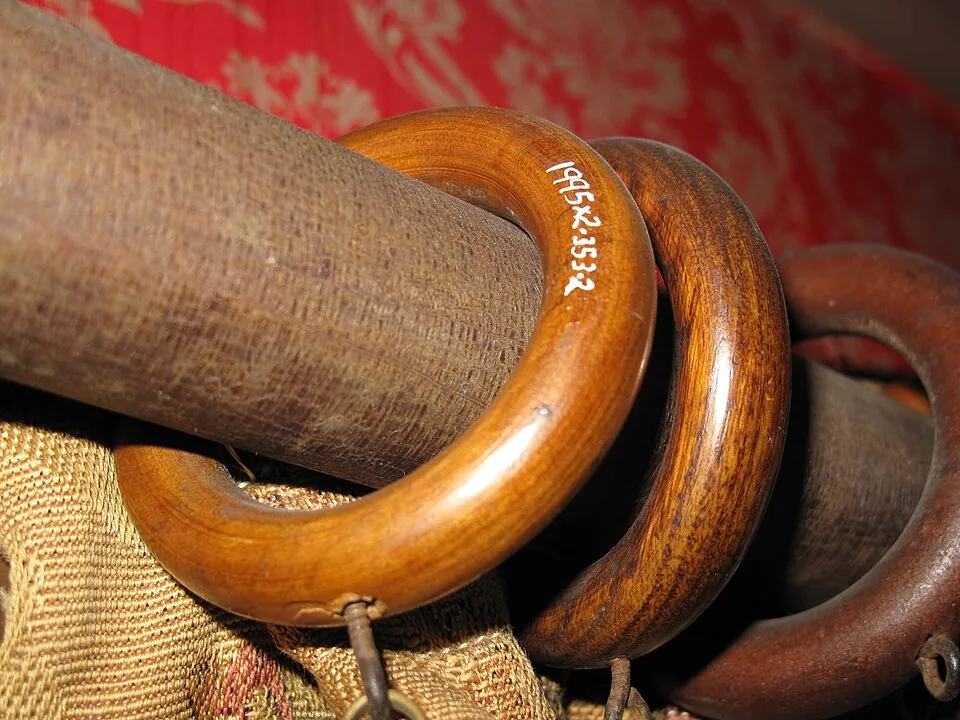
The parts that touch the fabric change how easily a curtain moves. Smooth rings, especially wooden or metal rings with a slightly loose fit, glide well, and clip rings make it simple to swap panels. Grommet panels slide freely on a smooth rod but can catch on a rod with a seam or a rough joint. A rod pocket gathers the fabric directly on the rod, which looks soft but drags when you draw it, so it suits curtains that stay mostly in place.
Finials are decorative end caps, and they do real work: they stop rings sliding off and they set the look. Choose a finial in proportion to the rod, since a large ball on a thin rod looks top heavy. Remember that finials add to the overall length, so a rod that just fits the wall space can run out of room once they are on. Measure the total width including finials before you buy.
Finally, think about the stack. When panels are open they bunch at each side, and the stack takes space, roughly one quarter to one third of the panel width. A rod that extends far enough to hold the whole stack beyond the glass keeps the full window visible. If space is tight, a lighter fabric or a rod with a return can reduce the stack and keep the line clean.
Brackets and anchors
Brackets carry the weight, and brackets fail more often than rods. Space them no more than about 48 inches apart, and put a bracket within a few inches of each end. Fix them into studs wherever possible, since a stud holds a heavy lined drape with ease. If a bracket falls where there is no stud, use a good toggle bolt or a heavy duty anchor rated for the load, not the small plastic plugs that come in the packet.
Check the wall. Plaster, brick and tile need different anchors, and a window header often has a solid wooden lintel above it, which is a good place to fix. A stud finder or a small magnet that finds screws can locate framing. If you are unsure what is behind the wall, drill a small pilot hole first.
Heavy drapes can weigh 10 to 20 pounds or more per panel, and that load pulls down and outward on the brackets. If the rod bows or the bracket leans away from the wall, add support at once, because a falling rod can bring plaster with it. Ceiling mounted brackets are an option for a very tall window, and they carry the load straight into the joists.
Bays, doors and rentals
Bay windows need a bay rod, a set of rods joined by corner connectors, or three separate rods on the three faces. A flexible rod that bends to the shape works for curved bays. Sliding doors need enough stack space beside the door so the panels do not block it, and a traverse rod makes daily use easier.
For rentals, choose adhesive hooks or tension rods for light panels, or screw into studs and fill the holes when you leave. Check the lease first, because some landlords allow small holes and some do not. A well fixed rod often gives a better result than a no drill workaround, so if drilling is allowed, use it.
Frequently asked questions
What size rod do I need for heavy curtains?
Use a 1.25 to 1.5 inch rod, a single piece if you can, brackets into studs and a center bracket for spans over 48 inches. Lined drapes can be heavy, and a thin rod will bow.
Are adjustable rods strong enough?
For light to medium panels, yes. The joint is the weak point, so avoid them for heavy drapes, and extend only as far as needed. A single piece rod is a safer choice for a long span.
Should the rod be wider than the window?
Yes, by about 3 to 6 inches on each side, so the panels stack off the glass. Beyond that, extra width only adds weight and makes the window look smaller.
Can I install a curtain rod without a stud?
For light panels, yes, with toggle bolts or good anchors. For heavy drapes, use studs or a lintel. A rod that holds light curtains may fail when you hang a lined pair.
What rod suits blackout curtains?
A strong single or wraparound rod with a center support, brackets close to the wall and a panel wide enough to cover the sides. Our guide to blackout and room darkening curtains explains the light leaks that remain.
The bottom line
Choose the rod to match the fabric: a 1 inch single rod for light to medium panels, a 1.25 to 1.5 inch rod for heavy drapes, a double rod for sheer and drape, a traverse rod for wide spans and a tension rod only for light curtains in a frame.
Mount it 4 to 6 inches above the frame and 3 to 6 inches past each side, add a center bracket over 48 inches and fix brackets into studs. Do this, and the rod will quietly do its job for years.