Curtains that look wrong almost always fail on one of two numbers. They are too narrow, so the panels hang flat like boards instead of folding, or they are the wrong length, ending a few inches above the floor in a no-man's land that looks like a mistake. Neither error is about taste. Both come from measuring the window instead of measuring the rod, and from buying whatever standard size is on the shelf.
This guide explains how to calculate width for fullness, which length to choose and where each belongs, how high and how wide to place the rod and how the choices change the apparent size of the window and the ceiling. It uses common figures for ready-made panels and shows what to do when your window falls between them.
Width: fullness is the whole point
A curtain panel is a piece of fabric gathered along its top edge. If the fabric is only as wide as the rod, it hangs flat and tight, and when closed it stretches taut across the window with no folds. The soft, rippling look of a good curtain comes from extra fabric. The ratio of fabric width to rod width is called fullness, and the standard targets are as follows.
| Fullness | Ratio to rod width | Look |
|---|---|---|
| Minimum | 1.5 times | Light folds, suits heavy or lined fabric and a casual look |
| Standard | 2 times | Full, even folds, the usual target |
| Generous | 2.5 times | Deep folds, best for sheers and lightweight fabric |
The calculation uses the rod width, not the glass. If the rod is 84 inches wide and you want 2 times fullness, you need 168 inches of fabric in total, which means two panels of 84 inches each, or in practice two panels of about 50 to 54 inches each plus a little more. Ready-made panels are sold at widths of 50 to 54 inches, and you usually buy a pair, which gives 100 to 108 inches in all. That suits a rod of 50 to 54 inches at 2 times fullness, or an 84 inch rod at about 1.25 times, which is too thin.
For a wide window, you need two pairs or custom panels. Do not stretch one pair across a rod it was not made for. Heavy fabrics such as velvet and lined drapes show fullness best at 2 times. Sheer or light linen looks best at 2.5, since it has less body and needs more folds to hide the see-through effect.
Length: four options and where each belongs
The length decision is about the lower edge of the curtain, where it meets the sill or the floor. There are four standard choices, and each suits a particular style and use.
- Sill length: the curtain ends at the sill, about a half inch above it. This suits a window with a radiator or a desk below, a kitchen window or a short casual look. It makes the window look smaller and can look cramped in a living room.
- Apron length: the curtain ends 4 to 6 inches below the sill, at the bottom of the window apron. It is a traditional length and suits a window where floor length is impractical, such as a window above a sofa or a sideboard.
- Floating or kiss length: the curtain hangs about a half inch above the floor. This is the cleanest and the most practical choice for a living room, since it clears the floor for vacuuming and does not collect dust, and it looks tailored.
- Puddle length: the curtain extends 1 to 3 inches onto the floor, or more for a dramatic effect. It suits formal rooms and heavy fabric, but it collects dust and can catch on furniture, so it works best at a window that is rarely opened.
For a living room, floating length is the best answer in most cases. It looks neat, it is easy to maintain and it creates a long vertical line that makes the room feel taller. A curtain that stops 2 to 4 inches above the floor looks like a measuring error, and is the single most common mistake. If you are between sizes, choose the longer length and hem it, since a curtain that is too long can be fixed and one that is too short cannot.
How to measure length correctly
Measure from where the rod will hang, not from the top of the window, down to the target point. If the rod will be 6 inches above the frame and the floor is 80 inches below the frame top, the curtain drop is 86 inches, less a half inch for float. The curtain's heading, the type of top, affects the final length. Rod pocket and grommet tops hang from the rod, so the drop is measured to the rod. Rings with clips and hooks add a few inches, since the fabric hangs below the ring. Check the product's stated length and where it is measured from.
Standard ready-made lengths are 63, 84, 95, 108 and 120 inches. An 84 inch panel suits an 8 foot ceiling only if the rod is at the window frame. A rod mounted higher to make the window look taller needs 95 or 108 inches. A 95 inch panel suits a ceiling of 8 to 9 feet with a high rod, and 108 inches suits a 9 to 10 foot ceiling. Measure the floor to the rod and add nothing for a float. Use a steel tape and measure in two or three places, since floors and ceilings slope.
Rod height: higher makes the window look taller
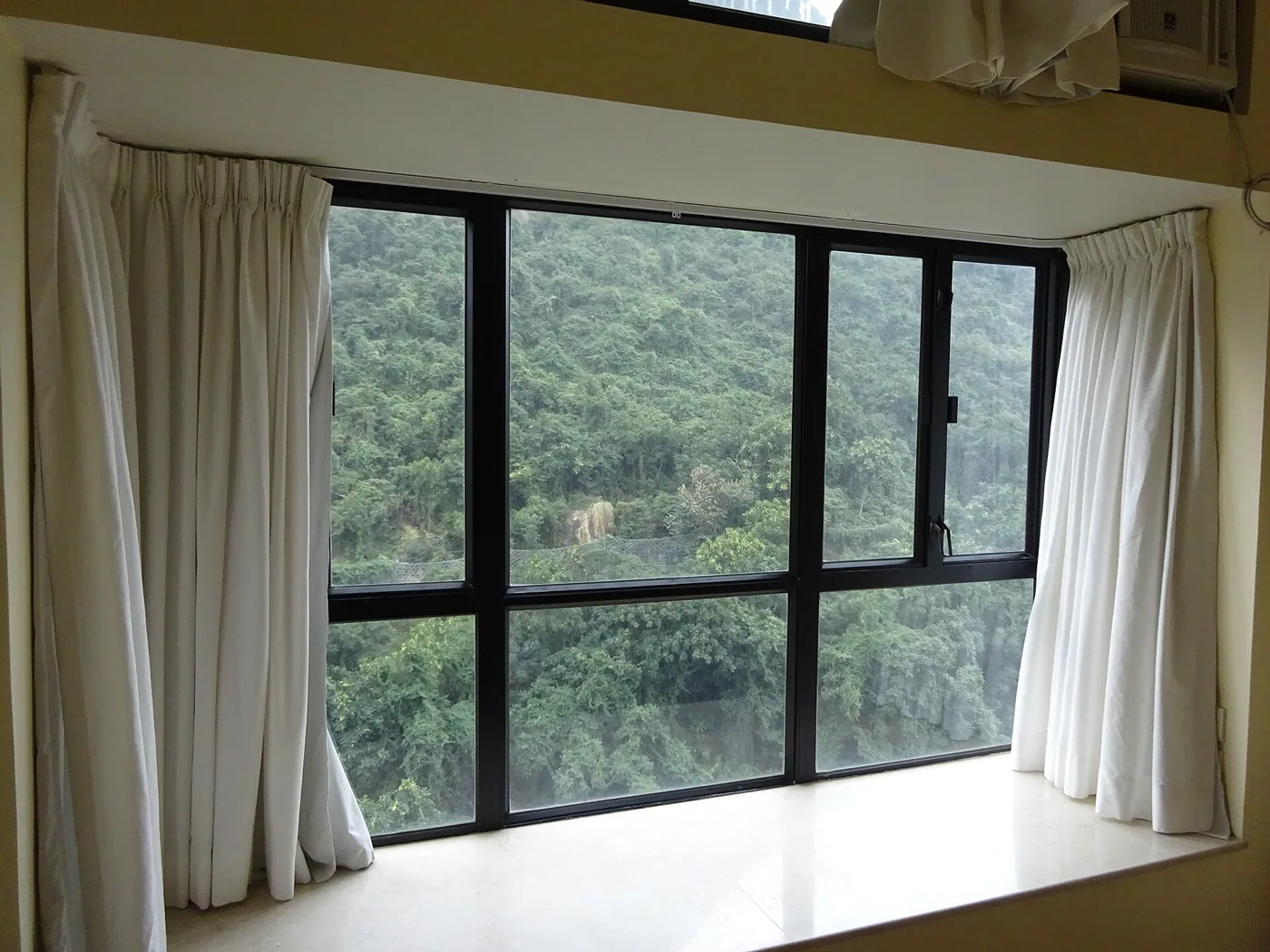
The rod's position changes how the window looks more than the curtain itself. A rod mounted just above the window frame, 2 to 4 inches, puts the curtain top at the frame and makes the window look its actual size. A rod mounted 4 to 6 inches above the frame is the usual recommendation and gives a modest lift. A rod mounted close to the ceiling, or halfway between the frame and the ceiling, makes the window and the room look taller, because the eye follows the vertical lines to the ceiling.
On a standard 8 foot ceiling with a window that is 4 feet above the floor, a rod at 6 inches above the frame is a good compromise. On a 9 foot ceiling or higher, you can raise the rod to 12 inches or more. If there is a crown molding, hang the rod just below it or at the same height as the molding's bottom edge, and make sure the curtain length is adjusted. Do not go so high that the curtain looks disconnected from the window. A visible gap of more than about 12 to 18 inches above the frame can look odd unless the ceiling is very high.
Beware of obstacles above the window such as a door frame, a vent or a beam. They may limit how high the rod can go. A ceiling-mounted track gives the highest effect and a clean look, and it is an option in rooms where wall space above the window is short.
Rod width: extend past the frame
The rod should extend 8 to 12 inches past the window frame on each side, sometimes more. This lets the curtains stack to the side when open and leaves the glass uncovered, which maximizes light. A rod that stops at the frame forces the panels to cover part of the glass when open, which makes the window look smaller and darker.
The stack back is the space the open curtain takes. A pair of curtains at 2 times fullness stacks about one third of its width. A 100 inch pair of panels takes 12 to 15 inches on each side when open, so extending the rod by 8 to 12 inches means the curtains cover very little of the glass. Heavier fabrics stack deeper and may need an extra few inches. If a wall or furniture limits the extension, choose a shorter stack with a lighter fabric or use a double rod with sheers behind.
A wide rod also makes a small window look wider, and a good trick for a narrow window is to extend the rod 16 to 18 inches on each side with full curtains. The effect is described in how to make a small living room look bigger.
A worked example from tape measure to order
Take a living room window that is 60 inches wide, with the frame top 84 inches above the floor and a ceiling at 96 inches. Start with the rod: extend it 10 inches past each side of the frame, which gives a rod of 80 inches, and place it 6 inches above the frame, at 90 inches from the floor. Now the width. At 2 times fullness you need 160 inches of fabric. Ready-made panels of 52 inches come in pairs, so two pairs give 208 inches, which is slightly generous at 2.6 times and fine for a light linen. One pair would give 104 inches, only 1.3 times, which is too thin.
Now the length. The rod sits at 90 inches, and floating length leaves a half inch of float, so the drop from the rod to the hem is 89.5 inches. If the panel hangs from rings with clips, the fabric sits about 1.5 inches below the rod, so the panel needs to be about 88 inches long. The nearest ready-made size is 95 inches, which you would hem by about 7 inches, or you could lower the rod to suit a 84 inch panel, though the effect on the window would change. Custom panels are the other route, but for most living rooms a hemmed 95 inch panel is the practical answer.
Write the numbers down with the date, the rod height and the heading type, because you will need them when you buy a replacement. Check the floor with a level before ordering. A floor that slopes by half an inch across the window means one panel will float higher than the other, and you will want to hem each panel separately.
Heading style and hardware
The way the curtain attaches changes how it hangs and how much fabric you need. Pleated heading with hooks creates regular folds and a tailored look. Grommet tops slide easily on a rod but create wide folds with a casual look, and they need 2 times fullness to look right. Rod-pocket tops gather in soft folds but are hard to slide. Tab tops and ring clips suit a casual room.
The rod's diameter matters. A rod of 1 inch suits light curtains, and one of 1.25 to 1.5 inches is better for heavy lined drapes. A rod that is too thin sags in the middle for an 84 inch span, so add a center support bracket for rods longer than about 48 to 60 inches. Choose brackets that fix into studs or use rated anchors, as heavy curtains weigh 10 to 20 pounds per panel.
Special cases
A sliding glass door needs panels that clear the track and the handle. Use a wide rod, extended 12 to 18 inches on each side, and a curtain that stacks off the opening, since the door has to slide. A bay window needs a flexible rod or a series of rods, with panels that follow the angle. A window next to a corner or a wall limits the stack, and you may have to extend the rod only on one side.
For a window over a radiator or a sofa, floor length may be a risk, because the radiator heat and the sofa back crowd the fabric. In that case use apron length, or a Roman shade. If the window is small and sits high on the wall, long curtains can still work, since they visually connect the window to the floor. For a sunny window, think about the fabric and the lining, as discussed in the curtain fabric guide and the blackout and room darkening guide.
Frequently asked questions
How wide should curtains be for a window?
Measure the rod, not the glass, and buy 1.5 to 2.5 times that width in fabric. Two times is the standard for a full, even fold.
How long should living room curtains be?
Floating length, about a half inch above the floor, suits most rooms. A puddle of 1 to 3 inches is more formal, and sill or apron length suits windows with furniture below.
How high should I hang the curtain rod?
4 to 6 inches above the frame is standard, and higher, up to halfway to the ceiling, makes the window look taller. Adjust for the curtain length when you raise the rod.
How far past the window should the rod extend?
8 to 12 inches on each side so the curtains stack off the glass. More helps a narrow window look wider, if there is wall space.
What if my window falls between standard sizes?
Buy the next size up and hem the length, or use two pairs for width. Never stretch a pair across a rod wider than it was made for.
Bottom line
Measure the rod and the floor, not the window. Aim for 2 times fullness in width, floating length for a living room and a rod 4 to 6 inches above the frame, extended 8 to 12 inches on each side.
Buy long and hem if you are unsure, and use a center support for wide rods. With the numbers right, even an inexpensive pair of panels will look tailored.