
Amazon affiliate links - we earn a commission.Affiliate disclosure

Buying guide · 12 min read · Updated 2026-11-28

Best Tower Speakers Under $500 (2026)

Five tower speaker options under $500, from Rockville and Polk floorstanders to an all-in-one Bluetooth tower, compared on drivers, power and placement.

Elena Hart, Lead Home EditorBy Elena HartLead Home Editor5 picks comparedSpec-sheet verified
Best Tower Speakers Under $500

At a glance

Our top picks

Side by side

Spec comparison

PieceQuantityDriversPowerDesign
Polk Audio Monitor XT70 Large Home Tower Speaker, Single, Midnight BlackBest OverallPolk Audio Monitor XT70 Large Home Tower Speaker, Single, Midnight BlackSingle speaker (buy two for stereo)Two 6.5 in dynamic balancen/an/a
Rockville RockTower 68C Classic Tower Speakers, 2-Pack, 125W RMS, Dual 6.5 inBest Value PairRockville RockTower 68C Classic Tower Speakers, 2-Pack, 125W RMS, Dual 6.5 in2 speakersDual 6.5 in woofers, midrange, 1 in tweeter125W RMS, 500W peak each3-way
BASAPUBU Passive Floorstanding Speakers Pair, 120W Peak, Dual 6.5 in WoofersBest Hi-Fi PairBASAPUBU Passive Floorstanding Speakers Pair, 120W Peak, Dual 6.5 in WoofersPairDual 6.5 in woofers and tweeters120W peakPorted bass reflex
Rockville RockTower 64B Black Tower Speaker, 3-Way, 6.5 in Woofer, 4 OhmBest 4 Ohm OptionRockville RockTower 64B Black Tower Speaker, 3-Way, 6.5 in Woofer, 4 Ohmn/an/a125W RMS, 500W peak3-way
Rockville ONE-TOWER Bluetooth Tower Speaker With HDMI ARC, Optical and RCABest All-in-OneRockville ONE-TOWER Bluetooth Tower Speaker With HDMI ARC, Optical and RCAn/aTwo 4 in woofers and full range200W peak, 60W RMSn/a

A tower speaker is a floorstanding cabinet with several drivers, built to reach lower bass and play louder than a bookshelf speaker. It suits a stereo setup or the front pair of a home theater, and it saves you from buying a subwoofer for music in some rooms. Placement matters as much as the speaker, so allow floor space and think about where the seating sits in the room.

This guide looks at tower speakers that fit under a $500 cap. The pool is thin, and it mixes pairs, single speakers and an all-in-one tower, so read the quantity in each listing. Listing prices move, and the cap reflects Amazon listing prices when this guide was last updated. Where the listing is unclear, we say so and let you decide.

Before you buy

6 Criteria to Look For Before Buying a Tower Speaker Under $500

  1. 01

    Quantity and price

    Check whether the listing is for one speaker or a pair. The Polk XT70 is sold singly, so a stereo pair costs double, while the Rockville 68C and BASAPUBU are pairs. The true cost is the cost of two towers plus an amplifier. A single speaker is not a flaw if you plan to buy two, but it changes the comparison. Always compare the price of a stereo pair, not the price of one box. Also check whether grilles, spikes and speaker wire are included, because small extras add to the true cost of a first system. Listings that bundle a pair often skimp on accessories, while single boxes from established brands usually include the basics.

  2. 02

    Impedance and amplifier

    Passive towers need an AV receiver or amplifier. Impedance matters: 8 ohms is easy for most amplifiers, while 4 ohms demands more. The 64B is 4 ohms, so check your amplifier's rating. Mixing a 4 ohm speaker with a weak receiver can cause overheating and shutdowns. If the receiver's manual lists a minimum impedance, believe it. If you plan to run the towers with a soundbar's receiver or a compact amplifier, confirm that it has binding posts, not just proprietary connectors. A passive tower is useless without a proper amplifier output.

  3. 03

    RMS power and sensitivity

    Peak watts are marketing, while RMS and sensitivity tell more. The Rockville lists 125W RMS, which is more informative than 500W peak. Higher sensitivity means louder output per watt. A speaker rated at 125W RMS does not need 125 watts to sound good, it just means it can handle it. Most rooms are filled well by an amplifier delivering 50 to 100 watts per channel. If a listing lists both RMS and peak, trust the RMS and ignore the peak. If it lists only peak, treat the speaker as an unknown until you hear it.

  4. 04

    Drivers and design

    Two-way towers use a tweeter and woofers, while three-way towers add a midrange. More woofers do not guarantee deeper bass. The XT70 uses two 6.5 inch drivers and a tweeter. Dual woofers can add output and bass impact, but cabinet size and tuning matter just as much as driver count. A dedicated midrange driver, as in the Rockville three-way designs, helps vocals and dialogue stay clear when the woofers are working hard. A two-way tower with larger woofers can still sound good in a smaller room.

  5. 05

    Placement and room

    Towers are 35 to 45 inches tall and weigh 40 to 60 pounds. They need 2 to 3 feet from the front wall if ported at the rear, and toe-in toward the listener. Floor spikes help on carpet. Carpet makes spikes more important, while hard floors prefer rubber feet. Heavy towers can also damage a wooden floor if dragged. If your room is under about 12 by 14 feet, a tower may overload the room with bass, and a bookshelf pair with a small sub is easier to control. Measure the space and keep the speakers away from corners.

  6. 06

    Safety and tipping

    A tall, narrow speaker can tip if bumped. Use the supplied outriggers or anti-tip hardware. Keep towers away from children and pets. Look for a wide base or outriggers, and never place a tower where a child can pull it. Anchoring the speaker to the floor with spikes or a base plate reduces wobble and improves bass definition.

Detailed reviews

The 5 best tower speakers under $500, explained

01
Polk Audio Monitor XT70 Large Home Tower Speaker, Single, Midnight Black
Single speaker1 in tweeterDual 6.5 in driversFloorstanding
Check price on Amazon
Best for: Stereo and home theater setups that want a refined floorstanding speaker.

The Polk Audio Monitor XT70 is a large floorstanding tower with a 1 inch tweeter and two 6.5 inch dynamic balance drivers, an upgrade to the company's earlier Monitor series. It is sold as a single speaker, so a stereo pair means buying two. The listing describes premium build quality and a modern design.

The trade-off is quantity and cost. A single speaker means the real price of a pair is double, and the XT70 sits at the top of the pricing ladder in this guide. Compared with the Rockville pairs, it is the more refined speaker, and its brand is well known, while the Rockville gives you two for the price of one.

In practice, you need an AV receiver or amplifier, and the towers need about 2 to 3 feet from the front wall if they are ported at the rear. Use floor spikes on carpet, and be mindful of tipping with children. A tower weighs 40 to 60 pounds, so plan two people for the box. Owners of tall speakers often say that a bit of toe-in toward the seat improves the centre image and reduces harshness. A good pair of speaker stands or a rack for the receiver completes the setup.

What works

  • Two 6.5 inch drivers deliver stronger bass than bookshelf speakers
  • Established brand with a modern design
  • 1 inch tweeter gives clear highs
  • Floorstanding design needs no stands

Watch out for

  • Sold as a single speaker, so a stereo pair costs double
  • Needs an AV receiver or amplifier
  • Needs space from the front wall

Specs

Quantity
Single speaker (buy two for stereo)
Tweeter
1 in
Drivers
Two 6.5 in dynamic balance
Type
Floorstanding tower
Finish
Midnight black
02
Rockville RockTower 68C Classic Tower Speakers, 2-Pack, 125W RMS, Dual 6.5 in
2 pack125W RMSDual 6.5 in8 ohm
Check price on Amazon
Best for: Budget stereo systems that want a pair of tall speakers.

The Rockville RockTower 68C is a pair of three-way tower speakers with dual 6.5 inch woofers, a dedicated midrange and a 1 inch tweeter, rated at 125W RMS and 500W peak each into 8 ohms. The same line also comes in black (68B) and dark wood (68D), which are the same speaker in different finishes. Getting two speakers in one purchase is the main attraction.

The trade-off is polish. Rockville is a budget brand, so the cabinet and crossover are simpler than a Polk or Klipsch, and the 500W peak figure is marketing. Compared with the Polk XT70, the 68C is cheaper for a pair and larger in driver count, but less refined.

In practice, pair it with a receiver, place it away from walls and use 14 gauge wire for longer runs. Use floor spikes on carpet. The finish options let you match the room. The three finishes let you match black, classic or dark wood decor, but all three share the same driver layout. Listing finishes vary, so check the colour before ordering.

What works

  • Pair in one purchase at a lower rung of the pricing ladder
  • Three-way design with dedicated midrange
  • 125W RMS rating is an honest power figure
  • Available in several finishes

Watch out for

  • Budget cabinet and crossover are less refined
  • 500W peak figure is marketing
  • Needs a receiver and floor space

Specs

Quantity
2 speakers
Power
125W RMS, 500W peak each
Drivers
Dual 6.5 in woofers, midrange, 1 in tweeter
Design
3-way
Impedance
8 ohms
03
BASAPUBU Passive Floorstanding Speakers Pair, 120W Peak, Dual 6.5 in Woofers
Pair120W peakDual 6.5 in40 Hz to 20 kHz
Check price on Amazon
Best for: Tight budgets that want a pair of ported towers.

The BASAPUBU is a pair of passive floorstanding speakers with dual 6.5 inch woofers, a ported bass reflex design and a quoted response of 40 Hz to 20 kHz. The listing gives 120W peak, which is marketing, and a response without a stated tolerance, so treat it as a rough guide. A ported design extends bass but needs space behind the speaker.

The trade-off is information. Compared with the Rockville 68C, the BASAPUBU gives less detail on RMS power and tolerance, and the brand is less established. It sits at the lower rung of the pricing ladder.

In practice, place it away from the wall to reduce boom and add a receiver. It is a budget route to floorstanding sound. Take the response figure as a hope, not a promise, and judge the sound by ear. Be prepared to experiment with placement.

What works

  • Pair of floorstanding speakers
  • Dual 6.5 inch woofers extend the bass
  • Ported design adds low end
  • Lower rung on the pricing ladder

Watch out for

  • Response claim has no stated tolerance
  • Peak power is marketing
  • Less established brand

Specs

Quantity
Pair
Power
120W peak
Drivers
Dual 6.5 in woofers and tweeters
Response
40 Hz to 20 kHz
Design
Ported bass reflex
04
Rockville RockTower 64B Black Tower Speaker, 3-Way, 6.5 in Woofer, 4 Ohm
3-way6.5 in woofer4 ohm125W RMS
Check price on Amazon
Best for: Buyers with a robust amplifier that handles 4 ohm loads.

The Rockville RockTower 64B is a three-way tower with a 6.5 inch woofer, a dedicated midrange and tweeter, a detachable grille and a 4 ohm impedance, rated at 125W RMS and 500W peak. A 4 ohm speaker draws more current from an amplifier, so check that your receiver supports 4 ohm loads. Check the listing for quantity, because it is described in the singular.

The trade-off is amplifier compatibility. Many receivers are happy at 8 ohms and strain at 4. Compared with the 68C, the 64B has fewer woofers but a lower impedance.

In practice, use a robust amplifier and thick wire. The detachable grille lets you choose a clean look or exposed drivers. If you are unsure about your amplifier, choose an 8 ohm speaker instead. Keep the grille on in a house with children.

What works

  • Three-way design with dedicated midrange
  • Detachable grille offers two looks
  • 125W RMS rating is clear
  • Mid tier on the pricing ladder

Watch out for

  • 4 ohm load can strain weaker receivers
  • Quantity should be checked in the listing
  • Budget cabinet

Specs

Design
3-way
Woofer
6.5 in
Power
125W RMS, 500W peak
Impedance
4 ohms
Grille
Detachable
05
Rockville ONE-TOWER Bluetooth Tower Speaker With HDMI ARC, Optical and RCA
200W peakBluetooth 5.0HDMI ARCAll-in-one
Check price on Amazon
Best for: Small rooms and TVs that need simple, receiver-free sound.

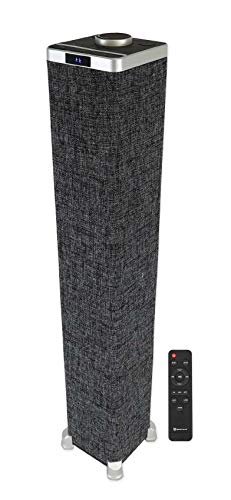
The Rockville ONE-TOWER is an all-in-one active tower with 200W peak and 60W RMS, two 4 inch woofers and Bluetooth 5.0, plus HDMI ARC, optical, RCA and USB playback. It is the only tower here that needs no receiver, so it is a simple upgrade to a TV. The listing positions it as a space-saving system.

The trade-off is output. At 60W RMS and 4 inch woofers, it is a modest speaker, not a true replacement for a stereo pair of towers. Compared with the 68C, it is a single speaker and lower on the pricing ladder.

In practice, put it beside the TV and connect with HDMI ARC. It suits a small room or a bedroom. It is a speaker for people who prefer one cable to a rack of boxes. Position it at ear height if you can.

What works

  • Active design needs no receiver
  • HDMI ARC, optical and Bluetooth inputs
  • Single tower is easy to place
  • Lowest rung on the pricing ladder

Watch out for

  • 60W RMS is modest
  • 4 inch woofers limit bass
  • Single speaker has limited stereo

Specs

Power
200W peak, 60W RMS
Drivers
Two 4 in woofers and full range
Wireless
Bluetooth 5.0
Inputs
HDMI ARC, optical, RCA, USB
Type
Active all-in-one tower

Spec decoder

What the listing measurements really mean

The numbers brands lead with, translated into what they tell you about fit, comfort and wear at home.

3-way

A 3-way speaker splits sound among a woofer, midrange and tweeter. It gives each driver a narrower job. The extra driver lets the woofer and tweeter work in a narrower range.

Watch forThe Rockville 68C and 64B are 3-way. Three-way designs usually give smoother midrange but add cost.

Ported bass reflex

A ported speaker uses a tube or slot to extend bass. It needs space from walls. Ports are tuned to a certain frequency, so a poorly tuned port can sound boomy.

Watch forThe BASAPUBU uses it. A rear port near a wall can sound boomy, so give it breathing room.

4 ohm vs 8 ohm

Impedance is the electrical load. 4 ohm speakers draw more current from an amplifier. A low impedance can overheat a weak amplifier.

Watch forThe 64B is 4 ohms, and the 68C is 8 ohms. Receiver manuals list the lowest impedance they can drive safely.

RMS vs peak

RMS is continuous power and peak is a short burst. RMS is more honest. Peak figures are often four times the RMS rating, which shows how loose they are.

Watch forThe Rockville lists both. Never mistake the peak figure for what you should feed the speaker.

HDMI ARC

HDMI ARC sends TV audio to a speaker or receiver through one cable. It simplifies setup. It also lets the TV remote control the volume.

Watch forThe ONE-TOWER includes it. Some TVs allow only one ARC device at a time.

Methodology

How We Evaluated These Tower Speakers Under $500

Quantity and value

We evaluated each listing for quantity. The XT70 is single, and the 68C and BASAPUBU are pairs. We noted the true cost of a stereo pair. Listings that hid the quantity in the title were noted. We also weighed whether the listing made the quantity easy to find.

Drivers and power

We compared driver counts and RMS ratings. The 3-way Rockville and the Polk stood out. Driver counts were weighed against cabinet size. A speaker with fewer but better drivers can beat one with more.

Amplifier needs

We noted which towers need a receiver. The ONE-TOWER is self-contained. Impedance was treated as a compatibility warning. A self-contained speaker was a plus for people without a receiver.

Owner feedback patterns

We looked at recurring themes in owner feedback, such as cabinet quality and tipping. We never count stars. These patterns shaped our cons. Cabinet rattle and tipping risk were the recurring complaints. Owner reports of tall speakers wobbling on carpet were taken seriously.

Budget band

We kept to speakers that are floorstanding towers and excluded marine speakers that use the word tower. Prices move, so check before buying. Boat and wakeboard tower speakers in the pool were off-topic and were excluded. Cabinets and finishes were compared only as far as the listings allowed.

Decision guide

How to Choose the Right Tower Speakers Under $500

By Setup

SituationPickWhy
Quality stereoPolk XT70Refined single tower
Budget stereo pairRockville 68CTwo for one price
Ultra budget pairBASAPUBUPorted pair
Strong amplifierRockville 64B3-way 4 ohm
No receiverONE-TOWERActive all-in-one

By Budget

TierPickWhat you get
LowestONE-TOWERAll-in-one
Lower64B3-way single
Lower-midBASAPUBUPorted pair
MidRockville 68C3-way pair
TopPolk XT70Refined tower

Passive vs Active

Passive (Polk, Rockville)

Needs a receiver but allows upgrades. More flexible and better for stereo.

Active (ONE-TOWER)

Self-contained and simple. Lower power and less upgradeable.

Choose passive for sound quality and active for simplicity.

By Room

RoomPickWhy
Large living roomPolk XT70Two 6.5 in drivers
Medium living roomRockville 68C3-way pair
Small roomONE-TOWERCompact all-in-one
Home theater frontRockville 64B3-way tower
Music roomBASAPUBUPorted pair

For Stereo Music Specifically

Look for

A matched pair, a good amplifier, 2 to 3 feet from the front wall and toe-in toward the listener. Add rugs or curtains if the room is hard and echoey.

In this comparison

The Polk and Rockville 68C suit stereo best.

When to Spend More

Spend more if

You want refined cabinets, a smoother response and a matched center and surrounds. Those cost more than this cap. Add a pair of surrounds and a center later if you want home theater sound.

Save if

You want big sound and bass for a living room. These towers do that.

Ownership

Maintenance schedule

The upkeep that decides whether a piece still looks good in year five.

TaskIntervalWhy it matters
Dust the cabinetsMonthlyDust builds up on grilles. A soft brush works. Use a soft brush on cloth grilles. Cloth grilles can be vacuumed on a low setting.
Check spikesEvery 6 monthsSpikes loosen. Tighten them for stability. A loose spike makes the tower wobble. A loose spike can scratch a wooden floor.
Check the wireEvery 6 monthsLoose wire causes crackling. Reseat and tighten. Corrosion on terminals can cause crackle. Use a small brush to clear dust from terminals.
Check tipping safetyEvery 6 monthsTowers can tip. Confirm outriggers are secure. Add an anti-tip strap if you can. Check that the base is level.
RepositionWhen furniture movesRoom changes affect bass. Adjust the distance from the wall. Even a few inches can change the bass. Use a tape measure to keep placement consistent.

FAQ

Frequently Asked Questions

Do I need two towers?

For stereo, yes. The Polk XT70 is sold singly, so buy two. Two matching towers also give a proper stereo image. Two towers give a proper stereo image.

Do I need an amplifier?

For passive towers, yes. The ONE-TOWER is self-contained. An all-in-one tower includes its own amplifier. A small receiver is enough for most rooms.

What does 4 ohm mean?

It is the electrical load. Check that your amplifier supports it. Check your amplifier manual to be sure. Check the manual for the minimum impedance.

How far from the wall?

About 2 to 3 feet if the speaker is ported at the rear. Give ported towers more space from the wall. Closer placement boosts bass but can sound boomy.

Are towers better than bookshelf speakers?

They reach lower bass and play louder, but need more space. Bookshelf speakers are easier to place in small rooms. A bookshelf pair with a sub is easier in small rooms.

What does a $500 cap buy?

A budget floorstanding speaker or pair. Premium towers cost more. Prices move, so check before buying. Check the cap at the time of purchase.

Bottom line

The short version

Browse more tower speakers under $500on Amazon →
Elena Hart, Lead Home Editor

About the author

Elena Hart

Lead Home Editor, SweetLivingRoom

Elena Hart leads SweetLivingRoom's buying guides, turning product dimensions, material specs and owner feedback into clear verdicts on sofas, rugs, lighting, storage and decor.

More from Elena →

Keep reading

Related guides