
Amazon affiliate links - we earn a commission.Affiliate disclosure

Buying guide · 13 min read · Updated 2026-11-21

Best Bookshelf Speakers (2026)

Six pairs of bookshelf speakers compared on powered versus passive design, driver size, Bluetooth and HDMI inputs, impedance and placement in living rooms.

Elena Hart, Lead Home EditorBy Elena HartLead Home Editor6 picks comparedSpec-sheet verified
Best Bookshelf Speakers

At a glance

Our top picks

Side by side

Spec comparison

Bookshelf speakers are compact two-way or three-way cabinets that give much bigger sound than a TV or a Bluetooth bar. They suit living rooms where floor-standing towers would dominate, and they work equally well for music, movies and a record player.

The first choice is powered or passive: powered pairs include amplifiers and plug in directly, while passive pairs need a receiver. After that come driver size, inputs and where the speakers will sit. This guide compares six pairs on those points.

Before you buy

6 Criteria to Look For Before Buying a Bookshelf Speaker

  1. 01

    Powered or passive

    Powered pairs like the Edifier R1280DBs and ULTIMEA BS-3 include amplifiers and plug into a TV or phone. Passive pairs like the Polk T15 and Klipsch R-41M need a receiver. Add the receiver cost to a passive pair before comparing prices.

  2. 02

    Driver size and bass

    A larger woofer moves more air, so the 5.25 inch Polk T15 plays deeper than the 4 inch Klipsch R-41M, whose response ends near 68 Hz. For movies, plan to add a subwoofer. Bookshelf speakers alone rarely give film-level bass.

  3. 03

    Impedance and amplifier match

    Impedance, such as 8 ohm on the Klipsch or 4 and 8 ohm on the Polk ES20, tells you how hard the speaker is to drive. Low impedance can strain a cheap receiver. Check the receiver's rating before buying passive speakers.

  4. 04

    Inputs and connectivity

    Optical, Bluetooth and HDMI ARC decide how easily powered speakers join your TV. The ULTIMEA has HDMI ARC, the Edifier has optical and Bluetooth. If your TV has only optical, either works.

  5. 05

    Placement and stands

    Speakers sound best with the tweeters at ear height, away from walls and with space behind rear ports. A bookshelf is often the worst spot, because it blocks the port and raises the height. Use stands or a console if possible.

  6. 06

    Room size and listening

    Small rooms suit compact pairs, and large open rooms may need louder or larger speakers. Think about listening distance and volume. Bass in a small room can boom, so placement matters more than size.

Detailed reviews

The 6 best bookshelf speakers, explained

01
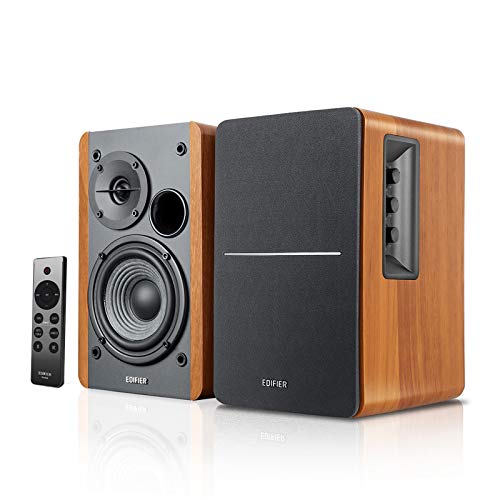
Edifier R1280DBs Active Bluetooth Bookshelf Speakers, 42W RMS, Optical and Coax Inputs
Powered pair42W RMSBluetooth 5.0Sub out
Check price on Amazon
Best for: Living rooms and desks that want a powered pair with Bluetooth and optical inputs.

Edifier's R1280DBs is an active pair with 42 watts of continuous power, a 13 mm silk dome tweeter, Bluetooth 5.0, optical and coaxial digital inputs and a subwoofer output with a built-in crossover. Active means the amplifier is inside, so the pair plugs into a TV, phone or computer without a receiver.

The tradeoff is that the speakers are small and wooden-look MDF cabinets, so they do not reach the deep bass or loudness of larger passive models. Compared with the Klipsch R-41M, they need no amplifier but offer less detail at high volumes. Against the ULTIMEA BS-3, they are simpler and cheaper, but lack an HDMI ARC input for a TV.

Place them on stands or a console at ear height with a gap behind for the rear port. Connect the TV optical output for a clean digital signal. In year three, the vinyl wrap on the cabinets is the part to watch for peeling at the corners, and the volume knob should be dusted to avoid scratchy turns.

What works

  • Active design plugs straight into a TV without a receiver
  • Bluetooth 5.0 streams from a phone or tablet wirelessly
  • A subwoofer output with built-in crossover allows later bass expansion
  • Optical and coaxial digital inputs give clean TV audio

Watch out for

  • Small cabinets limit deep bass and peak volume
  • No HDMI input for a direct TV connection

Specs

Type
Active, powered pair
Power
42W continuous RMS
Wireless
Bluetooth 5.0
Inputs
Optical, coaxial and analog
Extras
Subwoofer output with built-in crossover
02
Polk Audio T15 100 Watt Home Theater Bookshelf Speakers, Pair, 5.25 Inch Woofer
Passive pair5.25 in woofer0.75 in tweeterWall mountable
Check price on Amazon
Best for: Buyers with a receiver who want an affordable pair or surround speakers.

Polk's T15 pairs a 5.25 inch Dynamic Balance woofer with a 0.75 inch tweeter in a compact cabinet rated for up to 100 watts. It can be used on a shelf or wall mounted as front, left-right or rear speakers in a home theater, and Polk offers matching towers, a centre and a subwoofer for expansion into 5.1.

The tradeoff is that passive speakers need an amplifier or receiver, so the cost of a basic receiver must be added. Compared with the Edifier R1280DBs, the T15 plays louder with a bigger woofer but needs extra gear. Against the Polk ES20, it is simpler and cheaper but less refined.

Place the pair on stands or shelves with at least a few inches behind them, and use decent speaker wire. In year three, check the binding posts and the grille fit, and keep the tweeters clear of dust. Pair with a small receiver for a full music and movie system.

What works

  • A 5.25 inch woofer gives more bass than most small desktop pairs
  • Wall mountable design suits tight living rooms
  • Expands into a 5.1 system with matching Polk speakers
  • Passive design lets you choose your own amplifier

Watch out for

  • Needs an amplifier or receiver, which adds cost
  • A basic design that does not match more refined speakers

Specs

Type
Passive pair
Woofer
5.25 in Dynamic Balance
Tweeter
0.75 in
Power
Up to 100 watts
Mounting
Wall mountable
03
Klipsch R-41M Reference Bookshelf Speakers, Pair, 4 Inch Woofer, Tractrix Horn
Passive pair4 in woofer1 in aluminum tweeter8 ohm
Check price on Amazon
Best for: Listeners who want a detailed, efficient pair and have an amplifier and subwoofer.

Klipsch's R-41M combines a 4 inch spun-copper woofer with a 1 inch aluminum tweeter mated to a 90 by 90 degree Tractrix horn, with a frequency response from 68 Hz to 21 kHz within 3 dB and an 8 ohm impedance. The horn gives the tweeter high efficiency and a clear, forward sound that works well at low volumes.

The tradeoff is that the 4 inch woofer limits bass, with response only down to 68 Hz, so these pair best with a subwoofer for movies. Compared with the Polk T15, they are smaller but more detailed and efficient. Against the Edifier R1280DBs, they need an amplifier but are more refined.

Place them on stands with the tweeters at ear height, and toe them in slightly toward the seat. Pair them with a receiver of decent quality. In year three, the horn can collect dust and the binding posts should be checked for tightness. A subwoofer is a sensible addition.

What works

  • A Tractrix horn tweeter gives clear, detailed treble
  • High efficiency suits modest receivers
  • An 8 ohm impedance is easy for most amplifiers
  • A compact cabinet fits shelves and stands

Watch out for

  • A 4 inch woofer limits bass below 68 Hz
  • Needs an amplifier and ideally a subwoofer

Specs

Woofer
4 in spun-copper IMG
Tweeter
1 in aluminum LTS with Tractrix Horn
Response
68 Hz to 21 kHz, plus or minus 3 dB
Impedance
8 ohm nominal
Crossover
1,730 Hz
04
ULTIMEA BS-3 Large 3-Way Powered Bookshelf Speakers, HDMI ARC, Sub Out, 5.25 Inch Woofer
3-way powered5.25 in wooferHDMI ARCApp control
Check price on Amazon
Best for: TV setups that want powered speakers with HDMI ARC and app control.

ULTIMEA's BS-3 is a three-way powered pair with a 5.25 inch long-excursion woofer, a dedicated midrange driver and a tweeter, with HDMI ARC, optical, USB, RCA and subwoofer outputs plus app control. Edge horn technology directs treble toward the listening area, and the HDMI ARC input means a single cable can link a TV.

The tradeoff is complexity and unknown track record: it is a newer design from a brand with a shorter history than Edifier or Klipsch. Compared with the Edifier R1280DBs, it offers HDMI ARC and a bigger woofer but is more expensive. Against passive pairs, it needs no amplifier but locks you into its built-in amp.

Place the speakers at ear height on stands or a console and set the app up for room correction if available. Use the HDMI ARC port for the TV so the remote controls volume. In year three, check app and firmware updates and keep the vents clear of dust.

What works

  • HDMI ARC input links to a TV with a single cable
  • A 3-way design adds a dedicated midrange driver
  • A 5.25 inch woofer gives fuller bass than smaller powered pairs
  • Subwoofer output and app control allow tuning

Watch out for

  • A newer brand with a shorter track record
  • Upper middle cost tier for a powered pair

Specs

Type
3-way powered pair
Woofer
5.25 in, 15 mm long excursion
Inputs
HDMI ARC, optical, USB, RCA
Extras
Subwoofer output and app control
Cost tier
Upper middle of the group
05
Polk Audio Signature Elite ES20 Bookshelf Speakers, Pair, Walnut, Power Port
Passive pairPower Port bassDolby Atmos capable4 and 8 ohm
Check price on Amazon
Best for: Music and movie listeners who want stronger bass from a compact pair.

Polk's Signature Elite ES20 uses Power Port technology to deliver louder bass than a standard port, with high sensitivity and compatibility with 4 and 8 ohm amplifiers. It carries a Hi-Res Audio certification and Dolby Atmos capability, and the walnut finish is a step up in looks from basic black boxes.

The tradeoff is that it is a passive pair at the upper end of the group's cost, so you also need a receiver. Compared with the Polk T15, it is more refined and has stronger bass but costs more. Against the Klipsch R-41M, it has fuller low end but a less forward treble.

Place the speakers on stands with a few inches of space behind for the Power Port. Pair them with a good receiver and a small subwoofer for movies. In year three, check the finish for scratches and keep the grilles clean.

What works

  • Power Port technology gives fuller bass than a standard port
  • High sensitivity suits modest receivers
  • 4 and 8 ohm compatibility suits more amplifiers
  • Walnut finish suits a living room better than plain black

Watch out for

  • Needs a receiver, which adds cost
  • Upper end cost tier for a passive pair

Specs

Type
Passive pair
Bass
Power Port technology
Compatibility
4 and 8 ohm amplifiers
Certification
Hi-Res Audio
Cost tier
Upper end of the group
06
Sony SS-CS5M2 3-Way 3-Driver Hi-Res Bookshelf Speakers, Pair, 5.12 Inch Woofer
Passive pair3-way3 drivers5.12 in woofer
Check price on Amazon
Best for: Listeners who want a smooth three-way sound and have a receiver.

Sony's SS-CS5M2 is a three-way, three-driver compact bookshelf speaker with a 5.12 inch woofer, part of the CS home theater series. Splitting the frequency range across three drivers gives a smoother midrange than a simple two-way design, and the compact cabinet suits small spaces.

The tradeoff is that it is a passive pair, so a receiver is needed, and a three-way design adds crossover complexity. Compared with the Polk T15, it adds a midrange driver but costs more. Against the Klipsch R-41M, it has a bigger woofer but less efficiency.

Place the speakers on stands with the tweeters at ear height and a gap behind. Pair them with a mid-range receiver. In year three, check the binding posts and clean the drivers' grilles. A subwoofer is useful for movies.

What works

  • A three-way design gives a smoother midrange
  • A 5.12 inch woofer adds low-end weight
  • Hi-Res rating suits high-quality sources
  • Compact cabinet suits small living rooms

Watch out for

  • Needs an amplifier or receiver, which adds cost
  • Middle cost tier is above entry passive pairs

Specs

Type
Passive pair
Design
3-way, 3 driver
Woofer
5.12 in
Series
CS home theater
Cost tier
Middle of the group

Spec decoder

What the listing measurements really mean

The numbers brands lead with, translated into what they tell you about fit, comfort and wear at home.

RMS watts

RMS watts is continuous power, which is more useful than peak watts. It indicates loudness capacity.

Watch forThe Edifier R1280DBs lists 42W RMS; the Polk T15 lists a 100 watt maximum rating.

Frequency response

This is the range of bass to treble the speaker plays, with a tolerance in dB.

Watch forThe Klipsch R-41M lists 68 Hz to 21 kHz plus or minus 3 dB, so bass stops early.

Impedance

Impedance is the load the speaker gives the amplifier, in ohms. Lower impedance draws more current.

Watch forThe Polk ES20 lists 4 and 8 ohm compatibility; the Klipsch R-41M is 8 ohm.

Active vs passive

Active speakers have built-in amplifiers. Passive speakers need an external amplifier.

Watch forThe Edifier and ULTIMEA pairs are active; the Polk and Klipsch pairs are passive.

Subwoofer output

A sub out lets you add a subwoofer with a crossover to share the bass.

Watch forBoth the Edifier R1280DBs and ULTIMEA BS-3 list one.

Methodology

How We Evaluated These Bookshelf Speakers

Type and connections

We compared powered and passive designs and their inputs, from optical and Bluetooth on the Edifier to HDMI ARC on the ULTIMEA. We asked which suits a TV living room. We did not measure sound.

Drivers and bass

We read woofer sizes, from 4 inches on the Klipsch to 5.25 inches on the Polk T15. Larger woofers reach lower. We noted where a subwoofer helps.

Amplifier match

We considered impedance and power ratings, such as 8 ohm and 4 and 8 ohm. Poor matches strain a receiver. We favoured easy loads.

Placement and size

We looked at cabinet size, ports and mounting options. Wall mountable models like the Polk T15 suit tight rooms. We favoured flexible placement.

Owner feedback patterns

We researched common themes: thin bass, receiver mismatch and finish wear. These shape our cons. We did not use ratings or review counts.

Decision guide

How to Choose the Right Bookshelf Speakers

By Setup

SituationPickWhy
No receiverEdifier R1280DBsActive pair with Bluetooth
TV with HDMI ARCULTIMEA BS-3HDMI ARC input
Small receiverPolk T15Efficient passive pair
Detail at low volumeKlipsch R-41MHorn-loaded tweeter
Stronger bassPolk ES20Power Port design

By Budget

SituationPickWhy
Lower tierEdifier R1280DBs or Polk T15Active or passive value
MiddleSony SS-CS5M2Three-way passive
Upper middleULTIMEA BS-3 or Klipsch R-41MHDMI ARC or horn detail
Upper endPolk ES20Refined bass
Best value overallEdifier R1280DBsIncludes amplification

Powered vs Passive

Powered

The Edifier and ULTIMEA include amplifiers and plug straight into a TV or phone. They are simpler but lock you to their built-in amplification.

Passive

The Polk, Klipsch and Sony pairs need a receiver. They allow upgrades and often sound better at the same cost.

Pick powered for simplicity and passive if you own a receiver or want to upgrade later.

By Use

SituationPickWhy
TV and streamingULTIMEA BS-3HDMI ARC and app control
Music in a small roomEdifier R1280DBsCompact and wireless
Movies with a subPolk T15Expandable to 5.1
Vinyl and receiverKlipsch R-41MDetail and efficiency
Mixed useSony SS-CS5M2Smooth three-way sound

For Living Room Use Specifically

Look for

A pair that fits your TV or receiver, sits at ear height on stands and suits the size of the room.

In this comparison

The Edifier and ULTIMEA suit TV rooms with no receiver, while the Polk and Klipsch suit those with a receiver.

When to Spend More

Spend more if

You want stronger bass from the Polk ES20, HDMI ARC from the ULTIMEA or a refined pair for a good receiver.

Save if

You want a simple desktop or TV pair, where the Edifier R1280DBs is enough.

Ownership

Maintenance schedule

The upkeep that decides whether a piece still looks good in year five.

TaskIntervalWhy it matters
Dust the cabinets and grillesMonthlyDust dulls the finish and clogs ports. A dry cloth keeps them clean.
Check speaker wire connectionsTwice a yearLoose wire causes crackle. Re-seat binding posts.
Keep ports clearAlwaysBlocked ports muffle bass. Leave a few inches behind.
Update firmware on powered pairsAs promptedUpdates fix Bluetooth and app bugs. Skipping them leaves gaps.
Keep away from heat and dampAlwaysHeat and damp warp cabinets and age drivers. Keep them off radiators.

FAQ

Frequently Asked Questions

Do bookshelf speakers need to be on a bookshelf?

No. They usually sound better on stands at ear height with space behind them. A shelf is fine if the port is not blocked. If a rear-ported speaker has to sit close to a wall, stuffing the port with the supplied foam bung, where one is included, tames boomy bass, and a few inches of clearance on the sides reduces harshness from reflections.

How much do bookshelf speakers cost?

Prices move, so check the current listing. The Edifier and Polk T15 sit at the lower tiers and the Polk ES20 at the top. Brand and drivers drive cost.

Do I need a subwoofer?

For music in a small room, often not. For movies, yes, because small woofers do not reach deep bass. A sub also takes the low notes off the small woofers, which lets them play cleaner at higher volume, so even music listeners sometimes benefit once they turn it up for a party.

Can I connect bookshelf speakers to my TV?

Powered pairs connect through optical, HDMI ARC or analog. Passive pairs need a receiver between the TV and speakers. Check which output your TV actually offers before buying, because some newer sets drop the optical port and only pass sound through HDMI ARC or eARC, which suits the ULTIMEA but not the Edifier.

Are powered or passive speakers better?

Powered pairs are simpler, passive pairs allow upgrades. For the same cost, passive often sounds better but needs extra gear. The honest answer is that placement and room matter as much as the type, so a modest pair set up well will beat an expensive pair pushed into a corner or behind a cabinet door.

How far apart should I place them?

A common rule is about as far apart as the distance to the listener, forming a triangle. Angle the tweeters slightly toward the seat. Keep the pair the same distance from the side walls so the sound image stays centred, and move them a little at a time, since a few inches of change can transform the bass in a small room.

Bottom line

The short version

Browse more bookshelf speakerson Amazon →
Elena Hart, Lead Home Editor

About the author

Elena Hart

Lead Home Editor, SweetLivingRoom

Elena Hart leads SweetLivingRoom's buying guides, turning product dimensions, material specs and owner feedback into clear verdicts on sofas, rugs, lighting, storage and decor.

More from Elena →

Keep reading

Related guides