
Amazon affiliate links - we earn a commission.Affiliate disclosure

Buying guide · 13 min read · Updated 2026-11-21

Best Tower Speakers (2026)

Six floor standing tower speakers compared by driver layout, power handling, pair or single sale, cabinet build and the room each one needs.

Elena Hart, Lead Home EditorBy Elena HartLead Home Editor6 picks comparedSpec-sheet verified
Best Tower Speakers

At a glance

Our top picks

Side by side

Spec comparison

A tower speaker is a floor standing cabinet that houses several drivers in one tall box, so it reaches lower bass and plays louder than a bookshelf speaker without needing a separate stand. It is the classic choice for stereo listening and for the front left and right channels of a home theater.

The category has a few traps. Some listings sell one speaker and others sell a pair. Power ratings are quoted as peak watts, which tell you little. The details that count are driver layout, cabinet build, sensitivity and how the speaker behaves in a real living room. We compare published specifications here, so measure your own room before ordering.

Before you buy

6 Criteria to Look For Before Buying a Tower Speaker

  1. 01

    Pair or single

    Some listings, such as the Polk XT70, T50 and Sony CS3M2, sell one speaker, and a stereo pair needs two. The Klipsch R-26FA, Elimavi and BASAPUBU are sold as pairs. Always check the line, since a single priced at half of a pair is not a bargain. If you buy a single, check whether the seller also lists the second one with the same finish and batch.

  2. 02

    Driver layout

    A two way tower has a tweeter and woofers, and a three way, like the Sony, adds a midrange. More woofers, as on the Elimavi's three, add bass area but not necessarily better sound. Look for sensible crossover points. Many listings state the crossover frequency, and a well chosen split at about 2 to 3 kilohertz usually sounds smooth.

  3. 03

    Power and sensitivity

    Peak watts are marketing numbers. Sensitivity, measured in decibels at one watt, tells you how loud a speaker plays from a given amplifier, and horn designs like Klipsch are efficient. Pair the speaker with an amplifier that has comfortable headroom. As a rough rule, doubling the amplifier power adds only 3 decibels, so sensitivity matters more than a big wattage number.

  4. 04

    Cabinet and build

    MDF cabinets, as on the Klipsch, resist resonance. Lighter cabinets ring more. A heavier box is also more stable but needs a firm floor. Press on the side panel of a cabinet in the store if you can: a dull thump suggests a solid, damped box.

  5. 05

    Room size and placement

    Towers suit rooms of at least 10 by 12 feet. Place them two to three feet from the front wall and toe them in. Rear ported models near a wall sound boomy. If the room is small, consider bookshelf speakers on stands instead, since towers can overwhelm it.

  6. 06

    Safety and floor

    Towers are tall and can tip. Use the outriggers or spikes supplied, and keep them away from child traffic. Spikes suit carpet, while rubber feet suit hardwood. A heavy cabinet is safe if its base is wide, so look for outriggers that widen the footprint.

Detailed reviews

The 6 best tower speakers, explained

01
Klipsch Reference R-26FA Floorstanding Speakers Pair
Pair includedCopper spun IMG woofersHorn loaded tweeterMDF cabinet
Check price on Amazon
Best for: Living rooms that want a matched pair with punchy dialogue and music.

The R-26FA is sold as a pair and combines copper spun woofers with a horn loaded tweeter in an MDF cabinet. Klipsch is known for efficient horn designs that play loud from modest amplifiers and keep dialogue clear in film soundtracks.

Horn loaded tweeters are detailed but can sound bright in a small, bare room, so a rug and curtains help. The cabinet is a tall and relatively heavy MDF box, which is a solid base for the drivers, but it needs a firm floor and space from the wall. Against the Polk Monitor XT70, the Klipsch is the higher price tier and listed as a pair, while the Polk is sold singly. An Atmos enabled model also carries an upward firing driver, which only helps with a flat ceiling of eight to ten feet.

Plan a receiver or amplifier with enough power, place the towers about two to three feet from the front wall and toe them in. Anchor the speakers with the spikes or outriggers and keep children away from the cabinet edges. If you plan a full surround system, the same family offers matching center and surround speakers, which keeps the tonal balance consistent across the front stage. Treat a horn tweeter's brightness with a thick rug and drapes rather than turning the treble down, because absorbing reflections gives a more natural result than tone controls.

What works

  • Sold as a matched pair, not a single speaker
  • Copper spun woofers and horn tweeter give clear, dynamic sound
  • MDF cabinet is solid and resists resonance
  • Efficient design plays loud from a modest amplifier

Watch out for

  • Horn tweeter can sound bright in a bare room
  • Highest price tier in the lineup
  • Tall, heavy cabinets need space from the front wall

Specs

Sold as
Pair, two floorstanding speakers
Woofers
Copper spun IMG
Cabinet
MDF
Tweeter
Horn loaded
Atmos
Dolby Atmos enabled, per reviewers
02
Polk Audio Monitor XT70 Large Home Tower Speaker Single
Sold singly1 in tweeterTwo 6.5 in woofersHi-res certified
Check price on Amazon
Best for: Home theater front channels and stereo pairs built one speaker at a time.

The Polk Monitor XT70 is a large tower with a 1 inch tweeter and two 6.5 inch dynamically balanced woofers. It is sold singly, so a stereo pair needs two purchases, which is the first thing to check in the listing.

It sits between the T50 and the Klipsch in this lineup. The drivers are standard but the cabinet gives it more bass depth than a bookshelf speaker. As a single it is popular as a front left or right channel in a home theater and in combination with a matching center speaker. Compared with the Polk T50, the XT70 is the newer and higher tier design with a more refined cabinet.

Plan for two. Position each tower two to three feet from the wall and tilt them toward the listener, and use the spikes on carpet. Because it is sold singly, check that the second speaker comes from the same production batch and has the same finish, since vinyl wraps vary slightly. A matching Polk centre speaker and a pair of surrounds complete a basic home theater without any tonal mismatch.

What works

  • Two 6.5 inch woofers give full bass for a mid sized room
  • 1 inch tweeter keeps highs smooth
  • Matches Polk center and surround speakers
  • Large cabinet suits home theater use

Watch out for

  • Sold singly, so a pair costs double
  • Rear port needs space from the wall
  • Requires an AV receiver or amplifier

Specs

Sold as
Single speaker
Tweeter
1 in
Woofers
Two 6.5 in dynamically balanced
Type
Large floorstanding tower
Series
Monitor XT
03
Polk Audio T50 Home Theater Floor Standing Tower Speaker 150W Single
Sold singly150 W handling1 in tweeterDual 6.5 in bass
Check price on Amazon
Best for: First time home theater builders on a tight budget.

The T50 is the entry level Polk tower with a 1 inch tweeter, a 6.5 inch driver and dual bass radiators. It is sold singly and carries a power handling of 150 watts, a figure that describes how much it can take rather than how loud it plays.

Bass radiators add low frequency output without a port, which keeps the cabinet slim. The T50 trades refinement for price, and its construction is lighter than the XT series. It is also an older design, so its look is less contemporary. In a small to mid sized living room it makes a good first tower, and next to the Polk XT70 it is lower in tier and in bass depth.

Buy two if you want stereo, use a receiver and place them away from walls. At this tier the cabinet is lighter, so heavy bass passages can make the box buzz if it stands on a loose floor. A rubber mat or spike set solves most rattles.

What works

  • Brand name driver design at a low tier
  • Bass radiators add low end without a port
  • 150 watt power handling suits modest receivers
  • Slim cabinet fits smaller rooms

Watch out for

  • Sold singly, so a pair costs double
  • Lighter cabinet than the XT series
  • Older design with less refinement

Specs

Sold as
Single speaker
Power handling
150 W
Tweeter
1 in
Drivers
One 6.5 in plus dual 6.5 in bass
Audio
Hi-res
04
Sony SS-CS3M2 3-Way 4-Driver Hi-Res Floorstanding Speaker Single
Sold singly3-way, 4 driversHi-resCS series
Check price on Amazon
Best for: Home theater setups that want a matching Sony speaker family.

The Sony SS-CS3M2 is a three way, four driver floorstanding speaker aimed at home theater use and hi-res audio. A three way layout splits the highs, mids and bass across separate drivers, which can reduce distortion at high volume.

It is sold singly, so plan for two. Sony's design emphasises a clean mid range and wide dispersion, and it pairs with matching Sony center and surround speakers. The cabinet is heavier than the budget towers but the listing gives few specific dimensions in the information we reviewed, so check the height and depth on the listing before measuring your room. Against the Polk T50, the Sony is a more refined three way design.

Place it two to three feet from the wall and angle it toward the listener. Check the receiver's impedance range before connecting. Sony's family also includes matching center and rear speakers, and mixing brands in a surround system can leave gaps in tone, so staying with one family is sensible.

What works

  • Three way, four driver layout spreads the load
  • Hi-res audio support on the listing
  • Matches Sony center and surround speakers
  • Mid tier for a branded three way tower

Watch out for

  • Sold singly, so a pair costs double
  • Few specifics on size in the listing
  • Needs a receiver with adequate power

Specs

Sold as
Single speaker
Layout
3-way, 4-driver
Audio
Hi-res
Series
CS home theater
Type
Floorstanding
05
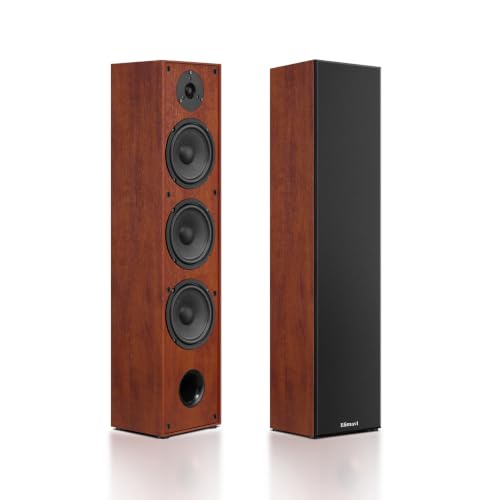
Elimavi Floor Standing Tower Speakers Pair 3 x 6.5 in Woofers 160W
Pair3 x 6.5 in woofers1 in silk dome tweeter160 W
Check price on Amazon
Best for: Stereo listeners who want a lot of bass area in a pair.

The Elimavi pair uses three 6.5 inch woofers and a 1 inch silk dome tweeter per speaker, with a two way crossover that sends 50 to 300 hertz to the woofers and 200 hertz to 20 kilohertz to the tweeter. It is sold as a pair and rated at 160 watts.

Three woofers give plenty of bass area, but the two way crossover means they share a lot of the midrange, which can make the sound less tidy than a three way design. The 160 watt figure is a power handling rating, not a loudness promise. Compared with the Elimavi dual woofer model, the three woofer version has more bass at a higher price tier.

Use an amplifier that can drive the speaker without clipping. Place them two feet from the wall and run the speaker wire neatly. Because brand support is limited, keep the box and your receipt, and test both speakers in the first days to catch any early fault.

What works

  • Sold as a pair, which lowers the cost per speaker
  • Three 6.5 inch woofers per tower give plenty of bass area
  • Silk dome tweeter offers smooth highs
  • Clear frequency split listed in the crossover

Watch out for

  • Brand has a short track record
  • Two way crossover shares the midrange across woofers
  • Power figure is a handling rating, not loudness

Specs

Sold as
Pair
Woofers
Three 6.5 in each
Tweeter
1 in silk dome
Crossover
Two way, 50 Hz to 300 Hz to woofers
Power
160 W
06
BASAPUBU Passive Floorstanding Speakers Pair 120W Peak Dual 6.5 in
Pair120 W peakDual 6.5 in woofers40 Hz to 20 kHz
Check price on Amazon
Best for: A first stereo system on a minimal budget.

The BASAPUBU is the lowest priced pair in the lineup, with dual 6.5 inch woofers, a ported bass reflex design and a listed response of 40 hertz to 20 kilohertz. It is sold as a pair, is passive and needs an amplifier.

Peak watt figures are marketing numbers, and the frequency response is given without a tolerance, so treat it as a rough guide. For a first stereo, it is a reasonable way to try a floorstanding system. The brand is new, and parts and support are less certain than with Polk or Klipsch. Next to the 150 watt BASAPUBU sibling, this model is the cheaper tier with less power handling.

Place the pair away from the wall, add pads under the feet and run a basic stereo amp or receiver. Do not push the volume to clipping. If one speaker buzzes, check that the binding posts are tight and the rear port is clear before assuming a fault.

What works

  • Lowest price tier among the towers
  • Sold as a pair
  • Ported design extends bass response
  • Dual 6.5 inch woofers suit small rooms

Watch out for

  • Peak power and response figures are loose claims
  • Lesser known brand with less support
  • Needs an amplifier or receiver

Specs

Sold as
Pair
Power
120 W peak
Woofers
Dual 6.5 in
Response
40 Hz to 20 kHz
Design
Ported bass reflex

Spec decoder

What the listing measurements really mean

The numbers brands lead with, translated into what they tell you about fit, comfort and wear at home.

Peak watts

The maximum short burst of power a speaker can handle, not a continuous rating. Continuous or RMS power is a more useful figure than peak, but few budget listings state it.

Watch forThe BASAPUBU and Elimavi list peak or handling figures.

Frequency response

The range of sound a speaker reproduces, ideally with a tolerance such as plus or minus 3 decibels.

Watch forElimavi's 40 hertz to 21 kilohertz carries a tolerance, others do not.

Sensitivity

The loudness a speaker produces from one watt at one metre. A difference of 3 decibels is about double the amplifier power.

Watch forHorn designs such as the Klipsch are efficient.

Bass reflex

A ported cabinet that extends low frequencies. A port can also whistle if it is too narrow, which is a common complaint on budget cabinets.

Watch forRear ports need space from the wall.

Passive

A speaker with no built in amplifier that needs an external receiver.

Watch forAll lineup towers are passive.

Methodology

How We Evaluated These Tower Speakers

Pair or single

We checked every listing for whether it sells one speaker or a pair and noted the cost implications.

Drivers and layout

We compared driver counts and crossover layouts from published specifications. We do not test products, so we rely on listings. We also noted any listing that states the crossover frequencies.

Power claims

We treated peak watt figures as marketing and favoured listings with tolerances.

Cabinet and stability

We weighed MDF cabinets against lighter builds and noted tip safety. We also considered the footprint and the risk of tipping.

Room fit

We matched each tower to a living room of at least 10 by 12 feet.

Decision guide

How to Choose the Right Tower Speakers

By Room and Use

SituationPickWhy
Stereo and musicKlipsch R-26FAMatched pair, detailed sound
Home theater frontsPolk XT70Large tower, matches Polk centers
Small budgetBASAPUBULowest tier pair
Matching Sony systemSony SS-CS3M2Three way design
Bass heavy stereoElimavi 3 wooferThree woofers per tower

By Budget

SituationPickWhy
Lowest tierBASAPUBUPair at the lowest tier
Low tierSony SS-CS3M2Single three way
Low to middlePolk T50Single branded tower
Middle tierElimavi 3 wooferPair with three woofers
Higher tierPolk XT70 and Klipsch R-26FAMid and upper brand towers

Pair vs Single

Sold as a pair

The Klipsch, Elimavi and BASAPUBU ship two speakers. They suit a stereo system and simplify budgeting.

Sold singly

The Polk and Sony models ship one speaker. They suit home theater builds where you pick each channel.

Choose a pair for stereo, singles for a custom theater. If you are unsure, buy a pair so the two speakers match exactly.

By Listening Style

SituationPickWhy
Film dialogueKlipsch R-26FAHorn tweeter, clear dialogue
Pop and rockPolk XT70Full bass
Casual listeningBASAPUBUSimple and affordable
Home theater frontsSony SS-CS3M2Matches Sony center
Big bassElimaviThree woofers

For Living Rooms Specifically

Look for

A cabinet finish that matches the room, a tip safe base and a size that leaves 2 to 3 feet behind it.

In this comparison

The Klipsch and Polk XT70 suit living rooms best.

When to Spend More

Spend more if

You listen to music daily, want a matched pair or plan to add a center and surrounds.

Save if

You want a first stereo or a casual TV upgrade.

Ownership

Maintenance schedule

The upkeep that decides whether a piece still looks good in year five.

TaskIntervalWhy it matters
Check spikes and feetEvery six monthsTowers settle. A level base prevents wobble.
Check speaker wireEvery six monthsConnections loosen. A tight connection prevents buzz. Check that bare wire strands do not touch, since a stray strand can cause a short.
Dust cabinets and grillesEvery two weeksDust dulls finishes. A dry cloth is enough. Never use spray cleaners on the cloth grilles or drivers.
Inspect woofer edgesYearlySurround rubber ages. Cracks mean distortion.
Keep away from heatAlwaysHeat dries glue and warps cabinets.

FAQ

Frequently Asked Questions

Are tower speakers better than bookshelf speakers?

Towers reach lower bass and play louder, but need more room. Bookshelf speakers with stands are more flexible in small rooms. Towers also remove the need for stands, which can be a visual advantage in a living room.

Do I need a subwoofer with towers?

Not always. Towers cover bass well for music, but a subwoofer helps with film effects. If you add a subwoofer later, set the crossover at about 80 hertz to hand off the lowest bass.

How much power do I need?

Pair the speaker with an amplifier that has comfortable headroom. Sensitivity matters more than peak watts.

Do towers come in pairs?

Some do and some are sold singly. Check the listing before you buy.

How far from the wall should I place towers?

Two to three feet from the front wall, with a slight toe-in toward the listener. If the room is narrow, place them along the long wall to keep the stereo image wide.

How much should I spend?

A low tier pair suits a first stereo. Spend more for a matched pair with a solid cabinet.

Bottom line

The short version

Browse more tower speakerson Amazon →
Elena Hart, Lead Home Editor

About the author

Elena Hart

Lead Home Editor, SweetLivingRoom

Elena Hart leads SweetLivingRoom's buying guides, turning product dimensions, material specs and owner feedback into clear verdicts on sofas, rugs, lighting, storage and decor.

More from Elena →

Keep reading

Related guides