
Amazon affiliate links - we earn a commission.Affiliate disclosure

Buying guide · 13 min read · Updated 2026-11-28

Best Bookshelf Speakers Under $200 (2026)

Six bookshelf speaker pairs under $200, from Klipsch passive models to Edifier powered monitors, compared on drivers, amplification, sensitivity and room fit.

Elena Hart, Lead Home EditorBy Elena HartLead Home Editor6 picks comparedSpec-sheet verified
Best Bookshelf Speakers Under $200

At a glance

Our top picks

Side by side

Spec comparison

A pair of bookshelf speakers is the simplest route to better sound than a TV or a phone can give. They are small enough for a shelf, a desk or a stand, and they suit music as well as movies. The big decision is passive or powered, because passive speakers need an amplifier and powered ones do not.

This guide looks at bookshelf speakers that fit under a $200 cap, and we favour the upper band of it. Listing prices move, and the cap reflects Amazon listing prices when this guide was last updated. Peak watt figures are marketing, so we lean on drivers, RMS power and design.

Before you buy

6 Criteria to Look For Before Buying a Bookshelf Speaker Under $200

  1. 01

    Passive or powered

    Passive speakers need an AV receiver or amplifier, while powered speakers have the amplifier built in. The Klipsch pairs and Audio Express are passive, and the Edifier models are powered. If you do not own an amplifier, a powered pair is cheaper overall and simpler to set up. A powered pair also avoids mismatches between an amplifier and speakers, which is the most common beginner mistake. A passive pair rewards you later, because you can upgrade the amplifier without replacing the speakers.

  2. 02

    RMS power and sensitivity

    Peak watts are marketing, while RMS or continuous watts and sensitivity in dB tell more. A speaker with 88 to 92 dB sensitivity plays loudly with little power. The Klipsch horn design is efficient, so a modest amplifier works. If your amplifier is modest, say 40 to 50 watts per channel, look for sensitivity of about 88 dB or higher. A less sensitive speaker will need more power to reach the same volume.

  3. 03

    Driver size and bass

    A 4 inch woofer cannot reach deep bass, and a 6.5 inch woofer goes lower but needs a bigger cabinet. The R-41M lists a 68 Hz low limit. Add a subwoofer if you want the lowest octave. In a small room, a modest low limit is often a benefit, because deep bass excites room modes and sounds boomy. In a larger room, a sub gives you control over the lowest notes.

  4. 04

    Frequency response claims

    A response like 68 Hz to 21 kHz with a plus or minus 3 dB tolerance is meaningful, while a response without a tolerance is vague. The R-41M gives the tolerance. Be careful with listings that only state a range. If a listing gives no tolerance at all, treat the number as a loose description rather than a specification. A real range such as 68 Hz to 21 kHz within 3 dB is easier to compare.

  5. 05

    Placement and room

    Place speakers at ear height on stands or a shelf, about 6 to 8 feet apart, toed in slightly. Hard floors and bare walls reflect sound, so rugs and curtains help. Keep the speakers a few inches from the wall. Speakers placed too close to a corner will boom, and speakers placed too far apart leave a hole in the middle. An equilateral triangle between the speakers and your seat is a good starting point.

  6. 06

    Connections

    Powered pairs often include RCA and 3.5 mm inputs, and some add Bluetooth. Passive speakers need binding posts or banana plugs and speaker wire. Check what your source offers. A Bluetooth input is handy for casual listening, but a wired connection from a source or a digital converter usually sounds better.

Detailed reviews

The 6 best bookshelf speakers under $200, explained

01
Edifier MR4.5 Bi-Amped Powered Studio Monitor Bookshelf Speakers, 80W RMS
80W RMS4.5 in woofers1 in silk tweeterTone controls
Check price on Amazon
Best for: Desks and living rooms that want a complete powered pair with tuning controls.

The Edifier MR4.5 is a powered pair with 80W RMS in total, split into 30W for each woofer and 10W for each tweeter, a bi-amped design that gives each driver its own amplifier. The 4.5 inch mid-bass drivers and 1 inch silk dome tweeters are paired with independent high and low controls that adjust by up to 6 dB above 10 kHz and below a low shelf. It is a studio-style monitor adapted for a living room or desk.

The trade-off is size and finish. A 4.5 inch driver gives a firmer bass than a 3 or 4 inch one, but it still cannot reach the lowest octave, and the cabinet is bulky for a small desk. Compared with the Edifier R980T, the MR4.5 offers more power and tuning, and sits at a higher rung on the pricing ladder.

In practice, place the speakers on stands or a shelf with the tweeters at ear height, about 6 to 8 feet apart and slightly toed in. Use the tone controls to match a bright or boomy room, and connect through the supplied inputs. Dust the front baffle with a soft brush. Owners of powered monitors often say they sound best when the speakers are pulled a few inches off the wall and aimed slightly inward, so give them a little breathing room.

What works

  • Bi-amped design gives each driver its own amplifier
  • High and low trim controls adapt to the room
  • 4.5 inch mid-bass driver gives firmer bass than smaller monitors
  • No separate amplifier needed

Watch out for

  • Cabinet is bulky for a tight desk
  • Cannot reach the deepest bass without a sub
  • Needs a power outlet for both speakers

Specs

Power
80W RMS (30W x2 + 10W x2)
Woofer
4.5 in mid-bass
Tweeter
1 in silk dome
Controls
High and low trim, +/-6 dB
Type
Powered, bi-amped
02
Klipsch R-15M Reference Bookshelf Speakers, Pair, Tractrix Horn and Copper Woofer
Passive pairTractrix hornLTS tweeterIMG woofer
Check price on Amazon
Best for: Owners of an amplifier who want efficient, detailed bookshelf speakers.

The Klipsch R-15M is a passive pair built around the company's 90 by 90 Tractrix horn, an aluminium tweeter with Linear Travel Suspension and a spun copper injection-moulded graphite woofer. The horn gives the speakers high efficiency, so even a modest amplifier can make them loud. The woofer is larger than the R-41M's, which gives a bit more bass.

The trade-off is brightness. Horn-loaded tweeters are detailed and dynamic but can sound bright in a bare room, so rugs and curtains help. Compared with the R-41M, the R-15M sits one step higher on the pricing ladder and plays a little lower, though it needs a bigger shelf.

In practice, you need a receiver or amplifier, a pair of speaker wires with banana plugs and a shelf or stand at ear height. Use 16 gauge wire for runs under 50 feet. Keep the speakers a few inches from the wall for a cleaner midrange. If you want more bass later, a small powered subwoofer joined to the amplifier is the most common upgrade for this pair.

What works

  • Tractrix horn gives high efficiency and detail
  • Spun copper woofer is light and quick
  • Works with modest amplifiers
  • Classic Klipsch design

Watch out for

  • Can sound bright in bare rooms
  • Needs an amplifier or receiver
  • Bass is limited without a sub

Specs

Type
Passive pair
Tweeter
Aluminium LTS with 90 x 90 Tractrix horn
Woofer
Spun copper IMG
Needs
Amplifier or receiver
Design
Reference series
03
Klipsch R-41M Reference Bookshelf Speakers, Pair, 4 in Copper Woofer
Passive pair4 in woofer68 Hz to 21 kHz8 ohms
Check price on Amazon
Best for: Small rooms and desks with an existing small amplifier.

The Klipsch R-41M is a compact passive pair with a 4 inch spun-copper woofer and a 1 inch aluminium LTS tweeter mated to a 90 by 90 square Tractrix horn. The listing gives a frequency response of 68 Hz to 21 kHz within 3 dB and an 8 ohm nominal impedance, which is a useful honest range. It is the smallest of the Klipsch speakers here.

The compromise is bass depth. A 68 Hz low limit means no deep bass, so a subwoofer is a sensible addition. Compared with the R-15M, the R-41M is smaller and cheaper, and it fits a desk or a tight shelf better.

In practice, pair it with a small stereo amplifier, place it at ear height and add a subwoofer later if you want more low end. The horn tweeter suits a medium room. Stands that put the tweeter at ear height make a bigger difference than an expensive cable.

What works

  • Compact cabinet fits small shelves
  • Published frequency response with a tolerance
  • Efficient horn tweeter plays loud with little power
  • Pairs well with a subwoofer

Watch out for

  • 68 Hz low limit lacks deep bass
  • Needs an amplifier or receiver
  • Horn tweeter can sound bright

Specs

Woofer
4 in spun-copper IMG
Tweeter
1 in aluminium LTS, 90 x 90 Tractrix horn
Response
68 Hz to 21 kHz +/- 3 dB
Impedance
8 ohms nominal
Type
Passive pair
04
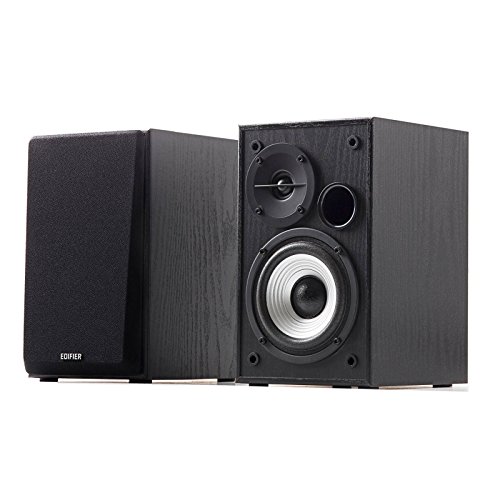
Edifier R980T 4 in Active Bookshelf Speakers, 24W RMS, Wood Enclosure
24W RMS4 in wooferWood enclosureRCA and 3.5 mm
Check price on Amazon
Best for: Desks and small rooms that want a simple powered pair.

The Edifier R980T is an active pair with 24W of RMS power, 4 inch woofers and 100 percent wooden enclosures, which the listing says reduce resonance. RCA and 3.5 mm cables are included, so it is ready to connect to a laptop, a TV or a phone. It is the simplest powered pair here.

The trade-off is output. At 24W RMS it suits a desk or a small room, not a large living room, and it has no tone controls. Compared with the MR4.5, it is smaller, cheaper and less powerful.

In practice, place the speakers on the desk at ear height, with the tweeter pointing at your head. Use the included cables and avoid pushing them to maximum volume. Pair the speakers with a matching stand or a sturdy shelf to avoid desk vibration.

What works

  • Wooden enclosures reduce resonance
  • Cables included for easy setup
  • Active design needs no amplifier
  • Compact size suits a desk

Watch out for

  • 24W RMS is limited for larger rooms
  • No tone controls
  • Less bass than larger monitors

Specs

Power
24W RMS total
Woofer
4 in
Enclosure
Wood
Inputs
RCA and 3.5 mm cables included
Type
Active pair
05
Audio Express KOE B102 100W Passive Bookshelf Speakers, Pair, Hi-Res Audio
100WPassive pairIndividually measuredHi-res
Check price on Amazon
Best for: Hobbyists who like measured data and own an amplifier.

The Audio Express KOE B102 is a passive bookshelf pair rated at 100W, and each speaker ships with its own measured sound-pressure and frequency response curve. That per-unit measurement is unusual at this price and gives a rough guide to quality control. The listing describes hi-res audio capability, which depends on your source and amplifier.

The trade-off is that the brand is less established, and the speakers still need an amplifier. Compared with the Klipsch pair, the KOE offers a measured curve but less heritage and fewer reviews to lean on.

In practice, treat it as an interesting option for a hobbyist with a small amplifier. Place it at ear height and give it breathing room from the wall. A measured curve is a nice touch, but your room will still change the sound more than a few decibels of tolerance.

What works

  • Each speaker ships with its own measured curve
  • Passive design lets you choose your amplifier
  • Hi-res capable design
  • Mid tier on the pricing ladder

Watch out for

  • Needs a separate amplifier
  • Less established brand
  • Limited bass without a sub

Specs

Power
100W
Type
Passive pair
QC
Each speaker ships with its own SPL and response curve
Audio
Hi-res capable
Needs
Amplifier
06
PyleUsa 6.5 in Wood Bookshelf Speakers, 200W Peak, Wall Mountable
6.5 in woofer50W RMS200W peakWall mountable
Check price on Amazon
Best for: Budget systems that want bigger woofers and wall mounting.

The PyleUsa is a passive 6.5 inch bookshelf pair with a 0.75 inch dome tweeter, 50W RMS and 200W peak power, in a classic wood finish with a sealed enclosure. The larger woofer gives more bass than the Klipsch R-41M, and the wall-mountable design suits a home theater. The RMS number is the honest one.

The trade-off is refinement. A budget passive pair usually has a less detailed top end and a looser cabinet than a Klipsch. Compared with the R-15M, the Pyle is cheaper and bigger but less polished.

In practice, pair it with a receiver and treat the wall mount as a way to free shelf space. Use it where price matters more than finesse. A wall mount keeps the speakers off the shelf, but check that the wall can hold them and that the cable can reach.

What works

  • 6.5 inch woofer gives more bass than small speakers
  • 50W RMS is an honest power rating
  • Wall mountable design saves shelf space
  • Classic wood finish

Watch out for

  • Less refined top end than Klipsch
  • Needs an amplifier
  • Peak power figure is marketing

Specs

Woofer
6.5 in
Tweeter
0.75 in dome
Power
50W RMS, 200W peak
Finish
Classic wood, sealed enclosure
Mount
Wall mountable

Spec decoder

What the listing measurements really mean

The numbers brands lead with, translated into what they tell you about fit, comfort and wear at home.

RMS power

RMS power is the continuous output a speaker or amplifier can deliver. It is a more honest figure than peak.

Watch forThe Edifier MR4.5 lists 80W RMS, and the Pyle lists 50W RMS. Always check whether a listing quotes RMS for the pair or for each speaker.

Bi-amped

Bi-amped means separate amplifiers for the woofer and tweeter. It lets each driver work within its range.

Watch forThe MR4.5 uses bi-amping. Bi-amping is common in studio monitors and rare in cheaper desktop speakers.

Tractrix horn

A Tractrix horn is a flared waveguide that increases efficiency and focuses sound. It makes speakers louder with less power.

Watch forThe Klipsch R-15M and R-41M use it. Horn designs can sound very lively at first, so give your ears a day to adjust.

Sensitivity

Sensitivity is the loudness a speaker produces at one watt and one metre, in dB. Higher means louder per watt.

Watch forFew budget listings give it clearly. Sensitivity is often missing from budget listings, so absence is itself a clue.

Impedance

Impedance is the electrical load, in ohms. Most home speakers are 8 ohms.

Watch forThe R-41M lists 8 ohms nominal, so check your amplifier's rating. A low impedance with a weak amplifier can overheat the amplifier.

Methodology

How We Evaluated These Bookshelf Speakers Under $200

Drivers and design

We evaluated driver sizes and enclosure design from the listings. The MR4.5's 4.5 inch bi-amped drivers and the Klipsch horn design stood out. We also checked cabinet material, since wooden enclosures reduce resonance.

Amplification

We compared passive and powered designs. Powered pairs scored higher for simplicity, and passive pairs for flexibility. We assumed most buyers own no amplifier, so powered pairs started with an advantage.

Specs honesty

We favoured listings that give RMS power and a frequency response with a tolerance. Peak figures were treated as marketing. We downgraded listings that give only peak figures.

Owner feedback patterns

We looked at recurring themes in owner feedback, such as bright tweeters and noise. We never count stars. These patterns shaped our cons. Bright highs and hum from cheap powered pairs were the recurring complaints.

Budget band

We favoured the upper band of the $200 cap and kept to one speaker that appears in our main bookshelf guide. Prices move, so check before buying. Satellite and ceiling speakers in the pool were excluded as off-topic.

Decision guide

How to Choose the Right Bookshelf Speakers Under $200

By Setup

SituationPickWhy
No amplifierEdifier MR4.5Powered pair
Own an amplifierKlipsch R-15MEfficient passive
Small deskEdifier R980TCompact active
Small shelfKlipsch R-41MCompact passive
Wall mountingPyle 6.5 inWall mountable

By Budget

TierPickWhat you get
LowerEdifier R980TSimple active pair
Lower-midPyle 6.5 inLarge passive pair
MidAudio Express KOE B102Measured passive pair
Upper-midKlipsch R-41MCompact horn pair
Top of capMR4.5 and R-15MPowered monitors or horn passive

Powered vs Passive

Powered (Edifier)

No amplifier needed and simple to connect. Less upgradeable and needs power at both speakers.

Passive (Klipsch, Pyle, KOE)

Flexible and upgradeable with a good amplifier. Needs an amplifier and wiring.

Choose powered if you want a simple setup and passive if you own or plan to buy an amplifier.

By Room Size

RoomPickWhy
DeskEdifier R980TSmall active
BedroomKlipsch R-41MCompact passive
Small living roomEdifier MR4.580W RMS
Medium living roomKlipsch R-15MEfficient passive
Home theaterPyle 6.5 inLarge woofer

For Music Specifically

Look for

Smooth midrange, a 4 to 6.5 inch woofer and good stands. Add a subwoofer for deeper bass.

In this comparison

The MR4.5 and R-15M suit music best.

When to Spend More

Spend more if

You want larger drivers, better cabinets and a deeper, smoother sound. Those cost more than this cap.

Save if

You want clearer sound than a TV or laptop gives. These pairs do that.

Ownership

Maintenance schedule

The upkeep that decides whether a piece still looks good in year five.

TaskIntervalWhy it matters
Dust the bafflesMonthlyDust builds up on drivers and dulls the sound. A soft brush works. Never use liquid cleaners on driver cones.
Check the wireEvery 6 monthsLoose wire causes crackling. Reseat and tighten. A fraying strand can cause intermittent noise or a short.
RepositionWhen furniture movesRoom changes affect the sound. Adjust the toe-in. Even a few inches can change the bass noticeably.
Check the standsEvery 6 monthsStands can wobble. Tighten the hardware. A felt pad or isolation foam can also reduce desk vibration.
Avoid clippingAlwaysPushing the volume to the maximum can damage drivers. Turn down if the sound distorts. Distortion is the sign to turn down, not up.

FAQ

Frequently Asked Questions

Do I need an amplifier?

For passive speakers, yes. Powered speakers have one built in. A powered pair avoids the cost of a receiver.

Are peak watts important?

No. RMS power and sensitivity tell more. They can be useful for comparing models but are not a guide to loudness.

Do I need a subwoofer?

Not strictly, but small speakers lack the deepest bass. A sub fills that gap. A subwoofer is also easy to add later.

How should I place them?

At ear height, 6 to 8 feet apart and toed in slightly. Rear ports prefer more space from the wall.

Do they need stands?

Stands put the tweeter at ear height. A solid shelf also works. Sturdy shelves can work if they are at ear height.

What does a $200 cap buy?

A decent pair of compact speakers. Premium cabinets and drivers cost more. Prices move, so check the cap before buying.

Bottom line

The short version

Browse more bookshelf speakers under $200on Amazon →
Elena Hart, Lead Home Editor

About the author

Elena Hart

Lead Home Editor, SweetLivingRoom

Elena Hart leads SweetLivingRoom's buying guides, turning product dimensions, material specs and owner feedback into clear verdicts on sofas, rugs, lighting, storage and decor.

More from Elena →

Keep reading

Related guides