Surround sound looks easy in the diagrams: a circle of speakers, a listener in the middle, everyone happy. A real living room has a sofa pushed against the back wall, a door on one side, a window on the other and a family who do not want cables across the carpet. The room, not the diagram, decides what you can do.
This guide gives you the target angles and heights for a 5.1 layout, the adjustments that make it work in a small or awkward room, the problem of the sofa against the back wall, wireless rear speakers and the options for renters who cannot drill. It also covers the speaker wire and the room acoustics, which affect the result as much as the position.
The 5.1 layout in numbers
A 5.1 system has five speakers and a subwoofer. The center speaker carries most of the dialogue and sits on the axis of the screen. The front left and right speakers carry music and effects across the front. Two surround speakers fill the sides and rear with ambience. The subwoofer, the .1, handles low bass. The standard reference layout places the listener at the center, with the front pair spread at 22 to 30 degrees to each side of the center line, which produces a wide front stage without a hole in the middle.
The surround speakers sit to the sides of the listener, at about 90 to 110 degrees from the front. They should be 2 to 3 feet above ear height when seated, which projects sound across the room and avoids a distinct spot of sound at one ear. All speakers should be aimed at the listening position, toed in slightly if they sit far apart.
| Speaker | Position | Height |
|---|---|---|
| Center | Directly below or above the screen, on the center line | Close to the screen, ideally within the seated ear height range |
| Front left and right | 22 to 30 degrees either side of the listener, in line with the TV edges | Tweeters at seated ear height, about 36 to 42 in |
| Surround left and right | 90 to 110 degrees at the sides, or slightly behind | 2 to 3 ft above seated ear height |
| Subwoofer | Front of the room, near a wall, found by trial | Floor |
Use the layout as a starting point. A symmetrical room allows nearly the full reference. A real room needs adjustments, and the receiver's setup microphone can help you finish the job by measuring distance, level and frequency response.
Front speakers and the center
The front three speakers do most of the work, so they matter most. Place the left and right speakers on either side of the TV, at the same distance from the center, with the tweeters at ear height, which for a seated person is 36 to 42 inches. If your speakers are on stands, set the stands level and equal. Floor-standing speakers can sit at the TV edges, and bookshelf speakers on stands or a console do the same job.
The center speaker should sit directly above or below the screen, as close as practical and on the center line. A center below the TV, on the console, is common, and if the TV is high, aim the speaker upward by a few degrees, or place it on a small wedge. A center above the screen is acceptable on a wall mount. The center should never be hidden behind a closed door or in a deep cabinet, because dialogue becomes muffled.
A soundbar can replace the three front speakers, and a bar with rear speakers is a simple way to get surround. If you start with a bar, the placement rules in the soundbar placement guide apply to the front, and the surrounds follow the same angles as below.
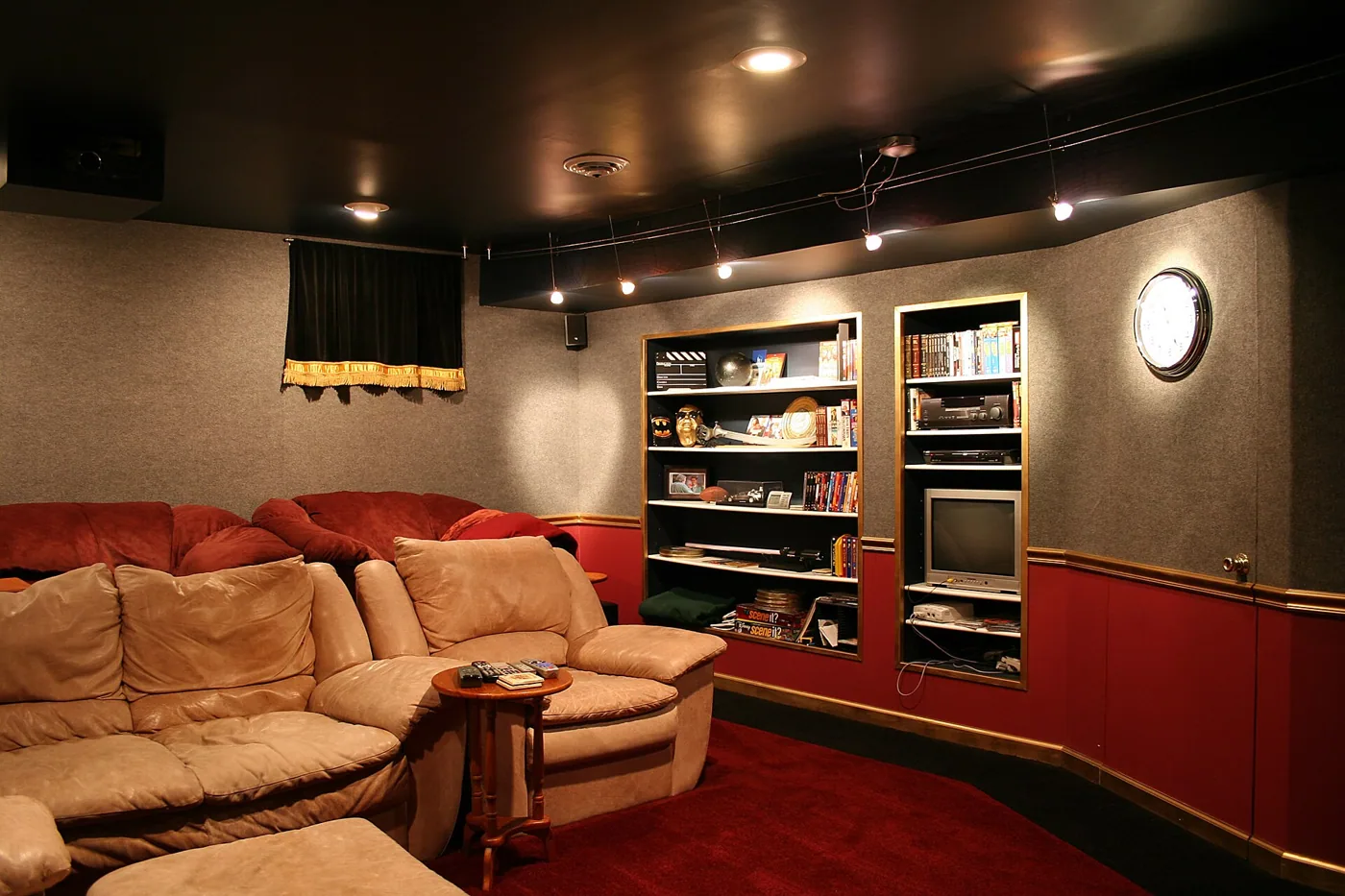
Surround speakers: height, angle and distance
Surround speakers add the sense of space, and they are the speakers most often placed badly. They are meant to blend into the room, not to call attention to themselves, so they sit slightly above ear height and to the sides. Place them on side walls, at 2 to 3 feet above the seated head, or on stands beside the sofa. Use the receiver's distance and level calibration so that the sound from each speaker arrives at the right time.
Dipole or bipolar speakers, which radiate sound forward and backward, create a diffuse sound and suit side walls. Direct-radiating speakers, which fire like a normal speaker, work in the rear. Many modern home theater packages use identical speakers all around, and that is fine in a small room. If you have a choice, a surround speaker that is smaller than the front speakers is not a problem, since the receiver can set a crossover to the sub.
In a room with a high ceiling or beams, avoid placing the surrounds at the ceiling, since the sound disperses. In a room with a low ceiling, avoid placing them directly overhead, since it feels harsh. Where height speakers are part of a Dolby Atmos setup, additional placement rules apply, with upward-firing modules on top of the fronts or ceiling speakers above the seat.
When the sofa is against the back wall
This is the most common problem. The ideal layout puts the listener a few feet from the back wall, with the surrounds beside them. If the sofa is against the wall, the surrounds would sit right behind the listeners, which draws attention and overpowers the front. There are three practical ways to handle it.
- Side-wall placement: mount the surrounds on the side walls, level with or slightly behind the seating, at 2 to 3 feet above ear height. The sound reaches the listener from the side and the wall reflects some of it.
- Rear-wall placement above the sofa: mount small speakers on the rear wall at least 3 feet above the head, angled slightly downward and set to a lower level. This works with a sofa against the wall but gives less side envelopment.
- Move the sofa forward: even 2 to 3 feet from the wall lets the surrounds sit beside the sofa on stands. A sofa table behind it can serve as a shelf for small speakers.
The speaker's level should be lowered if it sits close to a listener's ear. Use the receiver's test tone to balance the levels, and listen to a familiar film scene to check the result. Avoid mounting a speaker directly behind the head, since small movements of the head change what you hear.
Wireless rear speakers
Wireless rear speakers remove the longest cable run, which is the one from the front of the room to the back. They still need power, so a cord goes to a wall outlet, but they avoid the long audio wire that must cross a doorway or a rug. Many soundbar systems offer wireless surrounds as an option, and some receivers support wireless speakers via a dedicated transmitter.
Wireless is not perfect. Each speaker needs mains power, so the position depends on outlet locations, and a battery-powered model needs regular charging. The latency is usually small enough not to be noticed with film, but some systems have a slight delay with fast action. Compression can reduce quality compared with a wire, but for the surround channels that carry ambience, it is rarely audible. If you go wireless, plan where the power cord will run and use cord covers, a point covered in how to hide TV wires.
Cables, routing and rental options
Speaker wire for a rear speaker typically runs 15 to 30 feet, and a 16 gauge wire is adequate for most home runs, with 14 gauge for runs over 40 feet. Run it along the baseboard under a cord cover, through a gap under a door or beneath a carpet edge with a flat cable. A flat speaker cable under a rug is invisible, but check that it does not run through a high-traffic spot where it will wear. Never run it across a doorway without protection, since it is a trip hazard.
Renters can use stand-mounted speakers that need no drilling, adhesive cable channels that peel off cleanly and wireless rears. Mount speakers on stands or on a bookshelf behind the sofa, and use removable hooks for small lightweight satellites if the rental allows. The point is to avoid permanent changes while getting the speakers in the right place.
Height speakers and Dolby Atmos
Object-based formats such as Dolby Atmos add speakers above the listener, so sound can move overhead. A common home layout is 5.1.2 or 5.1.4, with two or four height channels. Height speakers can be in-ceiling, mounted high on the walls, or upward-firing modules that sit on top of the front speakers and bounce sound off the ceiling. Ceiling speakers sit about 2 to 4 feet to either side of the seat and slightly forward, while the upward-firing type needs a flat, reflective ceiling of around 8 to 10 feet to work.
The honest advice is that height channels are a refinement and not a first step. A well-placed 5.1 system in a good room beats a poorly placed 5.1.4 every time. Get the fronts, center and surrounds right before you add the ceiling. If your living room has a low or sloped ceiling, a heavily textured ceiling or exposed beams, an upward-firing module will give little, and in-ceiling speakers may be impossible in a rental. Skip them in that case, and spend the money on better front speakers or a larger sub.
Speaker size, crossovers and the subwoofer link
You do not need matching speakers all around, but the front three should be of the same family, so that sound moves smoothly across the screen. Surround speakers can be smaller, as they carry ambience and a modest range of frequencies. The receiver's bass management sets a crossover frequency, commonly 80 hertz, below which bass is sent to the subwoofer. Small speakers should be set to small, and the sub takes over below the crossover. Large floor-standing speakers can run full range, though many owners still send the bass to the sub for a cleaner result.
Speaker placement also depends on size. A large floor-standing speaker needs 1 to 2 feet from the wall behind to avoid boom, while a small bookshelf speaker can sit closer. In a small living room, compact speakers and a good subwoofer give better results than big towers that dominate the space and excite the room's bass modes. Placement of the sub is covered in the soundbar placement guide, and the same trial method applies.
Open rooms, furniture and what gets in the way
In an open-plan living room the sound escapes into the kitchen or the hall, and the surrounds lose their effect. Keep the listening distance short and the surround speakers close to the seat, and consider placing them on the side of the sofa, where they can be nearer to the listener than to the open space. Furniture matters too. A large armchair between a speaker and the listener blocks high frequencies, a bookcase that rattles at certain bass notes can add noise, and a glass coffee table can reflect sound toward the ears.
A last check is the walkway. A speaker stand placed in a path will be knocked over, and a cord across a doorway will trip someone. Mark each position with tape, live with the layout for a week and move anything that gets in the way before you fix a wall bracket or drill a hole.
Room acoustics and the final tweak
A room full of hard surfaces, such as bare floors, large windows and flat walls, reflects sound and blurs dialogue. Soft furnishings help. A rug, curtains and a bookcase of uneven items scatter and absorb reflections, the same techniques covered in how to reduce echo in a living room. Even a modest improvement makes the speakers sound better than moving them by a foot.
When the layout is in place, run the receiver's auto-calibration. It uses a microphone placed at the listening position to set distance, level and an equalization curve. Place the microphone at ear height on a tripod or a stack of books, run the calibration in a quiet room and then adjust by ear. Check the sub level with a bass-heavy scene, and the center level with dialogue.
Frequently asked questions
How far from the wall should surround speakers be?
Wall-mounted surrounds sit right on the wall at 2 to 3 feet above ear height. Stand-mounted speakers do best a few inches from the wall to avoid boomy bass.
Do I need rear speakers for surround sound?
For true 5.1, yes, but a soundbar with virtual surround can give some effect without them. Real rear speakers give a clearer sense of space and are worth adding if the room allows.
Can I place surround speakers on the floor?
You can, but the sound is less natural. Place them on stands or on a shelf, at 2 to 3 feet above ear height if possible. If you must use the floor, aim them upward.
What is the best place for the subwoofer?
Near the front of the room, along a wall or in a corner, and chosen by trial. Try the crawl test: put it at your seat, play bass, and find the spot where it sounds best.
How do I hide speaker wires in a rental?
Use adhesive cord covers, run flat wire under a rug edge and consider wireless rear speakers. Plan the route to avoid doorways.
Bottom line
Aim for the reference layout and then bend it to the room. Put the center on the screen axis, the fronts at 22 to 30 degrees at ear height and the surrounds at the sides, above ear height. Handle the sofa against the wall with side-wall speakers or a move forward.
Run the auto-calibration, check by ear and improve the room with soft furnishings. Surround sound works in an ordinary living room when the speakers are in sensible places and the cables are out of the way.