A sleeper sofa promises two pieces of furniture in the space of one, and it delivers the promise unevenly. Many are good sofas and poor beds, or the reverse. The cause is usually the mechanism: the folding frame that turns a seat into a bed also decides the thickness of the mattress, the position of the bars under a sleeper's back, the floor space needed to open it and how long it lasts under repeated use.
This guide explains the main mechanisms, with the tradeoffs each one makes, and gives measurements to check before you buy. It is written for a household that wants a guest bed in a living room or a study, and it treats the sofa and the bed as equal jobs, since a sleeper sofa that fails at either is a poor purchase.
The pull-out sleeper
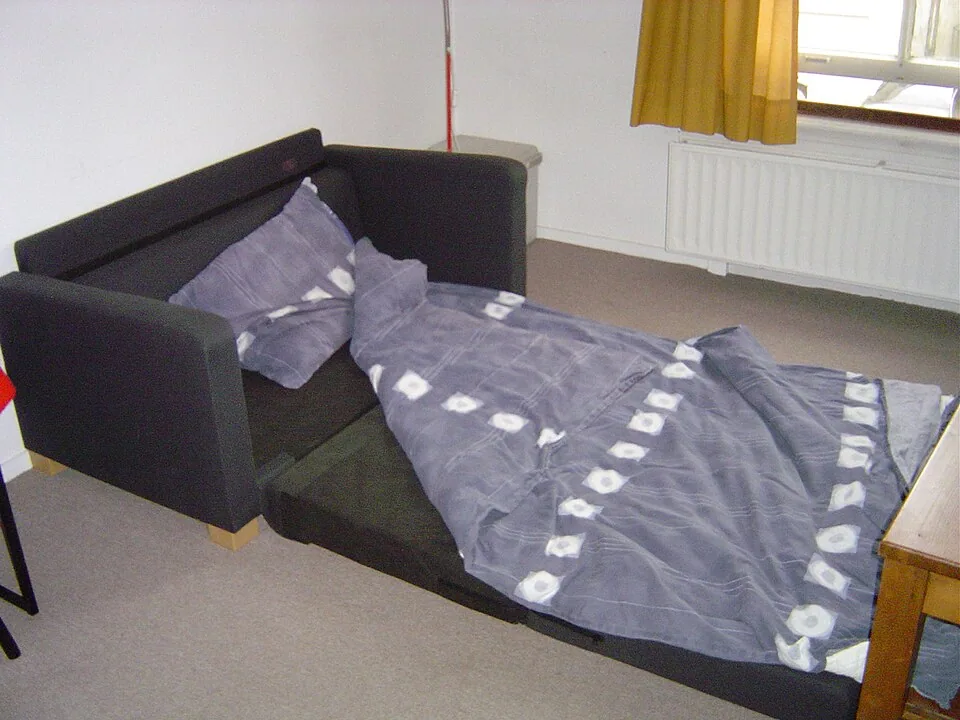
The classic mechanism, sometimes called a fold-out or a trifold, hides a folded mattress and a metal frame inside the sofa body. Lift the seat cushions, pull on a handle and the frame unfolds forward and downward, forming a bed typically 54 to 60 inches wide for a full and 60 inches for a queen. The mattress is folded in thirds, so it is thin, usually 4 to 5 inches, to fit inside the sofa.
The benefits are a flat, bed-sized surface and a sofa that looks and sits like a normal sofa when closed. The tradeoffs are weight, price and the bar. The metal frame with its cross-bars is heavy, so pull-outs weigh 150 to 250 pounds, and the mattress rests on a grid of springs or mesh with a support bar under the hinge, which many sleepers feel in the middle of the back. Better models have a thicker mattress, memory foam or a hinged frame that spreads the load, and a listing that gives a mattress thickness of 5 inches or more is a good sign.
Click-clack and bi-fold mechanisms
A click-clack sofa has a back that clicks into three positions: upright for sitting, partly reclined for lounging and fully flat for sleeping. The seat and back cushions form the bed surface directly, with no hidden mattress. The name comes from the sound of the mechanism as it locks into each position.
The strengths are simplicity, low cost and a small footprint, because the bed uses the same floor area as the sofa with a little extra length behind. A typical click-clack sofa measures 72 to 80 inches long, and flattened, it forms a bed about 36 to 48 inches wide, so it suits one person or a child. The weaknesses are a surface that is narrower than a standard bed and a seam where the seat and back meet, which can be felt through a thin cushion. They are practical for occasional use and for a small room, and they suit a guest who stays one or two nights.
Futons
A modern futon is a version of the bi-fold: a frame with a wood or metal base that folds from a sofa to a bed, with a separate mattress that sits on the frame. The mattress is typically 6 to 8 inches thick, which is far more than a pull-out, and it can be cotton, foam or a combination. It suits a household that wants a more bed-like surface in a small footprint.
The mattress is both the strength and the weakness. A thick futon mattress makes a comfortable bed, but it is bulky, heavy and stiff to fold, and as a sofa it can feel lumpy and low. The frame needs to be sturdy, especially at the hinge, because the mattress rests on slats and the fold puts stress on the joints. If you plan to use it as a daily sofa, check that the frame has a solid back and arms, and that the mattress does not shift when you sit.
Daybeds and trundles
A daybed is a bed frame styled as a sofa, with a back and arms on three sides. A trundle is a second mattress on wheels that slides out from beneath, so one piece can become two beds. A daybed with a trundle suits a spare room or a study that doubles as a guest room.
The sleeping surface is a normal twin mattress, which is the best option for comfort, since you can choose its firmness and replace it. The downsides are space and seating. A daybed has no real seat depth, as it is only 30 to 40 inches deep and has a bed-height seat of 20 to 24 inches. It also needs clearance on the open side to pull out the trundle, which is another 38 inches or so. For a living room that needs a proper sofa, it is a poor fit, and for a spare room it is excellent.
| Mechanism | Bed size | Mattress thickness | Floor space to open | Best for |
|---|---|---|---|---|
| Pull-out | Full or queen | 4 to 5 inches | About 80 inches in front | Occasional adults |
| Click-clack | Narrow, 36 to 48 inches | Cushion thickness | Small gap behind | One night, a child |
| Futon | Full or queen | 6 to 8 inches | About 20 inches behind | Dual-use small rooms |
| Daybed with trundle | Twin, two beds | Standard twin mattress | About 38 inches to one side | Spare rooms |
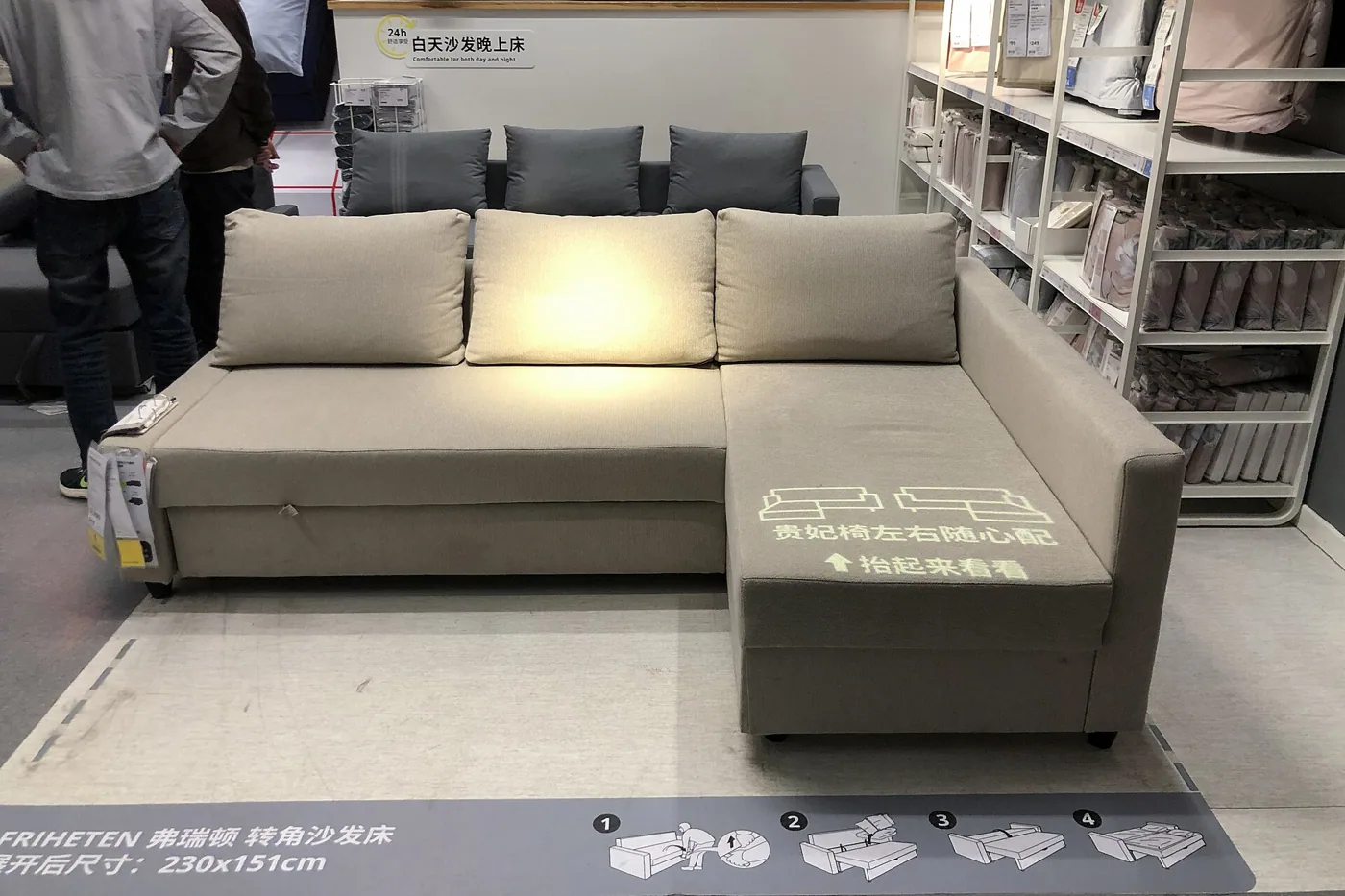
| Corner sleeper with chaise | Twin to full | Pad, 4 to 5 inches | About 60 inches along the chaise | Sectionals |
The clearance in front, and why it matters
A pull-out sleeper needs the length of the bed in front of the sofa when open. A queen mattress is about 80 inches long, so the open sofa needs 80 inches of free floor from the back of the sofa, which is about 40 inches beyond its own depth. If a coffee table or a rug sits in that space, you must move it each time, and in a room that is less than about 11 feet deep, the bed may not open at all.
Measure the space with the bed open, not the sofa closed. The open bed should leave at least 24 inches to walk around it, and the door of the room should not be blocked. A room that works for a sofa may not work for the bed, which is why many owners end up never opening the sleeper. If the room is small, a click-clack or a chaise sleeper, which opens along its own length, is a better solution. Our small-room sofa guide covers the footprint numbers.
The bar in the back and other comfort issues
The most common complaint about pull-out sleepers is the bar that sits under the sleeper's back or hips. It is the crossbar that carries the weight of the folded section, and on a thin mattress it is easy to feel. Better models place the bar near the edge of the mattress, use a thicker pad that cushions it, or avoid it with a different hinge design.
Other comfort issues come from the mattress material. A traditional innerspring pad is cheap and bouncy but thin and prone to sag. A memory foam or a gel foam mattress is more comfortable and also heavier, which makes the mechanism harder to move. An air mattress version is light and adjustable, but it may leak and needs a pump. If a guest will sleep there more than a few nights, a better approach is a mattress topper of 2 to 3 inches, kept in a closet, which transforms a thin pad into something tolerable.
Frames, hinges and what fails
The mechanism takes more stress than any other part of a sofa, because it carries the full weight of a sleeper while folding and unfolding. The parts that fail are the hinges, the springs that counterbalance the weight and the mesh or slats that support the mattress. A steel frame with welded joints and heavy gauge tubing lasts longer than one with stamped parts and thin rivets.
Opening and closing it should be smooth, with moderate effort and no catching. A mechanism that needs a hard pull or sticks at one point is wearing. Look for a statement of weight capacity: a pull-out for two adults should list 450 pounds or more. The seat frame also matters, as we explain in our guide to sofa frame materials, since a sleeper's wooden or metal frame must carry both roles.
How a sleeper sits as a sofa
A sleeper sofa must work as a sofa for the other 360 nights a year. Because it holds a mattress and a frame, its seat cushion is often thinner and firmer, and the sofa is deeper and heavier than a standard one. Check that the seat depth is in a comfortable range, as explained in our guide to seat depth, and that the cushions are of a decent density, as in our guide to cushion fill.
Sit on it and listen for the frame under your weight. A mechanism that creaks when you lean back is a sign that the sleeper will rattle. Check the height of the seat, which is often an inch or two higher than normal because of the frame, and the width of the arms, which are often wide to hide the mechanism. Most of all, avoid a sleeper that you would not choose as a sofa, because you will use it as one most of the time.
Bedding, storage and the daily routine
A sleeper sofa only works as a bed if the bedding has a home. Fitted sheets for a thin mattress, a pillow set and a blanket need a closet nearby, since the sofa itself cannot hold them when it is closed. Some models have a storage drawer under the seat, and a chaise sleeper often has a compartment in the chaise, which is a real advantage in a flat with limited storage.
Set up the bed the way you would for an overnight guest: a mattress protector to keep the pad clean, fitted sheets cut for a 4 to 5 inch mattress, and a topper if you have one. Folding the sofa back requires the bedding to be removed, or tucked in flat, because a bunched sheet jams the mechanism. A routine of opening the bed once or twice a year, even without a guest, keeps the hinges moving and lets you spot a failing part before a guest arrives.
Delivery, weight and moving
A pull-out sleeper is one of the heaviest sofas of its size, and delivery needs planning. At 150 to 250 pounds, it needs two strong people and a clear route, and the folding frame cannot be separated from the body. Standing it on its end can bend the mechanism, so ask the delivery team to carry it flat or tilted, as we describe in our guide to fitting a sofa through the door.
Moving house is the same story. A futon or a click-clack is much lighter and often comes apart, and a daybed disassembles into rails and slats. If you expect to move within a few years, the weight of a pull-out is a real cost, and a lighter mechanism is worth thinking about.
One more consideration is stairs: a sleeper that cannot be turned on its end may not fit a narrow stairwell at all, so confirm the route before ordering, and check whether the seller offers delivery to the room.
Frequently asked questions
How much space does a sleeper sofa need to open?
A pull-out queen needs about 80 inches from the back of the sofa to the front when open, so roughly 40 inches in front of the closed sofa. A click-clack needs very little, and a daybed trundle needs about 38 inches on the open side. Measure with the bed open, not closed.
Are sleeper sofas comfortable for a long stay?
Most are fine for a night or two and less so for a week. A thicker mattress, a topper and a model without a bar under the back make a long stay more comfortable. For regular use, a futon, a daybed or a proper guest bed is a better choice.
What size sleeper sofa fits a small apartment?
A loveseat sleeper of 58 to 66 inches, a click-clack of 72 to 78 inches or a chaise sleeper suits a small room. Check the open dimensions, because a loveseat pull-out is often a twin or a narrow full.
What if my situation is different, such as a regular guest who is tall?
Look at the length of the open bed: a standard full is 75 inches and a queen 80. A guest over 6 feet tall needs a queen or a daybed with a twin mattress of 75 inches, and a click-clack of 72 inches will leave their feet hanging.
Can I replace a sleeper sofa mattress?
Often yes, if you know the dimensions, since sleeper mattresses are made in standard thin sizes. Measure the existing one, including thickness, and order a replacement of the same size, and consider a memory foam model for comfort.
Bottom line
Decide how often the bed will be used and by whom. For occasional adults, a pull-out with a mattress of 5 inches or more is the standard solution, if the room can take 80 inches. For a child or a single night, a click-clack saves space. For a study or a spare room, a daybed with a trundle gives the best sleeping surface.
Whichever you choose, treat it as a sofa first, and check the clearance and the weight capacity. For how we weigh multi-purpose furniture in our picks, see how we evaluate our products.