A delivery crew arrives, tilts the sofa at the front door, and it stops with two inches to spare on every side but one. That corner, a stubborn point where the arm meets the back, is the spot where most failed deliveries end. The sofa was narrow enough, and the door was wide enough, but a flat comparison of width against width misses the way a bulky object actually travels through a gap.
The question is not whether the sofa is narrower than the door. It is whether some orientation of the sofa has a cross-section that passes through the opening, and whether the sofa can reach that orientation at every turn on the way. This guide walks through the geometry in plain terms, the practical tricks that gain a few inches, and what to buy when none of it works.
How a sofa passes through an opening
A doorway is a rectangle, and a sofa is a three-dimensional box with a long length, a moderate depth and a height. To pass through, the sofa must present its two shortest dimensions to the opening and push through along its length. A 84 inch long, 38 inch deep and 34 inch high sofa has a smallest cross-section of 38 by 34 inches. For the sofa to fit through a standard 32 inch clear door, that cross-section has to rotate until its diagonal is smaller than the opening.
The diagonal of a rectangle is longer than either side. A 38 by 34 inch cross-section has a diagonal of about 51 inches, which sounds like a problem, but the relevant figure is how the sofa tilts as it enters. If you hold the sofa so its tall dimension sits along the door's height, the door only needs to be wide enough for the depth. A door that is 32 inches wide and 80 inches tall will take a sofa 34 inches high, standing on its end, because the sofa's 38 inch depth fits within the 80 inch height of the door.
In other words, standing the sofa on its end changes the question. The sofa does not need a wide door, it needs a door that is wide enough for its smallest dimension, usually height or depth, and tall enough for the other one, which an 80 inch door usually is. That is why the on-its-side rule works so often.
Measuring the doorway correctly
Measure the clear opening, not the frame. Open the door to 90 degrees and measure from the face of the door stop on the hinge side to the edge of the door itself on the other, or the edge of the stop on the latch side if that is narrower. A door opened to 90 degrees leaves 1.5 to 2 inches of the slab inside the opening, so a nominal 32 inch door often has a clear opening closer to 30 inches.
Measure the height too. A standard interior door is 80 inches, but older homes and apartments can have 78 inches or less, and a header or a bulkhead can reduce it. Check any door viewer, hardware or weatherstripping that sticks out and could catch.
Then measure every other gate on the route: the building entrance, an elevator, a corridor, each stairwell turn and the final doorway into the room. The narrowest point sets the limit for the whole route. People often measure the front door of a house and forget the 28 inch bedroom-corridor door or the cramped bend in a stair, and the sofa gets stuck at the later gate with no way out.
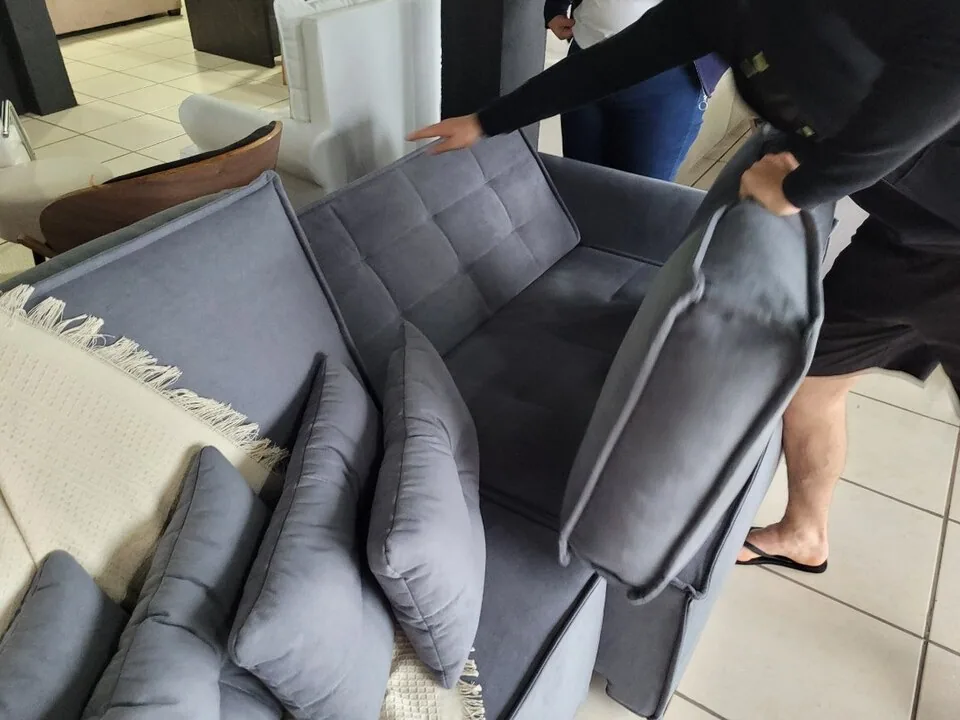
Measuring the sofa for the route
Listings give width, depth and height, but you need three more numbers. The first is the diagonal depth, from the front top corner to the rear bottom corner, which shows how much the sofa needs when tilted. The second is the height at the arm, because arms often stand taller than the back cushions on traditional frames. The third is the back-to-seat diagonal, which governs how the sofa passes sideways.
If the listing does not provide these, measure a similar sofa or compute the diagonal from width and depth using a calculator. The diagonal is the square root of depth squared plus height squared. A 38 inch depth with a 34 inch height gives about 51 inches. A 40 inch depth with a 36 inch height gives about 54 inches. Both are well beyond a 30 inch door, and neither will pass flat, which is why the sofa goes on its end.
| Route constraint | Measure | Compare against | Typical fix |
|---|---|---|---|
| Doorway | Clear width at 90 degree open | Smallest sofa dimension | Remove door, tilt on end |
| Hallway corner | Width on both legs of the turn | Sofa length and depth together | Legs off, back off, modular |
| Stair turn | Diagonal clearance at landing | Sofa length on tilt | Lower profile, different route |
| Elevator | Door width, car depth and height | Sofa length on end | Stand it on its end |
| Balcony hoist | Balcony door width | Smallest dimension | Crane or window removal |
Tricks that gain inches
Removing the door from its hinges recovers the thickness of the slab and the hinge knuckles, typically 1.5 to 2 inches, with a screwdriver and a few minutes. For a front door with a storm door or a screen, remove both. Take off any hardware that protrudes, such as a deadbolt strike or a doorstop, since these snag on corners and fabric.
Removing the legs on a sofa gains 4 to 6 inches of height, which is enough to turn a failed delivery into a successful one. Many legs unscrew with a twist, and some are attached with a hanger bolt. Check the listing or the underside for a threaded post before relying on this. Similarly, some sofas have removable backs, held with brackets, and some have removable arms. These details are not in the headline dimensions, and they matter.
Protect the sofa and the route. Wrap the sofa in a moving blanket or stretch wrap, and put corner guards on the door frame. A sofa that is forced through a tight gap will tear fabric and scar the frame, and any damage that occurs after delivery is usually not covered by the seller.
Stairs, turns and the rule of the long diagonal
Turns are the harder case. On a landing, the sofa must rotate through 90 degrees while its length swings across the corner. The longest straight object that can make a turn depends on both corridor widths and the angle, and a rule of thumb is that a corridor of 36 inches turning into another of 36 inches will pass a sofa about 80 inches long if it is also under 36 inches high on its end. Longer sofas need a wider corridor or tilt at a different angle.
The best way to check is to measure the diagonal at the turn and compare it with the sofa diagonal, as we describe in our guide to measuring a living room for a sofa. When the numbers are within an inch, assume it will not pass, because frames flex less than people hope.
Stairs also change the geometry because the ceiling above a staircase slopes with the steps. A sofa tilted to climb has to clear the ceiling at its leading end, which means its length is limited by the headroom at the turn. If the landing has a low soffit or a beam, the sofa's tilted length is what matters, and the solution is often to lift it over a balcony, or to choose a sofa that comes apart.
Modular and knock-down frames as the escape hatch
When the route is truly tight, the answer is to buy a sofa that travels in pieces. Modular sofas consist of separate seat, corner and arm modules, each of which passes through a door on its own. Knock-down frames ship flat and assemble with bolts. Both are designed to solve the delivery problem, and they also solve the problem of future moves.
The tradeoff is the strength of the connections and the number of gaps between modules. A well-made modular sofa with metal connector plates holds together for years, while a cheap one drifts apart and leaves gaps between cushions. Check that modules lock to each other and are not simply stacked. If you are weighing a sectional against a sofa, our comparison of the two covers the layout side of the choice, and the sectional roundup lists compact frames.
A paper test before you buy
Cut a sheet of cardboard or tape a rectangle onto the floor matching the sofa's smallest cross-section, for example 38 by 34 inches. Carry it, or push it, along the actual route, turning it as you would turn the sofa. Cardboard is crude, but it reveals the pinch points that a tape measure hides: the light switch at hip height, the radiator that juts out of the hallway wall, the banister that curves into the stairwell.
The test is especially useful for corners. A rectangle that passes a doorway can still stall when it meets a perpendicular wall two feet beyond the frame. Walking the cardboard through also tells you how many people you need. A route with three turns and a staircase calls for at least two strong helpers, and a delivery team of two is the practical minimum for anything over 80 inches long.
Take a photo of every tight spot with a tape measure held across it. If the delivery firm asks for dimensions or if you need to dispute a failed delivery, those photos are better evidence than your description. Keep them alongside the order number and the listing dimensions.
What the seller's delivery policy really means
Phrases on a listing are not equivalent. "Curbside delivery" means the sofa is left at the street, and you carry it. "Threshold" means it is brought to the front door. "Room of choice" means the crew carries it to the room, but usually will not disassemble anything and will refuse a route they judge unsafe. "White glove" means assembly and debris removal, and often a promise to try tricks such as removing a door.
What most policies share is a clause that the buyer is responsible for confirming that the item will fit. If the sofa does not fit, you may pay return shipping, a restocking fee, or both, and some sellers will not accept a return on an item that has been unwrapped. For a large sofa, the return cost can run to a meaningful part of the purchase, which is why a ten-minute check is worth more than any discount.
Other routes: windows, balconies and crane lifts
If the stairs and doors fail, a window or balcony is the last resort. A window with a removable sash, 36 inches or wider, can pass a sofa on its end, and some delivery firms can hoist it with a lift or crane. This is expensive and often needs building management approval, which is a good reason to settle the question before buying rather than after.
Ask the seller about delivery policy before you order. Many sellers will deliver only to the curb or the first dry area, and a few will walk it to the room but refuse to remove doors or take apart the sofa. If the delivery is "threshold only", the carry is on you, and any damage during the carry is yours. Take photos of the route and the sofa when it arrives, and read the return rules for damaged or undeliverable items.
Frequently asked questions
How wide does a door need to be for a standard sofa?
A clear opening of 30 inches will usually pass a standard three-seat sofa on its end, provided the sofa's smallest dimension is under about 34 inches and the ceiling height allows the tilt. A 28 inch opening is tight and often needs the legs off, and anything under 26 inches calls for a modular frame.
Is it cheaper to take the door off or the legs off?
Both are free if you do them yourself. The door off gains about 1.5 inches in width, while the legs off gain 4 to 6 inches in height, which makes the legs the bigger gain when height is the limit. Do whichever matches the limiting dimension, or both.
Should I measure the sofa myself on delivery day?
Measure at least the diagonals before delivery, because a crew arriving and failing costs you a restocking fee and a delay. If the sofa is stuck on the day, stop forcing it, since pushing a wedged frame can crack the rails. Back it out and look for the cause of the jam.
What if my situation is different, such as a spiral staircase?
A spiral staircase usually rules out any one-piece sofa over about 70 inches. Look for modular or knock-down options, or consider a hoist through a window or balcony. Ask a professional mover for an on-site check, because a visit costs far less than a failed delivery.
Will a sofa fit if it is just under the limit?
Treat anything within an inch as a failure. Upholstery compresses a little, but frames do not, and trim and hardware in the doorway add friction. Aim for at least 2 inches of clearance on every constraint on the route.
Bottom line
Measure the clear opening at every gate on the route, compare each one with the sofa's smallest dimension and its diagonal, and plan to carry it on its end. Take off the door, the legs and any removable back or arms before the crew arrives, and clear the route of furniture and rugs. If the numbers are tight at any point, choose a modular or knock-down sofa instead of hoping.
The best time to fix a delivery problem is before you order. Check the sofa's diagonal, ask the seller about its delivery policy, and use a floor plan from our measuring guide to confirm it fits the room as well as the door. For how we weigh delivery and frame practicalities in our picks, see how we evaluate.