Amazon affiliate links - we earn a commission.Affiliate disclosure
Guide·12 min read

Gallery Wall Layout Guide: Spacing, Templates and Hardware

Plan a gallery wall with 2 to 3 inch spacing, a center near 57 inches, paper templates, grid or salon layouts and the right hanging hardware for each weight.

By Elena Hart · Updated 2026-11-20

Quick answer

Keep 2 to 3 inches between frames, treat the whole group as one shape with its center near 57 inches from the floor, and size the group to about two thirds of the furniture below. Plan on the floor first, then make paper templates and tape them to the wall before any nail goes in. Choose a grid for a formal, uniform look and a salon layout for a collected one, and match the hardware to each frame's weight, using two hooks for anything wide or heavy.

A gallery wall is the decorating project that people start with enthusiasm and finish with a wall full of extra nail holes. The usual reason is that they hung the first picture in the middle, then added the others around it, and ended with a group that drifts to one side. A gallery wall that works looks planned, even when it is meant to look casual, and the plan is made on the floor, not on the wall.

This guide gives the numbers and the sequence: how far apart to place frames, how high to center the group, how big the group should be, how to plan with paper templates, how to choose between a grid and a salon layout and which hanging hardware suits which weight. It also explains how to build a gallery wall slowly over time without losing the pattern.

Spacing between frames

The gap between frames is the most visible number in a gallery wall. The standard is 2 to 3 inches. At that distance the frames read as one group, and the eye sees the wall as a single composition. A gap of 1 inch looks tight and crowded, which can be good for a dense salon wall but is hard to hang accurately. A gap of 4 inches or more starts to look scattered, and the frames lose their relationship.

Choose one gap and use it consistently. Consistency matters more than the exact number: a 2.5 inch gap everywhere looks more organized than a mix of 2 and 4. Use a spacer, such as a piece of cardboard cut to the gap, when you measure from one frame to the next. For a very large group of frames, a slightly wider gap of 3 inches looks more comfortable, and for a small group of three or four frames, 2 inches looks right.

For frames of different sizes, measure the gap from the frame edges, not from the picture inside. A thick frame or a wide mat can make the gap look larger than it is. Align at least one edge in each row or column, either the top, the bottom or the center, so the group has a structure that the eye can follow.

ElementRecommendedNote
Gap between frames2 to 3 inUse the same gap throughout
Center of the groupAbout 57 in from the floorLower if the ceiling is low or the group sits over a sofa
Group width over furnitureTwo thirds to three quarters of the furnitureMeasure the whole group, not one frame
Gap above the sofa6 to 10 inMeasured from the bottom frame to the sofa back

Height and overall size

The same logic as for single pictures applies to the group, as set out in how high to hang art above a sofa. Treat the whole gallery as one big piece of art. Its center should be near 57 inches from the floor, which is average eye height, and its bottom edge should sit 6 to 10 inches above a sofa or a console. For a group over a sofa, the width should be two thirds to three quarters of the sofa.

The shape of the group matters as well. A rectangle or a square is the easiest to manage, and a group that is wider than tall suits a wall above a sofa. A tall, narrow group suits a stairwell or a narrow wall between windows. An irregular shape, such as one that follows a staircase, requires a template to get right. If the wall is large, a bigger group looks better than a small group in the middle, because a small group on a large wall looks lost.

Count the frames. A group of 5 to 9 frames fills a typical sofa wall. Fewer than 5 looks like a few pictures on a wall, not a gallery, and more than 12 needs a very large wall. Odd numbers and a mix of sizes look natural, and the group should include at least one large frame, which anchors the layout, with medium and small ones around it.
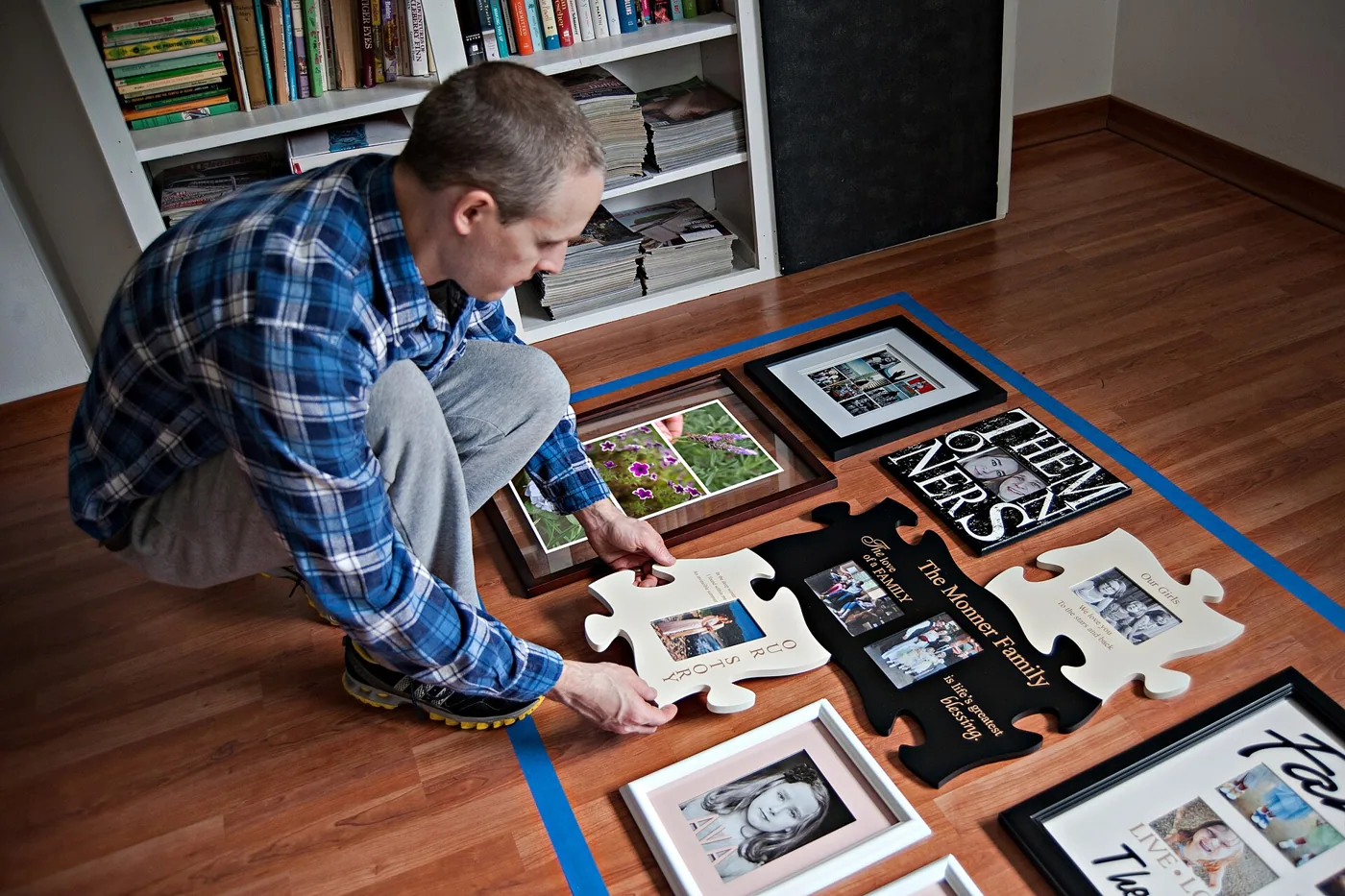
Photo frames laid out on a floor beside a tape measure to plan a wall arrangement
Laying the frames on the floor with a tape measure lets you adjust spacing and balance before any nail goes into the wall.

Plan on the floor, then on the wall with paper

The reliable method has three steps. First, lay the frames on the floor, in the shape you want, and move them until the layout looks balanced. Use a floor of similar size to the wall, or mark the wall dimensions with tape on the floor. Take a photo so you can return to the arrangement. Second, trace each frame on kraft paper or newspaper, cut out the shapes and mark where the hanging point is on each one. Third, tape the paper templates to the wall, in the same layout, using painter's tape, and adjust them until the arrangement looks right from across the room.

The templates let you move and stand back, look at the result in the room's light and see how it relates to the furniture. They also let you mark the nail position directly through the paper, so you hammer the nail in the right place the first time. For each template, measure from the top of the frame to the hanging point, which is the wire at its peak or the D-ring or the sawtooth hanger, and mark that distance below the top of the template.

Start the actual hanging with the anchor frame, the largest or the one at the center, and work outward. Hang the second frame using a spacer for the gap, and use a level for each. Check the layout every few frames from a distance. If one frame looks off, move it before you drive the nail, and remove the template after the frame is up.

Grid or salon: two kinds of layout

The grid is the formal option. All frames are the same size, or in a few repeating sizes, hung in rows and columns with a constant gap. It looks calm and modern, and it works well for a set of prints, photographs or botanical drawings in matching frames. The grid is easy to plan, since it is a pattern, and it is the best layout for a wall that you want to look neat. The weakness is that it shows every misalignment, so it demands accurate measuring.

The salon layout, named for the crowded displays of nineteenth-century art exhibitions, mixes frame sizes, shapes and finishes in an irregular but balanced arrangement. It looks collected and personal, and it suits a mix of paintings, photos and objects. It is more forgiving of small errors, but harder to design, since there are no repeating units. The key is to keep the outer edge of the group roughly a rectangle or a clear shape, and to hold the gap constant inside it.

Two variations fall between them. A column or a row layout, with frames aligned on a center line, gives a formal order in a narrow space. A staggered grid, with the frames of one row offset from the next, gives a more relaxed pattern with the same gap. Choose the layout that fits the content and the room: a grid for a collection of similar pieces, a salon for a mix.

Mixing frames, mats and content

A group can use frames of different materials and colors if one element holds it together. The common ties are a shared color, such as all black or all wood frames, a shared mat, such as white mats in different frames, or a consistent theme in the content, such as botanical prints or family photos. Without a tie, a mix of random frames looks messy. A tie gives permission to vary the rest.

Mix sizes thoughtfully. Put the large pieces toward the center or in a diagonal line, with medium and small ones around them, so the weight is balanced. Use a few frames with generous mats to add calm space among crowded ones. Put a mirror or a small shelf in the group, as discussed in mirror size for a living room, to add variety in texture and to reflect light.

Consider the glass. Frames with glass reflect light and are hard to see from some angles. Use non-glare glass or acrylic for pictures near windows, and choose lighter acrylic for large frames, since it weighs less and is safer. Be careful about mixing very different image types, such as a bright abstract and a faded sepia photograph, as the contrast can make the older one look dull.

Hanging hardware by weight

Match the hardware to the frame's weight and the wall. A typical small frame, up to 5 pounds, hangs on a single nail or a picture hook rated for 10 to 20 pounds. A medium frame of 5 to 20 pounds needs a hook rated at least twice its weight, and two hooks for a frame wider than 24 inches, to keep it level. A heavy frame or mirror over 20 pounds needs two hooks into studs, or anchors rated for the weight. Always choose hardware rated for at least twice the weight of the frame.

Different frame backs need different fixings. A wire on the back hangs from one hook, and it stretches to a point, so measure from the wire's peak when the frame is pulled up. A sawtooth hanger sits on a nail head and is fine for small frames. D-rings and strap hangers are for heavier frames, with two hooks. In a rental, use adhesive strips rated for the weight of each frame, and follow the instructions about wall surfaces, because strips can peel paint off. A set of strips for each frame makes arrangement changes easy.

Keep the layout stable. A frame that tilts every time someone passes is a nuisance, and a bit of museum putty or a small bumper at the bottom corners stops it. In a house with children, use a locking hook on the heaviest frame and avoid hanging glass frames in a spot where a ball is likely to fly. For wall lighting around the group, the sconce guide at wall sconce height explains how to place lights without glare on the glass.

Working around furniture, switches and corners

Real walls are not blank. A light switch, an outlet, a thermostat, a door frame or a sloped ceiling over a staircase cuts into the space, and the layout must treat these as part of the plan. Draw the obstacles on the template: cut a paper circle for the switch plate and tape it in place, and see how the frames sit around it. A frame that is hung close to a switch plate should be separated by at least 3 to 4 inches, or the two will look cramped. Where a switch is in the way, it is often neater to let the group end at the switch than to wrap around it.

Furniture changes the shape. A group above a sofa should be centered on the sofa, not the wall, and a group above a console should stay within its width. Lamps and plants in front of the wall add depth, so keep the frames higher than any tall object on the furniture, with at least 4 to 6 inches of clearance to avoid a lamp shade touching a frame. For a group on a staircase wall, follow the slope: the bottom edge of the group should be parallel to the stairs, at a consistent distance of about 6 to 8 inches above the handrail or the treads, measured vertically.

Corners are a trap. A group that stops a few inches from a corner looks cramped, and one that wraps around a corner onto the next wall is difficult to hang. Leave at least 6 to 8 inches between the last frame and the corner, or deliberately break the group so that the two walls have separate arrangements, each with its own center.

Lighting and looking after the wall

A gallery wall changes with the light. Daylight from a window casts reflections across glass frames, and the glare changes with the time of day. Before you finalize, look at the wall at several times and note where the glare falls. Use anti-glare glass for the frames in the brightest spots, and keep the layout flexible so you can move a frame that reflects a window. At night, a picture light or a track light with a narrow beam provides a soft wash, and lights should be aimed at about 30 degrees to avoid reflections on glass.

Care is simple: dust the frames monthly with a dry cloth, and check the hooks once a year, especially for heavy pieces. Avoid hanging prints on exterior walls that get damp, or near a radiator that dries them out. Keep original photographs and valuable prints out of direct sun, which fades the color, and use UV-protective glass for the pieces you want to last.

Building the wall over time

Many people add frames slowly, over months or years. That works if you start with a plan. Decide the final outline of the wall, with a tape on the wall, and hang the anchor frame and a few others, keeping the space for later. Add one frame at a time, always at the chosen gap. If you do not have a template for future pieces, leave the outline in mind and keep a few paper templates in a drawer.

Be ready to edit. A gallery wall is not finished when it is full. Remove a frame that does not belong, swap prints with the seasons and rearrange when a new piece arrives. Use a consistent hanging method, such as the same type of hook and a standard distance from the top of the frame to the hook, which makes moving a frame easy. Fill old nail holes with a dab of spackle when you move them.
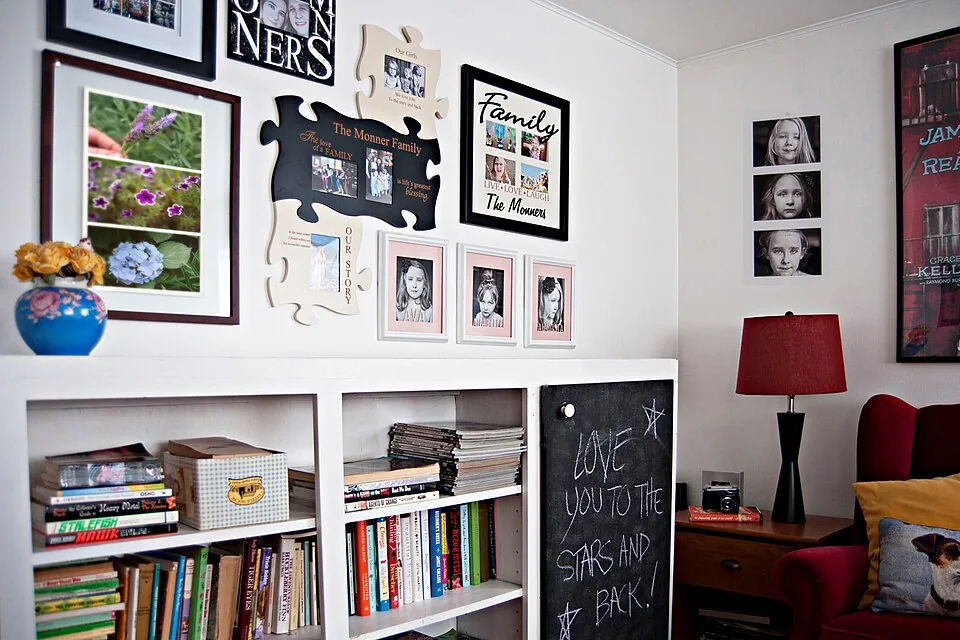
A photo frame arrangement on a wall beside a bookcase and an end table with a lamp
A frame group beside a bookcase and a lamp: keep clearance from tall objects so shades and frames do not touch.

Frequently asked questions

How far apart should frames be on a gallery wall?

2 to 3 inches, the same throughout. Closer looks crowded and wider looks scattered.

How high should a gallery wall be hung?

Center the whole group near 57 inches from the floor, and keep the bottom 6 to 10 inches above a sofa or console if there is furniture below.

How many frames do I need?

Five to nine fill a typical sofa wall, with at least one large frame to anchor the layout. Odd numbers and mixed sizes look natural.

What is the best way to plan a gallery wall?

Lay frames on the floor, trace them on paper, tape the templates to the wall and adjust before you drive any nails.

What hooks should I use?

Rated for at least twice the frame weight, with two hooks for wide or heavy frames. Use studs or anchors for anything over 20 pounds.

Bottom line

Plan on the floor, use paper templates and hang from the anchor frame outward. Keep a 2 to 3 inch gap, center the group near 57 inches and size it to two thirds of the furniture.

Choose a grid for order and a salon layout for personality, tie mixed frames together with a shared element and match the hardware to the weight. The result will look intentional, and you will only need to make the holes once.

Image credits

  • accent-chair-desk-corner.webp: JohnLEE Brothers, CC0, source
  • accent-chair-green-velvet.webp: Shixart1985, CC BY 2.0, source
  • accent-chair-hero.webp: Shixart1985, CC BY 2.0, source
  • anchor-built-in-bookcases-room.webp: Carol M. Highsmith, Public domain, source
  • anchor-small-bookcase-hall.webp: Steven Pavlov, CC BY-SA 4.0, source
  • anchor-white-bookcase-wall.webp: Egilus, CC BY-SA 4.0, source
  • arrange-living-room-hero.webp: Kotivalo, CC BY-SA 4.0, source
  • arrange-living-room-seating-group.webp: Neoclassicism Enthusiast, CC0, source
  • arrange-living-room-sofa-wall.webp: Adele Berenstein, CC BY 2.0, source
  • artsofa-pictures-on-wall-room.webp: Tudor Washington Collins, CC BY 4.0, source
  • artsofa-sofa-corner-mural.webp: G�nter Seggeb�ing, Coesfeld, CC BY-SA 3.0, source
  • artsofa-sofa-mural-wall.webp: G�nter Seggeb�ing, Coesfeld, CC BY-SA 3.0, source
  • blackoutcurtain-floor-length-pair.webp: Ounfs Robmmy 238, CC0, source
  • blackoutcurtain-olive-heavy-fabric.webp: Easysayg, CC BY-SA 4.0, source
  • blackoutcurtain-white-sheer-hotel.webp: HuiDongXLW RMDa, CC0, source
  • ceilingfan-five-blade-light.webp: CommandProMC, CC BY-SA 4.0, source
  • ceilingfan-pull-chain-light.webp: Hans Olav Lien, CC BY-SA 3.0, source
  • clean-fabric-sofa-blanket.webp: Shixart1985, CC BY 2.0, source
  • clean-fabric-sofa-hero.webp: Lear 21, CC BY-SA 4.0, source
  • clean-fabric-sofa-slipcover.webp: Enric, CC BY-SA 4.0, source
  • clean-rug-fringe-pattern.webp: Sununa, CC BY-SA 4.0, source
  • clean-rug-runner-hall.webp: Sununa, CC BY-SA 4.0, source
  • coffeetable-round-yellow-sofa.webp: Vaibhavratnaparkhi, CC BY-SA 4.0, source
  • coffeetable-tan-sofa-dark-table.webp: Shixart1985, CC BY 2.0, source
  • coffeetable-two-wood-tables.webp: Sophia Baboolal, CC0, source
  • color-temp-bright-bulb.webp: Xzantiyamoloy, CC BY 4.0, source
  • color-temp-gu10-spot.webp: Dmitry G, CC BY-SA 3.0, source
  • color-temp-hero.webp: LoMit, CC BY-SA 4.0, source
  • color603010-paint-swatches-wall.webp: Chris Rycroft, CC BY 2.0, source
  • color603010-rainbow-swatch-range.webp: Joyful spherical creature, CC BY 4.0, source
  • color603010-swatch-cards-neutrals.webp: Clean Wal-Mart, CC BY 2.0, source
  • cornertv-1960s-room-tv-window.webp: Kotivalo, CC BY-SA 4.0, source
  • cornertv-budapest-sofa-room.webp: Justin Sch�ler, CC0, source
  • cornertv-white-room-console.webp: Oliur Rahman, CC0, source
  • curtainfabric-heavy-olive-folds.webp: Easysayg, CC BY-SA 4.0, source
  • curtainfabric-hotel-floor-length-pair.webp: Ounfs Robmmy 238, CC0, source
  • curtainfabric-white-light-filtering.webp: HuiDongXLW RMDa, CC0, source
  • curtains-hk-window-stacked-open.webp: YSSKACH WFAMOACSH TUNGA, CC BY-SA 4.0, source
  • curtains-hotel-living-zone-floor-length.webp: Ounfs Robmmy 238, CC0, source
  • cushion-fill-hero.webp: Dalton Scavassa, CC BY-SA 4.0, source
  • cushion-fill-pillows-leather.webp: Aaaatu, CC BY-SA 4.0, source
  • depth-grey-sofa-cushions.webp: Dalton Scavassa, CC BY-SA 4.0, source
  • depth-grey-sofa-hero.webp: Lear 21, CC BY-SA 4.0, source
  • depth-sectional-living-room.webp: Shixart1985, CC BY 2.0, source
  • dimmer-rotary-wall.webp: Paolomarco, CC BY-SA 4.0, source
  • dimmer-slide-wall.webp: BrokenSphere, CC BY-SA 3.0, source
  • dimmer-wiring-box.webp: Kurtkaiser, CC0, source
  • door-hotel-living-room.webp: Adele Berenstein, CC BY 2.0, source
  • door-orange-sofa-hero.webp: Shixart1985, CC BY 2.0, source
  • echo-1960s-room-soft-furnishings.webp: Kotivalo, CC BY-SA 4.0, source
  • echo-fabric-acoustic-panels-wall.webp: 36N63, CC BY-SA 4.0, source
  • echo-panel-mineral-wool-core.webp: JoraK, CC BY-SA 4.0, source
  • entcenter-low-stand-devices.webp: William Hook, CC BY-SA 2.0, source
  • entcenter-old-tv-setup.webp: William Hook, CC BY-SA 2.0, source
  • entcenter-wood-wall-unit-living-room.webp: Casey Fleser, CC BY 2.0, source
  • fabric-green-velvet-hero.webp: Neoclassicism Enthusiast, CC0, source
  • fabric-grey-sofa-cushions.webp: Lear 21, CC BY-SA 4.0, source
  • fabric-sofa-blanket.webp: Shixart1985, CC BY 2.0, source
  • floatshelf-mixed-books-rows.webp: Roman Eisele, CC BY-SA 4.0, source
  • floatshelf-steel-support.webp: Fructibus, CC0, source
  • floatshelf-white-bookcase-wall.webp: Egilus, CC BY-SA 4.0, source
  • floor-lamp-height-hero.webp: Agbarto, CC0, source
  • floor-lamp-height-stained-glass.webp: Louis Comfort Tiffany / Tiffany Studios, CC0, source
  • floor-lamp-height-white-reading-lamp.webp: FASTILY, CC BY-SA 4.0, source
  • frame-black-leather-sofa.webp: www.Pixel.la Free Stock Photos, CC0, source
  • frame-green-velvet-sofa.webp: Neoclassicism Enthusiast, CC0, source
  • frame-grey-sofa-hero.webp: Dalton Scavassa, CC BY-SA 4.0, source
  • gallerywall-frames-bookcase-lamp.webp: Personal Creations, CC BY 2.0, source
  • gallerywall-frames-floor-tape.webp: Personal Creations, CC BY 2.0, source
  • gallerywall-frames-on-wall-home.webp: Personal Creations, CC BY 2.0, source
  • hang-light-hero.webp: Martin Falbisoner, CC BY-SA 4.0, source
  • hang-light-lamp-with-shade.webp: LoMit, CC BY-SA 4.0, source
  • hang-light-red-drum-lamp.webp: Agbarto, CC0, source
  • jute-sisal-combing-fibre.webp: Uncredited for Keystone View Company, Public domain, source
  • jute-sisal-hero.webp: B.navez, CC BY-SA 3.0, source
  • jute-sisal-plantation.webp: Forest & Kim Starr, CC BY 3.0, source
  • knotted-rug-cut-pile-carpet.webp: Daderot, CC0, source
  • knotted-rug-hero.webp: Daderot, CC0, source
  • knotted-rug-prayer-wool.webp: Daderot, CC0, source
  • lampshade-cream-base.webp: LoMit, CC BY-SA 4.0, source
  • lampshade-empire-lamp.webp: J.Dncsn, CC BY-SA 3.0, source
  • lampshade-paper-rect-lamp.webp: Zeitlupe, CC BY-SA 4.0, source
  • layer-rugs-armchairs.webp: PattayaPatrol, CC BY-SA 4.0, source
  • layer-rugs-conversation-pit.webp: Marsh Davis; Indiana Landmarks, CC BY 4.0, source
  • layer-rugs-hero.webp: BusterD, CC BY-SA 4.0, source
  • layered-light-hero.webp: FASTILY, CC BY-SA 4.0, source
  • layered-light-red-shade-lamp.webp: Agbarto, CC0, source
  • layered-light-table-lamp.webp: LoMit, CC BY-SA 4.0, source
  • leather-care-black-sofa.webp: www.Pixel.la Free Stock Photos, CC0, source
  • leather-care-burgundy-set.webp: Dominic's pics, CC BY 2.0, source
  • leather-care-hero.webp: Thomas Quine, CC BY 2.0, source
  • ledstrip-cove-fireplace.webp: Andrey Gvrv, CC BY-SA 3.0, source
  • ledstrip-spool-driver.webp: Dmitry G, CC BY-SA 3.0, source
  • ledstrip-tv-back.webp: Stilfehler, CC BY-SA 4.0, source
  • loveseat-sofa-armchair-room.webp: Adele Berenstein, CC BY 2.0, source
  • loveseat-sofa-hero.webp: Aaaatu, CC BY-SA 4.0, source
  • loveseat-sofa-leather-pair.webp: Dominic's pics, CC BY 2.0, source
  • lowlight-snake-plant-corner-pot.webp: Enzo Rippa, CC BY-SA 4.0, source
  • lowlight-snake-plant-window-table.webp: Martin Olsson, CC BY-SA 3.0, source
  • lowlight-zz-plant-potted.webp: Jamshid Nurkulov, CC BY-SA 4.0, source
  • lumens-bulb-hero.webp: R. Henrik Nilsson, CC BY 4.0, source
  • lumens-led-bulbs-group.webp: Geoffrey.landis at English Wikipedia, CC BY 3.0, source
  • measure-cabin-sofa.webp: Shixart1985, CC BY 2.0, source
  • measure-room-depth.webp: Shixart1985, CC BY 2.0, source
  • measure-sofa-hero.webp: Shixart1985, CC BY 2.0, source
  • mirror-above-mantel-living-room.webp: Tudor Washington Collins, CC BY 4.0, source
  • mirror-round-blue-wall-window.webp: Ciara N� Riain, CC BY-SA 4.0, source
  • mirror-round-over-wood-console.webp: Shixart1985, CC BY 2.0, source
  • mixpatterns-armenian-patterned-pillows.webp: Ararat Trvants, CC BY-SA 4.0, source
  • mixpatterns-couch-pillows-set.webp: Dawid Skalec, CC BY-SA 4.0, source
  • mixpatterns-leather-sofa-pillows.webp: Aaaatu, CC BY-SA 4.0, source
  • no-overhead-hero.webp: Gotogo, CC BY-SA 4.0, source
  • no-overhead-red-shade-lamp.webp: Agbarto, CC0, source
  • no-overhead-white-floor-lamp.webp: FASTILY, CC BY-SA 4.0, source
  • nodrillcurtain-hk-window-open.webp: YSSKACH WFAMOACSH TUNGA, CC BY-SA 4.0, source
  • nodrillcurtain-olive-rail-folds.webp: Easysayg, CC BY-SA 4.0, source
  • nodrillcurtain-white-light-panel.webp: HuiDongXLW RMDa, CC0, source
  • open-plan-rug-armchairs.webp: PattayaPatrol, CC BY-SA 4.0, source
  • open-plan-rug-hero.webp: NPS Photo, Public domain, source
  • open-plan-rug-sunken-living.webp: Marsh Davis; Indiana Landmarks, CC BY 4.0, source
  • ottoman-coffee-table-pair.webp: Sophia Baboolal, CC0, source
  • ottoman-leather-round-pair.webp: Olugold, CC BY-SA 4.0, source
  • ottoman-round-stool-top.webp: Olugold, CC BY-SA 4.0, source
  • paintsheen-open-paint-cans.webp: United Soybean Board, CC BY 2.0, source
  • paintsheen-paint-can-brush.webp: Shixart1985, CC BY 2.0, source
  • paintsheen-swatch-cards-range.webp: Chris Rycroft, CC BY 2.0, source
  • pets-sofa-kitten-cushions.webp: Feliciano Guimar�es from Guimar�es, Portugal, CC BY 2.0, source
  • pets-sofa-slipcover.webp: Enric, CC BY-SA 4.0, source
  • pillows-decorative-couch-set.webp: Dawid Skalec, CC BY-SA 4.0, source
  • pillows-leather-sofa-group.webp: Aaaatu, CC BY-SA 4.0, source
  • pillows-wooden-sofa-red-cushions.webp: Zohasheikh, CC BY-SA 4.0, source
  • readinglamp-adjustable-torchiere.webp: Agbarto, CC0, source
  • readinglamp-armchair-corner-lamp.webp: Kotivalo, CC BY-SA 3.0, source
  • readinglamp-cozy-sunlit-corner.webp: Shixart1985, CC BY 2.0, source
  • recessed-gimbal-trim.webp: Stilfehler, CC BY-SA 4.0, source
  • recessed-housing-display.webp: Stilfehler, CC BY-SA 4.0, source
  • recessed-led-can-trim.webp: Stilfehler, CC BY-SA 4.0, source
  • recliner-buying-armchair-room.webp: Virginia State Parks staff, CC BY 2.0, source
  • recliner-buying-hero.webp: Laura Stoinski, CC0, source
  • recliner-buying-leather-sofa.webp: Aaaatu, CC BY-SA 4.0, source
  • rug-curl-fringe-rug.webp: Sununa, CC BY-SA 4.0, source
  • rug-curl-hero.webp: Sununa, CC BY-SA 4.0, source
  • rug-curl-runner-patterns.webp: Sununa, CC BY-SA 4.0, source
  • rug-dents-hero.webp: ProjectManhattan, CC BY-SA 3.0, source
  • rug-dents-wool-medallion.webp: Daderot, CC0, source
  • rug-on-carpet-armchairs.webp: PattayaPatrol, CC BY-SA 4.0, source
  • rug-on-carpet-flat-weave.webp: Mervat, CC BY 4.0, source
  • rug-on-carpet-hero.webp: NPS Photo, Public domain, source
  • rug-pad-dense-carpet.webp: ProjectManhattan, CC BY-SA 3.0, source
  • rug-pad-hero.webp: Sununa, CC BY-SA 4.0, source
  • rug-pile-flatweave-stack.webp: Mervat, CC BY 4.0, source
  • rug-pile-sarouk-wool.webp: Daderot, CC0, source
  • rug-shedding-pile-closeup.webp: ProjectManhattan, CC BY-SA 3.0, source
  • rug-shedding-wool-rugs.webp: Mervat, CC BY 4.0, source
  • rug-size-armchairs-on-rug.webp: PattayaPatrol, CC BY-SA 4.0, source
  • rug-size-conversation-area.webp: Marsh Davis; Indiana Landmarks, CC BY 4.0, source
  • rug-size-hero.webp: NPS Photo, Public domain, source
  • runner-size-hero.webp: Sununa, CC BY-SA 4.0, source
  • runner-size-red-runner.webp: Sununa, CC BY-SA 4.0, source
  • runner-size-three-runners.webp: Sununa, CC BY-SA 4.0, source
  • sag-cushions-hero.webp: Durova, CC BY-SA 3.0, source
  • sag-cushions-slipcover.webp: Enric, CC BY-SA 4.0, source
  • sag-cushions-sofa-deck.webp: Dalton Scavassa, CC BY-SA 4.0, source
  • sconce-above-tufted-chairs.webp: Jedodo756, CC0, source
  • sconce-brass-opal-shade.webp: unknown (see Commons page), CC BY-SA 4.0, source
  • sconce-wall-lamp-side-table.webp: Atilla Taskiran, CC0, source
  • sectional-dark-hero.webp: Shixart1985, CC BY 2.0, source
  • sectional-room-arrangement.webp: Kotivalo, CC BY-SA 4.0, source
  • sectional-white-corner.webp: GardenKings, CC BY-SA 3.0, source
  • shelfsag-mixed-books-shelf.webp: Roman Eisele, CC BY-SA 4.0, source
  • shelfsag-packed-bookshelf.webp: Csferrie, CC BY-SA 4.0, source
  • shelfsag-wood-shelf-rows.webp: PeaceSeekers, CC BY-SA 4.0, source
  • sidetable-cozy-sofa-room.webp: Breather, CC0, source
  • sidetable-kentwood-sofa.webp: Kari Shea, CC0, source
  • sidetable-round-wall-lamp.webp: Atilla Taskiran, CC0, source
  • sleeper-sofa-bed-made-up.webp: Maniago, Public domain, source
  • sleeper-sofa-open-hero.webp: N509FZ, CC BY-SA 4.0, source
  • sleeper-sofa-sofa-mode.webp: N509FZ, CC BY-SA 4.0, source
  • small-room-slim-arm-sofa.webp: Lear 21, CC BY-SA 4.0, source
  • small-room-sofa-hero.webp: Shixart1985, CC BY 2.0, source
  • small-room-two-seat-layout.webp: Adele Berenstein, CC BY 2.0, source
  • smallbigger-finland-studio-bright.webp: Aaaatu, CC BY-SA 4.0, source
  • smallbigger-hk-curtains-open-window.webp: YSSKACH WFAMOACSH TUNGA, CC BY-SA 4.0, source
  • smallbigger-white-room-console.webp: Oliur Rahman, CC0, source
  • smallstorage-finland-studio-room.webp: Aaaatu, CC BY-SA 4.0, source
  • smallstorage-leather-sofa-shelving.webp: Sabri Tuzcu, CC0, source
  • smallstorage-wall-shelves-books.webp: Roger W, CC BY-SA 2.0, source
  • smart-bulbs-bulb-in-hand.webp: Xzantiyamoloy, CC BY 4.0, source
  • smart-bulbs-led-internals.webp: Loadmaster, Bech, CC BY-SA 4.0, source
  • soundbar-below-lg-tv.webp: Dinkun Chen, CC BY-SA 4.0, source
  • soundbar-philips-front-grille.webp: Philips Communications, CC BY 2.0, source
  • soundbar-samsung-single-bar.webp: Dinkun Chen, CC BY-SA 4.0, source
  • stylebooks-packed-shelf-wall.webp: Csferrie, CC BY-SA 4.0, source
  • stylebooks-philosophers-shelf.webp: Roman Eisele, CC BY-SA 4.0, source
  • stylebooks-wall-shelves-bottles-books.webp: Roger W, CC BY-SA 2.0, source
  • styletable-book-stack-candle.webp: Gabbybratcher, CC BY-SA 4.0, source
  • styletable-two-tables-mugs.webp: Sophia Baboolal, CC0, source
  • styletable-yellow-sofa-cups-flowerpot.webp: Shixart1985, CC BY 2.0, source
  • surround-home-theater-tv-seating.webp: NPat318, CC BY-SA 4.0, source
  • surround-rear-view-seats.webp: NPat318, CC BY-SA 4.0, source
  • surround-sectional-media-room.webp: Derek Jensen (Tysto), Public domain, source
  • table-lamp-size-antique-shade.webp: Amitbalani, CC0, source
  • table-lamp-size-hero.webp: Tess Mattew, CC BY-SA 4.0, source
  • table-lamp-size-measured.webp: Tess Mattew, CC BY-SA 4.0, source
  • throwblanket-blue-throw-kitten.webp: TudorTulok, CC BY-SA 4.0, source
  • throwblanket-striped-couch-cat.webp: Roman Eisele, CC BY-SA 4.0, source
  • throwblanket-yellow-blue-couch.webp: Roman Eisele, CC BY-SA 4.0, source
  • tvheight-flat-panel-wall.webp: BrokenSphere, CC BY-SA 3.0, source
  • tvheight-plasma-wall-room.webp: Pkepneriv, CC BY-SA 3.0, source
  • tvheight-white-living-room.webp: Oliur Rahman, CC0, source
  • tvmount-articulating-arm.webp: Ben Scholzen, CC BY 2.0, source
  • tvmount-vesa-adapter-plate.webp: Tony Webster, CC BY 2.0, source
  • tvmount-wall-panel-room.webp: Pkepneriv, CC BY-SA 3.0, source
  • tvsize-dark-room-big-screen.webp: Christian Collins, CC BY 2.0, source
  • tvsize-media-room-screen.webp: NPat318, CC BY-SA 4.0, source
  • tvsize-tv-on-stand.webp: PhotoPicker13, CC BY-SA 4.0, source
  • tvstand-low-stand-devices.webp: William Hook, CC BY-SA 2.0, source
  • tvstand-wall-unit-living-room.webp: Casey Fleser, CC BY 2.0, source
  • tvwires-cable-box-wires.webp: Tony Webster, CC BY 2.0, source
  • tvwires-hdmi-connectors.webp: Kreuzschnabel, CC BY-SA 3.0, source
  • tvwires-wall-mounted-panel.webp: BrokenSphere, CC BY-SA 3.0, source
  • washable-rugs-flatweave-stack.webp: Mervat, CC BY 4.0, source
  • washable-rugs-hero.webp: Mervat, CC BY 4.0, source
  • washable-rugs-loomed-stripes.webp: Gcarrillog, CC0, source
  • wool-poly-hero.webp: Mervat, CC BY 4.0, source
  • wool-poly-oaxacan-wool.webp: Gcarrillog, CC0, source
  • wool-poly-prayer-rug.webp: Daderot, CC0, source

Related Guides