A sconce goes wrong in one of two ways. It is mounted too high and lights the ceiling like a spilled bucket, or it is mounted at exactly the height of a seated person's eyes and blinds them every time they turn their head. The right height is a narrow band, and it moves depending on what the sconce is for: wallwash, reading or decoration beside a piece of art.
This guide gives you the mounting heights that work in a typical living room with an 8 or 9 foot ceiling, explains how to adjust them for the seating and the object beside them, and covers the practical question of plug-in versus hardwired. It also flags the cases where the standard number gives the wrong answer.
The standard mounting range
The common rule is to place the center of the sconce at 60 to 66 inches above the finished floor. That is slightly above average standing eye height, roughly 57 to 60 inches, which means the light source sits just above the line of sight of someone passing, and the shade or the fixture casts light up and down the wall rather than into faces. On an 8 foot ceiling, 60 inches keeps the top of the fixture well under the ceiling plane, and on a 9 or 10 foot ceiling you can raise to 66 inches to keep proportion.
The center of a fixture is not always where the electrical box sits, which causes endless confusion. A sconce with a tall back plate or an arm may hang below or above its junction box. Measure to the middle of the shade or the light source, then work back to the box position, rather than assuming the box is the center. Mark the wall with painter's tape at the desired center height and hold the sconce against it before drilling or cutting.
| Situation | Center height from floor | Why |
|---|---|---|
| Flanking a fireplace or mirror | 60 to 66 in | Source sits near standing eye level |
| Beside a sofa for reading | 48 to 56 in | Light reaches the page below shoulder height |
| Hallway or narrow passage | 60 to 66 in | Keeps light above shoulders and out of faces |
| Beside a TV wall | 66 to 72 in | Keeps glow above screen reflections |
| High ceiling, 10 ft or more | 66 to 72 in | Maintains proportion to wall height |
These are the middle of the ranges, and they work with the bulb hidden. If the shade is open at the top and bottom, the fixture throws light along the wall and the height matters less, but an exposed source at any of these heights should be dimmed or fitted with a frosted bulb.
The seated glare problem
Because a living room is a seated space, glare should be judged from the sofa and not from standing. The typical seated eye height is about 38 to 42 inches. A sconce centered at 60 inches throws its source about 20 inches above a seated eye, which is high enough that the bulb face is outside the direct line of sight. A sconce centered at 48 inches puts the source only 6 to 10 inches above the eye, so a bare or lightly shaded bulb creates glare, while a fully diffused fixture is fine.
For that reason, a sconce next to a sofa for reading should have a shade that hides the bulb from the seated position, and a bulb with a frosted finish. The most common regret is a pair of attractive bare-bulb sconces mounted at 52 inches beside a sofa. They look good in photos taken standing up, and they are uncomfortable to sit near. Move them up 6 inches or swap in a shaded version before concluding the idea does not work.
A related point is lumen output. A decorative sconce rarely needs more than 300 to 450 lumens. A brighter bulb in a small shade is more likely to hurt than help. Match the output to the job: wallwash and ambiance need less than reading light. The layered lighting guide explains how sconces fit as an accent layer instead of a main source.
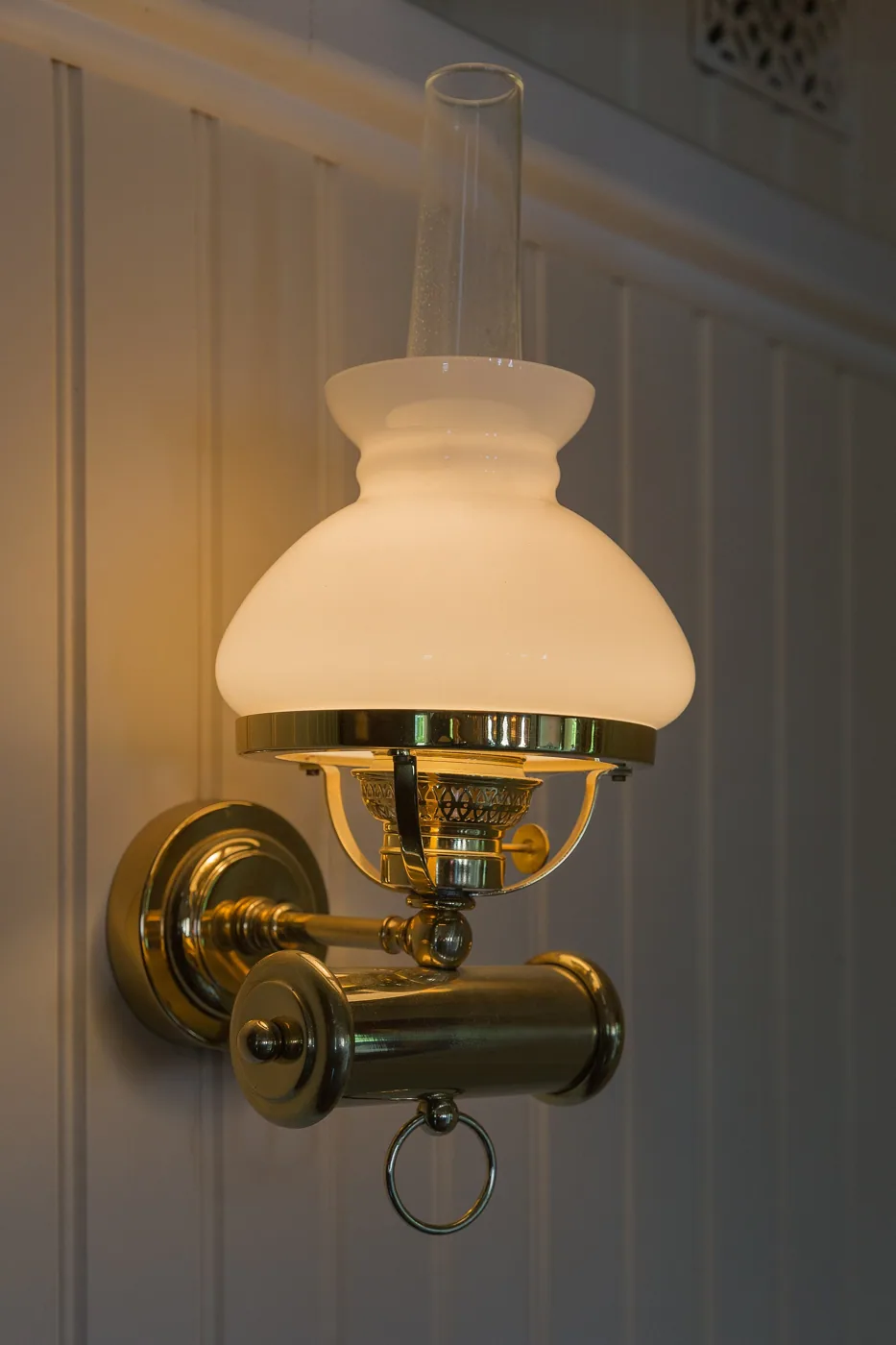
Beside art, a mirror or a TV
When sconces flank a picture or a mirror, align them to the object, not to a number. Place each one 6 to 12 inches from the frame edge, with their centers at the same height as the picture center, usually near 57 to 60 inches. If the artwork is large, the sconces can sit a bit higher so they do not look like they are hanging off its sides. The relationship between art height and sconce height is covered in how high to hang art above a sofa.
Beside a television, caution is needed. A bright sconce next to the screen reflects off the glass and raises the ambient light level in a way that washes out dark scenes. Mount the sconces 4 to 6 inches beyond the screen edge, a little above the screen center, and use warm 2200K to 2700K dim bulbs that are not the main light. A sconce that shines onto the wall, not toward the screen, avoids the reflection. Used well, they soften the contrast between a bright screen and a dark room, which reduces eye strain.
Beside a fireplace, aim to center the sconce on the fireplace opening height, between 60 and 66 inches, and keep the horizontal distance from the mantel at least 8 inches to avoid heat on the fixture. Check any fixture for its clearance rating if a wood-burning fireplace is below it.
Plug-in versus hardwired sconces
A hardwired sconce connects to the home wiring through a junction box in the wall, runs from a wall switch and leaves no cord visible. It needs an electrician or a confident DIY approach, a box rated for the fixture's weight and a route for the wire. A plug-in sconce has a cord and plugs into an outlet, with a switch on the cord or fixture. It requires no electrical work, which makes it the practical choice for renters or for walls where opening the drywall is costly.
The visible cord is the plug-in sconce's tradeoff. Hide it with a cord cover painted to match the wall, a raceway channel or, for the neatest result, a cord that runs behind the sofa. In the living room, cords that drop from 60 inches are conspicuous, so choose a model with a long cord and a cover that matches the wall color. Most plug-in sconces in a living room need a plan for the switch as well, since a pull cord at 60 inches is awkward to reach, and a smart plug or an inline dimmer makes control easier.
- Hardwired: cleaner look, wall-switch control, dimmable with an LED-rated dimmer, needs a junction box and often a permit.
- Plug-in: no wall changes, easy to move, suitable for rentals, but the cord needs concealment.
- Battery-powered: only suited to accent lighting, since runtime and brightness are limited.
Spacing pairs and runs
A pair of sconces should be centered on the object or space they flank. For a sofa, that means one on each side with the pair centered on the sofa's midpoint, at least 18 inches beyond each arm so the fixtures do not collide with a pillow or a seated shoulder. Where a single large piece of art hangs over the sofa, place the sconces on either side of it instead of the sofa.
A run of three or more sconces along a long wall is best spaced evenly, at 6 to 8 feet apart. Closer spacing creates scalloped bright patches, and wider leaves dark gaps. The spacing between sconces can be larger than between recessed lights because sconces rely more on the wall as a reflector.
Do not forget the wall surface. A light color wall reflects more and lets you use lower output. A dark wall absorbs light and may need a higher output, or a fixture that throws light more broadly. Whichever you choose, put the lights on a dimmer, and see dimmer switch types explained for the electrical compatibility.
Wall box, weight and mounting
The heavy ones fail slowly. A large sconce with a glass shade can weigh 5 to 10 pounds, and a poorly secured box will pull away from the drywall over a few years. Hardwired sconces need an electrical box fastened to a stud or a brace between studs, not just held by drywall tabs. For plug-in sconces, anchor the back plate to the wall with a proper drywall anchor or a screw into a stud, matched to the weight stated by the maker.
Check the box position before cutting if the wall already has outlets. Standard outlets sit about 12 to 16 inches above the floor, so a plug-in sconce at 60 inches needs a cord that is at least 5 to 6 feet long, ideally with a cover. Many sconces ship with a 6 foot cord that barely reaches, so measure the route before ordering.
Bulbs, shades and the light the wall receives
A sconce is lit by its wall as much as by its bulb, so the shade style decides what the wall looks like. An open-top fixture throws a scallop of light upward and downward, which emphasizes wall texture and works well on plaster or brick. A closed shade of fabric or frosted glass gives a soft glow with almost no wall pattern, and suits smooth painted drywall. A downlight-only sconce, with a solid top, produces a dramatic cone that can look like a spotlight and is better in a hallway than beside a sofa.
For bulbs, pick 2700K at 300 to 450 lumens for the living room, and a CRI of 90 or above if the sconces flank art or textiles. A bulb that is too cool next to a warm wall looks like a flaw. Candelabra-base LED bulbs are common in sconces and have a limited choice of lumen output, so check that the dimming range of the bulb matches your dimmer, a point explained in the dimmer guide. Decorative filament-style LEDs look attractive in clear glass but can be harsh when bare, so use them only inside a diffuser or at a height above the eye line.
Rentals, plaster and masonry walls
Renters have the plug-in route, but they should still avoid drilling large holes without permission. Adhesive-mounted back plates exist for lightweight sconces, though anything over about 3 pounds belongs on a screw into a stud. If the lease does not allow screws, a freestanding floor lamp with a tall arm, or a lamp on a console, can replace a sconce without touching the wall. The article on layered lighting covers a minimum viable version for a rental.
Old plaster walls over lath crack when a screw is driven in without a pilot hole, and the lath behind them can be hard to locate. Drill a small pilot hole, use a toggle anchor rated for the weight and test it with a firm pull before hanging the fixture. Masonry and concrete walls need a hammer drill, masonry bit and sleeve anchors, and any wiring in these walls usually runs in surface conduit rather than inside the wall, which changes where the sconce can go.
Finally, check the wall for hidden things: a stud finder with an AC detection mode helps you avoid live wiring, and plumbing runs often sit behind a wall shared with a bathroom or kitchen. If you are unsure, hang the sconce on the side of the wall away from those rooms, or ask an electrician to confirm the route.
Mistakes that are easy to avoid
Mounting sconces too high is the most frequent fault. A fixture centered at 72 inches in a room with an 8 foot ceiling casts a bright stripe on the ceiling and leaves the lower wall dim. Mounting them too low, beside a sofa at 45 inches, exposes the bulb. Both can be corrected by moving the fixture 6 to 10 inches.
Another mistake is ignoring the window. A sconce on a wall opposite a window sees a strong daylight contrast and looks dull by day and sharp at night. Placing sconces on the same wall as the window, or between windows, tends to hold up better.
Frequently asked questions
How high should a wall sconce be in a living room?
The center of the fixture should be about 60 to 66 inches above the floor. Drop to 48 to 56 inches beside a sofa for reading, provided the bulb is shaded, and go up to 66 to 72 inches on a high ceiling.
How far apart should wall sconces be?
For a pair flanking art, 6 to 12 inches from the frame. For a run along a long wall, 6 to 8 feet apart gives smooth coverage. Pairs beside a sofa should sit at least 18 inches beyond the arms.
Can I use sconces as my only lighting?
Not in most living rooms. Sconces provide accent and ambient light at modest output. Combine them with lamps and, if possible, ceiling light on a dimmer so you can set the room for different tasks.
Are plug-in sconces safe?
Yes, if the sconce is listed for the use and the cord is not run under rugs, bundled tightly or pinched. Keep the cord visible and accessible, cover it with a proper raceway and use LED bulbs, which produce little heat.
Do sconces need a dimmer?
They benefit from one. A dimmer lets you move from reading light to a soft evening glow, and it protects eyes from glare at night. Use an LED-rated dimmer and dimmable bulbs.
Bottom line
Mark the wall with tape at 60 to 66 inches, hold the sconce up, and check the view from the sofa before committing. If the bulb is visible from a seated position, raise the fixture or choose a shaded model. Keep pairs symmetrical and 6 to 12 inches from art.
Choose plug-in for flexibility and hardwired for a clean wall, and put either on a dimmer. Done well, sconces add the low, warm layer that ceiling lights cannot supply.