
Amazon affiliate links - we earn a commission.Affiliate disclosure

Buying guide · 13 min read · Updated 2026-11-29

Best TVs for Watching Sports (2026)

Seven TVs for sports compared on native refresh rate, motion handling, glare control and viewing angles, with honest notes on motion rate labels.

Elena Hart, Lead Home EditorBy Elena HartLead Home Editor7 picks comparedSpec-sheet verified
Best TVs for Watching Sports

At a glance

Our top picks

Side by side

Spec comparison

PieceScreen sizeRefresh ratePrice positionPanelHDR
TCL 65 in QM6K QD-Mini LED 144 Hz Google TVBest OverallTCL 65 in QM6K QD-Mini LED 144 Hz Google TV65 in, 4K144 Hz12th of 15 candidatesn/an/a
Samsung 65 in M70H Mini-LED 4K Smart TVBest Mini-LED ProcessingSamsung 65 in M70H Mini-LED 4K Smart TV65 in, 4Kn/a9th of 15 candidatesn/an/a
Roku 65 in Plus Series 4K QLED Mini-LED Smart TVBest Simple PlatformRoku 65 in Plus Series 4K QLED Mini-LED Smart TV65 in, 4Kn/a11th of 15 candidatesQLED with Mini-LED backlightDolby Vision listed
TCL 65 in T7 4K 144 Hz QLED Google TV, Dolby VisionBest Value 144 HzTCL 65 in T7 4K 144 Hz QLED Google TV, Dolby Vision65 in, 4K144 Hz13th of 15 candidatesn/aDolby Vision, HDR10+
TCL 55 in R7D QLED 4K Roku TV, Motion Rate 240Best Motion ProcessingTCL 55 in R7D QLED 4K Roku TV, Motion Rate 24055 in, 4Kn/a7th of 15 candidatesQLED, true 4KHDR10, HDR10+, HLG, Open HDR
Roku 55 in Pro Series 4K OLED 120 Hz Smart TVBest Viewing AnglesRoku 55 in Pro Series 4K OLED 120 Hz Smart TV55 in, 4K120 HzMost expensive of 15OLEDDolby Vision listed
TCL 75 in F8D 144 Hz QLED Fire TV, High BrightnessBest Big ScreenTCL 75 in F8D 144 Hz QLED Fire TV, High Brightness75 in, 4K144 Hz14th of 15 candidatesQLED, quantum dot colorn/a

Sports are the hardest content for a TV, because the picture is bright, full of fast motion and often watched in a lit room by several people at once. The specs that matter are therefore different from a movie TV. Brightness, glare handling, motion clarity and viewing angle matter more than deep blacks.

Marketing makes this harder, because many sets quote a motion rate figure that has little to do with the real refresh rate. This guide separates native panel speed from processing labels, and it is open about the figures that listings leave out.

Before you buy

6 Criteria to Look For Before Buying a TV for Watching Sports

  1. 01

    Native refresh rate versus motion labels

    A native 120 or 144 Hz panel updates that many times a second, as on the TCL T7 and the QM6K. A label such as Motion Rate 240 on the R7D is a processing figure that inserts computed frames. Live sports are usually broadcast at 60 frames per second, so a native 120 Hz panel is plenty, and the extra helps mainly with gaming.

  2. 02

    Brightness and glare

    Sports are watched in lit rooms and often in daytime, so peak brightness and anti-reflection coatings matter more than for movies. The QM6K and F8D pitch high brightness, but none of the listings gives a nit figure. Window placement and curtains help more than any single feature.

  3. 03

    Viewing angles

    A crowd on the sides of a couch needs wide angles. OLED, as on the Roku Pro, keeps color and contrast from the sides, while many LCD panels fade off axis. The listings do not state the LCD panel type, so seat testing in a store is the only reliable way to check.

  4. 04

    Local dimming and blooming

    Night games have bright lights against dark skies, which tempts blooming on LCDs. Mini-LED with local dimming, as on the QM6K, Samsung M70H and Roku Plus, helps. TCL's listing claims that its Halo Control System reduces haloing.

  5. 05

    Screen size and distance

    A 65 inch screen is about 57 inches wide and suits seating 7 to 10 feet away, and 75 inches suits 8 to 11 feet. A bigger screen helps you see the whole field. Make sure the console is wide enough, or mount it on the wall.

  6. 06

    Platform and live channels

    Roku, Google TV and Fire TV each have strong sports apps, and Roku makes live and free channels easy. The tuner and antenna matter for local broadcast games. A platform that is slow on game day is a bigger problem than a missing feature.

Detailed reviews

The 7 best tvs for watching sports, explained

01
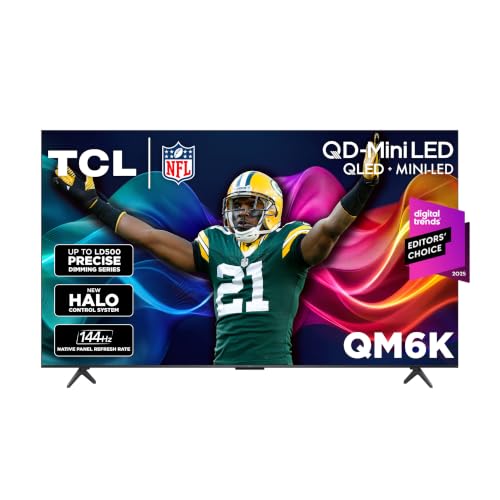
TCL 65 in QM6K QD-Mini LED 144 Hz Google TV
65 in 4KQD-Mini LED144 HzHalo control
Check price on Amazon
Best for: Bright rooms and mixed sports and gaming use that want Mini-LED and a fast panel.

The TCL QM6K is a 65 inch 4K TV that combines a Mini-LED backlight with quantum dot color, a 144 Hz refresh rate and a Halo Control System that the listing says reduces blooming. The listing is explicit that the series is aimed at sports, gaming and streaming, which matches the way most people use a big TV.

A high brightness backlight matters for sports, because day games and bright rooms wash out dim panels. Local dimming helps on dark scenes such as night matches, where bright stadium lights sit against dark skies. The listing does not state the zone count or the peak brightness in the portion we reviewed, so we cannot rank it numerically against the others.

It sits in the upper band of the price range. Compared with the Samsung M70H it lists a clearer refresh rate and a gaming pitch, while the Samsung leans on its processor. A 65 inch screen is about 57 inches wide and suits seating roughly 7 to 10 feet away.

What works

  • Mini-LED with local dimming handles night games and bright stadium lights
  • A 144 Hz panel suits fast sports and console gaming
  • Listing pitches high brightness for sunlit rooms
  • Google TV offers a broad range of sports and streaming apps

Watch out for

  • Zone count and peak brightness are not stated in the portion we reviewed
  • Upper band price, with a screen that needs a wide console

Specs

Screen size
65 in, 4K
Backlight
QD-Mini LED with local dimming
Refresh rate
144 Hz
Platform
Google TV
Price position
12th of 15 candidates
02
Samsung 65 in M70H Mini-LED 4K Smart TV
65 in 4KMini LEDMini LED HDRVision AI
Check price on Amazon
Best for: Households that want a Mini-LED set from a major brand with strong processing.

The Samsung M70H is a 65 inch Mini-LED 4K TV with a Mini LED Processor, a color system the listing calls Pure Color Spectrum and a Mini LED HDR mode that promises brighter highlights and deeper blacks than traditional HDR sets. Samsung's platform includes Vision AI features.

For sports, the useful part is the Mini-LED backlight, which lifts bright highlights such as a floodlit pitch. The listing does not state a native refresh rate in the portion we reviewed, so you should check the page for it before buying if you want to game. The color claim of one billion colors is a standard marketing figure for a 10 bit class panel and tells you little about real performance.

It sits in the middle of the price range. Compared with the TCL QM6K it is less documented for motion and refresh, but it benefits from Samsung's processing and platform. It is a good fit for a household that wants a well-known brand.

What works

  • Mini-LED backlight lifts bright highlights in daytime sports
  • Dedicated Mini LED processor handles upscaling and HDR
  • Established brand with a familiar smart platform
  • Mid-range listing price for a Mini-LED set

Watch out for

  • Native refresh rate is not stated in the portion we reviewed
  • The one billion colors claim is marketing and says little about quality

Specs

Screen size
65 in, 4K
Backlight
Mini LED
Processor
Mini LED Processor 4K
Color
Pure Color Spectrum, one billion colors
Price position
9th of 15 candidates
03
Roku 65 in Plus Series 4K QLED Mini-LED Smart TV
65 in 4KMini-LEDQLEDDolby Vision
Check price on Amazon
Best for: Sports households that want a simple platform and a Mini-LED backlight.

The Roku Plus Series 65 inch is a 4K QLED TV with a Mini-LED backlight, Dolby Vision and Roku's own platform. The listing says the Mini-LED backlighting brings out detail while the QLED color adds vividness, and it stresses simple setup and an uncluttered remote.

Roku's interface is the draw for a house full of sports fans, because it puts live and free channels on the home screen and gets everyone to the game quickly. It is a strong choice for a household where several people need to operate the TV. The listing in the portion we reviewed does not state a refresh rate or zone count, so check for them before buying.

It costs more than the Samsung and a little less than the QM6K in the upper band. Compared with the QM6K, it has a simpler platform but less documented motion performance. It is the better pick for ease of use.

What works

  • Mini-LED backlight with QLED color suits bright and dark games
  • Roku home screen puts live and free channels one click away
  • Dolby Vision is listed for premium streaming sports
  • Uncluttered remote suits every member of a household

Watch out for

  • Refresh rate and zone count are not stated in the portion we reviewed
  • Roku home screens carry promoted tiles

Specs

Screen size
65 in, 4K
Panel
QLED with Mini-LED backlight
HDR
Dolby Vision listed
Platform
Roku TV
Price position
11th of 15 candidates
04
TCL 65 in T7 4K 144 Hz QLED Google TV, Dolby Vision
65 in 4K144 HzQLEDDolby Vision
Check price on Amazon
Best for: Bright living rooms that want a big screen and a true 144 Hz panel.

The TCL T7 is a 65 inch QLED with a 144 Hz refresh rate, Dolby Vision and Atmos support, HDR10+ and Google TV. Its quantum dot layer is described as covering nearly the entire DCI-P3 color space, and the listing says the 144 Hz panel gives ultra-smooth action in live sports and games.

It does not have a Mini-LED backlight, so contrast is more modest than the QM6K, but for daytime sports in a lit room that matters less. A native 144 Hz panel is helpful if you play games on a capable console or PC. The listing gives no peak brightness figure.

It is one of the most expensive in the guide, and the price buys a 65 inch screen and a fast panel. Compared with the R7D it has a true panel speed rather than a processing label, and it is bigger.

What works

  • A native 144 Hz panel gives smooth motion for sports and games
  • Dolby Vision and HDR10+ cover the main premium formats
  • Quantum dot color covers nearly the whole DCI-P3 range
  • Google TV offers a wide range of sports apps

Watch out for

  • Standard backlight, so dark scenes show less contrast than Mini-LED
  • Peak brightness is not stated in the listing

Specs

Screen size
65 in, 4K
Refresh rate
144 Hz
Color
QLED, nearly full DCI-P3
HDR
Dolby Vision, HDR10+
Price position
13th of 15 candidates
05
TCL 55 in R7D QLED 4K Roku TV, Motion Rate 240
55 in 4KQLEDMotion Rate 240MEMC
Check price on Amazon
Best for: Smaller sports rooms that want MEMC motion handling and a simple Roku platform.

The TCL R7D is a 55 inch QLED with a true 4K panel, Open HDR, HDR10, HDR10+ and HLG, and a feature the listing calls Motion Rate 240 with MEMC. MEMC stands for motion estimation, motion compensation, and it inserts computed frames to reduce blur and judder in fast scenes.

It is important to know that Motion Rate 240 is a processing figure and not a native refresh rate. It is a helpful feature for sports, though it can make movies look unnaturally smooth, so use the setting for games and turn it off for films. The listing says it is a high brightness set that runs Roku.

It sits in the lower middle of the price range. Compared with the T7, it has a smaller screen and a processing label instead of a native fast panel, but it is cheaper and easier to place. It is a fair pick for a smaller room.

What works

  • MEMC processing reduces blur and judder on fast sports action
  • HDR10, HDR10+ and HLG cover broadcast and streaming formats
  • Roku platform is simple and puts live channels on the home screen
  • Fifty-five inch size suits smaller rooms and bedrooms

Watch out for

  • Motion Rate 240 is a processing label and not a native refresh rate
  • MEMC can make films look unnaturally smooth, so it needs a setting change

Specs

Screen size
55 in, 4K
Panel
QLED, true 4K
Motion
Motion Rate 240 with MEMC
HDR
HDR10, HDR10+, HLG, Open HDR
Price position
7th of 15 candidates
06
Roku 55 in Pro Series 4K OLED 120 Hz Smart TV
55 in 4KOLED120 HzDolby Vision
Check price on Amazon
Best for: Dim rooms with a crowd on the couch, where wide viewing angles matter most.

The Roku Pro Series is a 55 inch 4K OLED with a 120 Hz refresh rate, Dolby Vision and the Roku platform, in an ultra thin design. OLED lights each pixel individually, which gives perfect blacks and the widest viewing angles of any TV type, an advantage for a room where people watch from the sides.

For sports, OLED's response time is very fast, so motion looks clean. The tradeoff is brightness, since OLED panels are generally dimmer than Mini-LED sets, and a sunlit room can be a problem. Static graphics, such as score banners, also raise the risk of burn in over very long use, though normal viewing is safe.

It is the most expensive set in the guide. Compared with the TCL T7 it is smaller, darker and more costly, but the picture in a dim room with a crowd is far better. It is the pick for night games.

What works

  • OLED gives the widest viewing angles, so side seats look as good as center
  • Per-pixel lighting gives perfect blacks for night games
  • A 120 Hz panel with fast response keeps fast action clean
  • Roku platform is simple for a whole household

Watch out for

  • Most expensive of the fifteen candidates and the smallest screen here
  • Generally dimmer than Mini-LED in a sunlit room, with a small burn-in risk

Specs

Screen size
55 in, 4K
Panel
OLED
Refresh rate
120 Hz
HDR
Dolby Vision listed
Price position
Most expensive of 15
07
TCL 75 in F8D 144 Hz QLED Fire TV, High Brightness
75 in 4KQLED144 HzDolby Vision
Check price on Amazon
Best for: Large living rooms where a big, bright screen suits a sports crowd.

The TCL F8D is a 75 inch 4K QLED with a 144 Hz refresh rate, Dolby Vision, HDR10+ and a high brightness LED backlight that the listing says keeps glare from washing out the picture. It is the biggest screen in the guide, and the right choice for a room that wants a theater feel.

At 75 inches the screen is about 65 inches wide, and it needs a seating distance of roughly 8 to 11 feet. A bigger screen helps sports because you can see the whole field clearly from the couch. The listing does not state the peak brightness or HDMI port details.

It is near the top of the price range. Compared with the T7 it is larger and brighter by claim, and uses Fire TV instead of Google TV, so you will see promoted content. It is the best big screen for a large living room.

What works

  • Seventy-five inches shows the whole field from across a large room
  • A 144 Hz panel suits fast sports and console play
  • High brightness backlight is aimed at glare in lit rooms
  • Dolby Vision and HDR10+ cover the premium formats

Watch out for

  • Near the top of the price range and needs 65 inches of wall width
  • Fire TV places promoted content on the home screen

Specs

Screen size
75 in, 4K
Panel
QLED, quantum dot color
Refresh rate
144 Hz
Backlight
High brightness LED
Price position
14th of 15 candidates

Spec decoder

What the listing measurements really mean

The numbers brands lead with, translated into what they tell you about fit, comfort and wear at home.

Native refresh rate

How often the panel itself updates, in hertz. Higher values give smoother motion.

Watch forThe TCL T7, QM6K and F8D list 144 Hz, and the Roku Pro lists 120 Hz.

MEMC

Motion estimation and compensation, a processing step that inserts computed frames. It reduces blur but can look artificial.

Watch forThe TCL R7D uses it, and the setting is best turned off for films.

Local dimming

A backlight that dims in zones to improve contrast. More zones mean finer control.

Watch forThe QM6K lists it, but no zone count is given.

OLED

A panel where each pixel lights itself. It gives perfect blacks and wide viewing angles.

Watch forThe Roku Pro is OLED, and it is dimmer than Mini-LED sets.

QD-Mini LED

A Mini-LED backlight combined with quantum dot color. It aims for brightness and a wide color range.

Watch forThe QM6K uses it, and the brightness figure is not given.

Methodology

How We Evaluated These TVs for Watching Sports

Listing specifications

We read each listing for refresh rate, backlight type, motion handling and glare claims, and favored models that state them. We did not use star ratings or review counts.

Motion honesty

We separated native panel speeds from processing labels such as Motion Rate 240. We never claim to have measured motion clarity on any TV.

Room and angles

We considered brightness claims, anti-reflection features and the viewing angle advantage of OLED for crowds.

Platform

We compared Roku, Google TV and Fire TV for live and free channels and ease of use for a household.

Value and size

We ordered the sets by relative price and asked what each step up buys, from a native fast panel to OLED.

Decision guide

How to Choose the Right TVs for Watching Sports

By Room Light

SituationPickWhy
Bright room, day gamesTCL QM6KMini-LED and high brightness
Dim room, night gamesRoku Pro OLEDPerfect blacks and wide angles
Mixed lightSamsung M70HMini-LED processor
Large bright roomTCL F8D 75 inBig screen with high brightness

By Budget

SituationPickWhy
Lower mid-rangeTCL R7D 55 inMEMC motion at a smaller size
Mid-rangeSamsung M70HMini-LED from a major brand
Upper midRoku Plus or QM6KMini-LED, simple or fast
Top bandRoku Pro OLED or TCL F8DOLED or a big screen

Mini-LED vs OLED

Mini-LED

The QM6K, Samsung M70H and Roku Plus are bright and handle day games. They have narrower viewing angles than OLED.

OLED

The Roku Pro has the widest angles and perfect blacks. It is dimmer in a bright room.

Daytime viewers should pick Mini-LED, and night owls with a crowd should pick OLED.

Native vs Processed Motion

SituationPickWhy
True panel speedTCL T7 144 HzNative 144 Hz
Processing smoothingTCL R7DMotion Rate 240 with MEMC
Console gaming tooTCL QM6KNative 144 Hz and local dimming
Fast and bigTCL F8D144 Hz at 75 inches

For a Sports Crowd Specifically

Look for

Wide viewing angles, a bright panel, a platform that opens fast and a screen big enough for the whole field.

In this comparison

The Roku Pro gives the widest angles and the TCL F8D gives the biggest screen.

When to Spend More

Spend more if

You host crowds, watch at night or game seriously. OLED or a larger Mini-LED gives clear gains.

Save if

You watch in a lit room with a small group. The TCL R7D or T7 gives the key features.

Ownership

Maintenance schedule

The upkeep that decides whether a piece still looks good in year five.

TaskIntervalWhy it matters
Dust the screen and ventsMonthlyA dry microfiber cloth is enough. Dust in vents raises heat.
Update firmwareEvery three monthsSmart platforms patch bugs and sports apps. Updates can add features.
Check mount and cablesEvery six monthsLarge sets are heavy. Bolts and cables can loosen.
Review motion settingsAfter updatesUpdates can reset MEMC. Use it for games and turn it off for movies.
Vary static content on OLEDAlwaysStatic score banners can leave marks on OLED after very long use. Normal viewing is safe.

FAQ

Frequently Asked Questions

Do I need 120 or 144 Hz for sports?

Not really. Most broadcasts run at 60 frames per second. A native 120 Hz panel is plenty, and the extra helps mostly with gaming.

What does Motion Rate 240 mean?

It is a processing label and not a native refresh rate. It inserts computed frames to reduce blur.

Is OLED good for sports?

Yes, for dim rooms and wide viewing angles. It is dimmer in a sunlit room, and static banners carry a small burn-in risk.

What size TV is best for sports?

65 inches suits seating 7 to 10 feet away, and 75 inches suits 8 to 11 feet. Check the width of your console.

Does Mini-LED help with sports?

It helps with bright highlights and dark scenes at night. Check zone counts, which listings omit.

How do I watch local games?

Through an antenna, a streaming service or the platform's live channels. Check that your TV has a tuner for an antenna.

Bottom line

The short version

Browse more tvs for watching sportson Amazon →
Elena Hart, Lead Home Editor

About the author

Elena Hart

Lead Home Editor, SweetLivingRoom

Elena Hart leads SweetLivingRoom's buying guides, turning product dimensions, material specs and owner feedback into clear verdicts on sofas, rugs, lighting, storage and decor.

More from Elena →

Keep reading

Related guides