
Amazon affiliate links - we earn a commission.Affiliate disclosure

Buying guide · 12 min read · Updated 2026-11-21

Best TVs for Bright Rooms (2026)

Six TVs for sunny living rooms: Mini-LED sets with high brightness, an anti-glare matte CanvasTV and an OLED, with honest notes on reflections and glare.

Elena Hart, Lead Home EditorBy Elena HartLead Home Editor6 picks comparedSpec-sheet verified
Best TVs for Bright Rooms

At a glance

Our top picks

Side by side

Spec comparison

A TV for a bright room has to fight two enemies: ambient light that washes out the picture and reflections that put the window on the screen. Brightness handles the first, and the screen finish handles the second, and the two are separate features.

Peak brightness claims are slippery, because they describe a small highlight for a moment, not the whole screen. This guide uses them as a clue, flags where the listing gives none, and looks at the finish and the backlight type as well.

Before you buy

6 Criteria to Look For Before Buying a TV for Bright Rooms

  1. 01

    Peak versus full-screen brightness

    Peak brightness describes a small highlight for a moment, such as a sun or a spark. Full-screen brightness is what matters for a sunny room, and it is rarely stated. A Mini-LED set with a high peak claim, like the Hisense U8, usually also has good sustained brightness, but treat every number as a claim.

  2. 02

    Screen finish

    Glossy screens look punchy in the dark and reflect windows in the day. Matte and anti-glare finishes, like the CanvasTV, scatter reflections but soften contrast. Buyers often chase nits when reflections are the real problem.

  3. 03

    Backlight type

    Mini-LED with local dimming keeps contrast strong with lights on. Plain edge-lit panels look gray in daylight. OLED has perfect blacks but lower large-area brightness. Match the technology to when you watch.

  4. 04

    Room-aware picture

    Features like Dolby Vision IQ and ambient light sensors adjust the picture to the room. They help when the light changes from morning to night. The Toshiba lists Dolby Vision IQ, and the LG has a similar AI tuning.

  5. 05

    Placement and viewing angle

    Even the best TV struggles if a window sits directly opposite. Place the TV so windows are to the side, tilt it slightly if lamps reflect, and keep it away from direct sun. A wider viewing angle, as on an OLED, helps a wide room.

  6. 06

    Power use and heat

    Brighter panels draw more power, and high-brightness modes run warmer. Check the eco mode and automatic brightness settings. A set left at maximum brightness all day ages faster and costs more to run.

Detailed reviews

The 6 best tvs for bright rooms, explained

01
Hisense 65in U8 ULED Mini-LED 4K Google TV, 165Hz, 5000 Nit Peak
65in 4KMini-LED5000 nits peak165Hz
Check price on Amazon
Best for: Sunny living rooms that need peak brightness and strong local dimming together.

The Hisense U8 is a 65 inch Mini-LED 4K TV with up to 5600 local dimming zones, up to 5000 nits of claimed peak brightness, a native 165Hz panel and Google TV. It is the brightest claim in the group and the strongest answer to a sunny room.

The tradeoff is that peak brightness describes small highlights, not the whole screen, and the maker's figure is a claim, not a measurement we made. Compared with the TCL QM6K, the U8 lists more zones and a higher peak, so it should handle daylight HDR better. Compared with the CanvasTV, it has a standard finish, so reflections remain a risk if a window faces the screen.

A bright set also uses more power, so check the eco settings. Place it so a window is to the side, not behind you or opposite. A 65 inch screen suits a seating distance of 7 to 10 feet. It is the pick for a living room with big windows and a mix of daytime sports and evening films.

What works

  • Claimed peak brightness of up to 5000 nits is the highest in the group
  • Up to 5600 dimming zones give precise contrast, even with lights on
  • Native 165Hz panel suits sports and gaming with smooth, clear motion
  • Google TV platform has wide app support and good voice search

Watch out for

  • Peak brightness is a maker claim for small highlights, not the full screen
  • Standard screen finish still reflects windows if one faces the TV
  • High brightness means higher power draw than a standard LED set

Specs

Screen size
65 in, 4K UHD
Backlight
Mini-LED Pro, up to 5600 zones
Peak brightness
Up to 5000 nits claimed
Refresh
Native 165Hz, VRR 288
Platform
Google TV
02
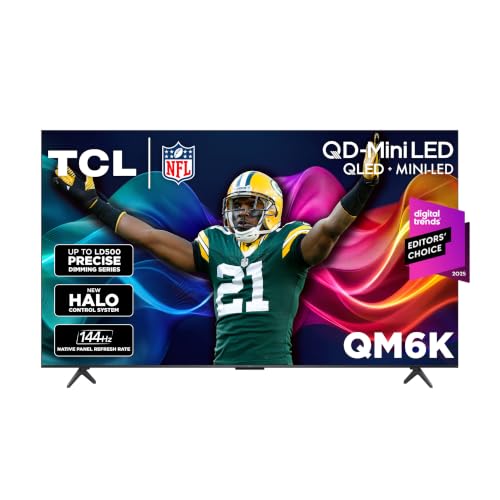
TCL 65in QM6K QD-Mini LED 4K Google TV, 144Hz, High Brightness
65in 4KQD-Mini LED144HzHalo Control
Check price on Amazon
Best for: Family rooms that want a bright Mini-LED set at a mid-tier cost for sports and streaming.

The TCL QM6K is a 65 inch QD-Mini LED 4K TV with a 144Hz panel and the TCL Halo Control System, which the maker says reduces blooming. The listing calls out high brightness and positions the set as affordable premium performance for sports, gaming and streaming.

The tradeoff is that the listing gives no peak brightness figure and no zone count, so the Hisense U8's numbers are clearer. Compared with the Samsung M70H, the TCL has a higher stated refresh rate and a quantum dot layer. Compared with the Toshiba 55 inch, it is larger and uses the Google TV platform.

The Halo Control claim matters in a bright room because blooming around bright objects is more visible with lights on. Use the sports mode in daylight and Movie mode at night. It is the sensible middle-tier pick for a family room that sees both daytime and evening use.

What works

  • QD-Mini LED backlight pairs quantum dot color with local dimming for a punchy picture
  • 144Hz panel suits sports and gaming with smooth, clear motion
  • Halo Control System is aimed at reducing blooming around bright objects
  • Google TV platform offers a wide app range and Chromecast built in

Watch out for

  • Listing gives no peak brightness or dimming zone count to compare
  • Standard screen finish reflects windows if one faces the TV
  • Google TV home screen shows recommendations and promoted content

Specs

Screen size
65 in, 4K UHD
Backlight
QD-Mini LED
Refresh
144Hz
Dimming
TCL Halo Control System
Platform
Google TV
03
Samsung 65in M70H Mini-LED 4K Smart TV, Vision AI, Pure Color
65in 4KMini-LEDVision AIMini LED HDR
Check price on Amazon
Best for: Moderately bright living rooms where a major brand and a fast interface matter.

The Samsung M70H is a 65 inch Mini-LED 4K TV with a Mini LED processor that the maker says delivers brighter highlights and deeper blacks, with a Pure Color Spectrum for one billion colors. It runs Samsung's Tizen platform with a Vision AI companion.

The tradeoff is that the listing is brief on numbers. There is no stated peak brightness, zone count or screen finish, so it is hard to compare with the Hisense. Compared with the TCL QM6K, Samsung's processor and platform are the draw rather than a higher refresh rate. Compared with the Toshiba 55 inch, it is larger and sits in a more established brand's support network.

Samsung's Tizen interface is fast and well supported by app makers. A 65 inch Mini-LED is a good middle option for a living room with moderate light. It suits buyers who prefer a major brand and a processor focused on highlights.

What works

  • Mini-LED backlight with a dedicated processor aims at brighter highlights
  • Pure Color Spectrum covers a wide range of colors for vivid daytime viewing
  • Tizen interface is fast and widely supported by streaming apps
  • Established brand support network makes service and parts easier to find

Watch out for

  • Listing gives no peak brightness, zone count or screen finish to compare
  • Tizen home screen includes ads and recommendations that some find busy
  • Refresh rate is not stated in the compact data, so gamers should check

Specs

Screen size
65 in, 4K UHD
Backlight
Mini-LED
Processor
Mini LED Processor 4K
Color
One billion colors, Pure Color Spectrum
HDR
Mini LED HDR
04
Toshiba 55in Z670R Mini-LED 4K QLED Fire TV, Native 144Hz, Woofer
55in 4KMini-LEDFALD144Hz
Check price on Amazon
Best for: Smaller sunny rooms that want Mini-LED, room-aware HDR and a built-in woofer.

The Toshiba 55 inch Z670R is a Mini-LED 4K TV with full array local dimming, a native 144Hz panel, HDR10+, Dolby Vision IQ and a bass woofer. Dolby Vision IQ adjusts the picture to the room light, which is directly useful in a space that changes from morning to night.

The tradeoff is size and brightness data. At 55 inches it is smaller than the 65 inch rivals, and the listing does not give a peak brightness. Compared with the Hisense U8, it is more modest but more compact. Compared with the Samsung, it adds a woofer and a stated 144Hz panel.

Dolby Vision IQ reads the ambient light and tweaks the picture, which helps in a room with changing light. A 55 inch screen suits a seating distance of 6 to 8 feet. It is the pick for a smaller living room that gets a lot of sun.

What works

  • Dolby Vision IQ adjusts the HDR picture to the light in the room
  • Full array local dimming on Mini-LED keeps contrast strong with lamps on
  • Built-in woofer gives more body to the sound than a thin stock speaker
  • 55 inch size fits a smaller living room or a seating distance of 6 to 8 feet

Watch out for

  • Smaller than the 65 inch sets, so it gives a less cinematic feel
  • Listing gives no peak brightness figure to compare with the Hisense
  • Fire TV home screen carries ads and promotes Amazon content first

Specs

Screen size
55 in, 4K UHD
Backlight
Mini-LED, full array local dimming
Refresh
Native 144Hz
HDR
HDR10+, Dolby Vision IQ
Audio
REGZA Power Audio Pro with woofer
05
Hisense 55in S7 CanvasTV Hi-QLED 4K Art TV, Hi-Matte, Anti-Glare
55in 4K144HzHi-MatteArt Mode
Check price on Amazon
Best for: Rooms where window and lamp reflections are the main complaint, not overall dimness.

The Hisense 55 inch S7 CanvasTV is a Hi-QLED 4K with a 144Hz panel, a Hi-Matte anti-glare finish, Art Mode and a teak frame included. The matte finish is built to turn harsh light into a softer glow, which is the direct answer to reflections.

The tradeoff is that a matte finish scatters light, so the picture is a little softer in a dark room and has slightly lower contrast than a glossy panel. Compared with the Hisense U8, it is not Mini-LED, so it lacks the peak brightness. Compared with the Toshiba, it is a design piece and glare solution rather than a contrast piece.

If your problem is a window reflected on the screen, this is the best match in the group. If your problem is overall dimness, the U8 is better. Mount it opposite or beside a window and use Art Mode to keep the wall attractive.

What works

  • Hi-Matte anti-glare finish cuts reflections from windows, lamps and daylight
  • Included teak frame and Art Mode make the TV part of the room design
  • 144Hz panel suits sports and gaming with Google TV app support
  • 55 inch size suits a smaller living room with bright natural light

Watch out for

  • Matte finish softens contrast slightly, so dark movie nights look flatter
  • Not Mini-LED, so peak brightness is lower than the Hisense U8
  • Art Mode keeps the screen lit, with a small cost in power use

Specs

Screen size
55 in, 4K UHD
Refresh
144Hz
Screen
Hi-Matte, anti-glare
Design
Art Mode, teak frame included
Platform
Google TV
06
LG 65in C6 OLED evo AI 4K Smart TV, Brightness Booster, a11 Processor
65in OLEDBrightness Boostera11 AIDolby Vision
Check price on Amazon
Best for: Rooms that are bright by day but used mostly for film and TV at night.

The LG C6 is a 65 inch OLED evo with over 8.3 million self-lit pixels, a Brightness Booster driven by the a11 AI processor and Perfect Black and Perfect Color. It is the only OLED in this guide and the premium choice for people who want the best contrast.

The tradeoff is that OLED is generally less bright than Mini-LED over large areas, so a very sunny room is not its home ground. Compared with the Hisense U8, the C6 wins on black levels and viewing angles but loses on sheer brightness. OLED also carries a small burn-in risk with static content, so avoid leaving a news ticker on all day.

The Brightness Booster is LG's answer to the brightness gap, and it helps. Keep the TV away from direct sunlight and use curtains in the afternoon. It suits a room that is bright in the day and watched mostly in the evening.

What works

  • Self-lit pixels give true blacks and the best contrast of any set here
  • Brightness Booster raises highlight brightness over earlier OLED generations
  • Wide viewing angles keep the picture stable from the sides of a wide room
  • a11 AI processor handles upscaling and picture tuning with little setup

Watch out for

  • OLED is generally less bright over large areas than Mini-LED in direct sun
  • Static content such as news tickers carries a small burn-in risk over time
  • Highest cost tier in the group, so it is a luxury for a bright room

Specs

Screen size
65 in, 4K UHD
Panel
OLED evo, self-lit pixels
Brightness
Brightness Booster
Processor
a11 AI Processor
Colour
Perfect Black and Perfect Color

Spec decoder

What the listing measurements really mean

The numbers brands lead with, translated into what they tell you about fit, comfort and wear at home.

Peak brightness (nits)

The highest brightness in a small area for a short time. It is not the full-screen level.

Watch forThe Hisense U8 claims up to 5000 nits, but that is a maker figure.

Dimming zones

Areas of the backlight that dim independently. More zones usually mean better contrast.

Watch forThe Hisense U8 lists up to 5600, and most others give no count.

Anti-glare or Hi-Matte

A screen coating that scatters reflected light, reducing mirror-like reflections.

Watch forThe CanvasTV uses it, so contrast is slightly softer.

Dolby Vision IQ

A feature that adjusts HDR to the room light using a sensor.

Watch forThe Toshiba lists it, but results depend on the sensor and the content.

OLED evo

LG's brighter OLED panel generation with self-lit pixels.

Watch forThe LG C6 uses it, but large-area brightness is still below top Mini-LED sets.

Methodology

How We Evaluated These TVs for Bright Rooms

Brightness claims

We read stated peak brightness, dimming zones and brightness features, such as the Hisense U8's 5000 nits claim and the LG Brightness Booster. We treated all of them as maker claims. We did not measure any set.

Reflections

We separated glossy and matte finishes and looked for anti-glare claims, such as the CanvasTV's Hi-Matte. Reflections were weighed alongside brightness. Listings that said nothing were marked down.

Backlight type

We compared Mini-LED, QLED and OLED. Each has a tradeoff between contrast and large-area brightness. The LG earned its place for contrast, and the Hisense for brightness.

Room fit

We covered 55 and 65 inch sizes and the platforms: Google TV, Tizen and Fire TV. Smaller rooms get the Toshiba and CanvasTV, and larger rooms get the 65 inch sets.

Ownership

We noted power draw, burn-in risk on OLED and ads on each platform. Owner feedback patterns informed these notes. We avoided claiming anything the listings do not state.

Decision guide

How to Choose the Right TVs for Bright Rooms

By Light Problem

SituationPickWhy
Overall dim picture in daylightHisense U8Highest brightness claim and many zones
Window reflections on the screenHisense CanvasTV 55inHi-Matte anti-glare finish
Changing light through the dayToshiba 55in Z670RDolby Vision IQ
Bright by day, films at nightLG C6 OLEDTrue blacks in the evening

By Budget

SituationPickWhy
Lowest relative priceToshiba 55in Z670RLowest tier with Mini-LED
Low to mid tierCanvasTV 55in or Samsung M70HGlare control or brand support
Mid tierTCL QM6KMini-LED with 144Hz
Upper tierHisense U8 or LG C6Brightness or OLED contrast

Mini-LED vs OLED

Mini-LED

The Hisense, TCL, Samsung and Toshiba sets are bright over large areas. They suit sunny rooms and daytime sports.

OLED

The LG C6 has perfect blacks and wide viewing angles but lower large-area brightness. It suits rooms that darken in the evening.

Pick Mini-LED if the room stays bright. Pick OLED if you watch mostly after dark and can close curtains.

By Room Size

SituationPickWhy
Smaller room, 6 to 8 feetToshiba 55in or CanvasTV 55in55 inch sizes
Standard room, 7 to 10 feetTCL or Samsung 65in65 inch Mini-LED
Large room with big windowsHisense U8Brightest set in the group
Home theater with blindsLG C6Best contrast

For Sunny Rooms Specifically

Look for

A Mini-LED backlight with many dimming zones, a stated peak brightness, an anti-glare or matte finish and a sensor for room-aware picture. Plan curtains as part of the setup.

In this comparison

The Hisense U8 leads on brightness, the CanvasTV leads on reflections and the Toshiba leads on room-aware HDR. No set solves a window opposite the screen alone.

When to Spend More

Spend more if

You have a large sunny room and want a sustained brightness figure from a premium Mini-LED, or you want OLED contrast with a brighter panel.

Save if

You can control the light with curtains, and a mid-tier Mini-LED like the TCL QM6K meets your needs.

Ownership

Maintenance schedule

The upkeep that decides whether a piece still looks good in year five.

TaskIntervalWhy it matters
Check picture modeEvery 3 monthsUpdates can reset picture settings. Re-select the Bright or Sports mode for day and Movie for night.
Dust and wipe the screenMonthlyMatte and anti-glare coatings scratch easily. Use a dry microfiber cloth and never spray liquid on the screen.
Avoid static images on OLEDOngoingLong static content such as a news ticker can cause uneven wear. Use the screen saver and pixel refresh features.
Clean ventsEvery 6 monthsBright panels run warm. Dusty vents trap heat, so a quick vacuum helps.
Adjust curtains and blindsDailyThe cheapest brightness upgrade is controlling the light. Close blinds at the time of day when the sun hits the screen.

FAQ

Frequently Asked Questions

How many nits do I need for a bright room?

Higher is better, but no single number guarantees a good picture. Mini-LED sets with a high stated peak and many dimming zones perform best, though the figures are maker claims.

Is matte better than glossy?

Matte cuts reflections but slightly softens contrast. If a window faces the screen, matte helps. If the room can be darkened, glossy looks punchier.

Can an OLED work in a bright room?

It can, especially newer models with a brightness boost, but it is generally less bright over large areas than Mini-LED. Close curtains for evening films.

Where should I place the TV?

Put windows beside the TV, not opposite or behind it. A slight tilt can move lamp reflections away from your eyes.

Do bright TVs use a lot of power?

They use more than dim ones, especially in peak modes. Use the eco mode and automatic brightness to reduce the cost.

Is burn-in a real risk on OLED?

It is a small risk with static content shown for many hours. Varied viewing and the built-in protection features keep it low.

Bottom line

The short version

Browse more tvs for bright roomson Amazon →
Elena Hart, Lead Home Editor

About the author

Elena Hart

Lead Home Editor, SweetLivingRoom

Elena Hart leads SweetLivingRoom's buying guides, turning product dimensions, material specs and owner feedback into clear verdicts on sofas, rugs, lighting, storage and decor.

More from Elena →

Keep reading

Related guides