Most rug shopping happens at the top of the rug: color, pattern, pile, fiber. The part that touches the floor gets a line in the specifications, if that. Yet the backing is the layer that decides whether the rug stays put, whether it smells for a week, whether it marks a wood or vinyl floor and whether it flexes without cracking after a few years in a room with sun or a heater.
This guide explains the common backing types, how each one is made and what it does well and badly. It covers floor safety, odor, rigidity, how backings behave over underfloor heating and how to choose a backing and a pad that suit each other. It is based on how rugs are manufactured and on patterns in owner feedback, and it avoids brand claims. Where makers do not publish details, it says so.
What a backing does
In a tufted or machine-made rug, the pile is stitched or woven through a primary backing, a fabric grid that holds the yarn in place, and the loops would pull out without something to lock them. A coating or a second layer of fabric is added to the underside to secure the tufts and to stabilize the rug. This final layer is what you see when you flip the rug over, and it is what we call the backing.
It carries out several jobs. It anchors the fibers so they do not shed or pull out, it keeps the rug flat and dimensionally stable, it protects the floor from the rough underside of the primary backing and, in some cases, it provides grip. The trade-offs come from the material: a sticky coating grips but can bond to a floor finish, a woven layer breathes but slides and a natural fiber is stable but takes up moisture.
Not every rug has a separate backing. Hand-knotted and many flat-woven rugs are structural: the foundation threads and the pile or weft are the same fabric, so there is no layer to add. We return to those below. The point to take from this section is that the word backing covers very different things, and a listing that says only non-slip backing tells you little.
Latex backing
Latex is the most common coating on machine-made and tufted rugs. A liquid latex, either natural rubber latex or a synthetic version such as styrene-butadiene, is applied to the underside, which locks the tufts and sticks the secondary fabric. The result is a firm, slightly tacky surface that grips many floors and keeps the rug flat.
Its strengths are grip, low cost and good tuft retention. It is the reason many rugs are reasonably stable on a hard floor without a pad. The weaknesses are age and chemistry. Over several years, latex can dry out, harden and crumble into a yellow or tan powder, especially in a sunny spot, on a warm floor or when it has been exposed to cleaning chemicals, and the powder can stain a floor. New latex can also have an odor that fades over days or weeks, and some people are sensitive to natural latex, so check the listing if there is an allergy in the household.
Latex can also react with some floor finishes. Direct contact with vinyl, some polyurethane finishes and certain laminate surfaces can lead to discoloration or a sticky residue, so many manufacturers advise using a pad between the latex backing and these floors. Our guide to rug pads explains which pads are safe for which finishes.
Cloth and woven polypropylene backing
Many rugs have a secondary backing of woven fabric, often polypropylene or cotton, attached with a coating or stitched on. Some are called action backing, a loosely woven synthetic fabric that is the common secondary layer on tufted and machine-made rugs. It adds stability and covers the primary backing, and it feels like a coarse woven cloth.
The benefit is that it breathes and has no tacky coating, so it does not stick to floors or leave marks, and it does not crumble with age. It is generally gentle on floors, though the rough weave can abrade a soft finish if grit gets trapped beneath. The downside is that it has little grip. A rug with a plain cloth backing slides on a smooth floor and creeps on carpet, so it needs a pad. Because the cloth is porous, it can also absorb moisture and spills, which can dampen a floor.
Cotton backings, which appear on some flat-weave and hand-tufted rugs, are soft and stable and also need a pad for grip. They can shrink or distort if the rug is washed carelessly, and they can hold odors if soaked. If a listing says cotton backing, expect natural fiber behavior.
Jute backing
Jute is a natural plant fiber woven into a coarse, stiff backing used on some wool and traditional rugs and on natural-fiber rugs. It is strong and stable, does not stretch and does not off-gas. It gives a rug a firm hand and flat lay, and it is considered a good traditional backing for a quality rug.
Its weakness is water. Jute absorbs moisture, swells and can brown or rot if it stays damp, and it can leave a stain on the floor underneath. It is also rough and can scratch hard floors if grit works under the rug, so a pad is advisable. Jute backings are not suited to bathrooms, kitchens or entryways where wet shoes are common, and they need immediate drying after a spill. We cover the fiber in our guide to jute versus sisal rugs.
Jute can also shed small fibers and dust from the back for a while, and it carries a faint grassy smell, which fades. If the rug is a jute or sisal weave itself, the structure is part of the rug, not a separate backing, and the cleaning rules are the same.
Rubber and non-slip backings
Rubber backings, natural or synthetic, are the strongest gripping option. A thin layer of rubber, a waffle pattern or dots of PVC on the underside creates friction with the floor, which keeps a rug from sliding. These are common on washable rugs, doormats, runners and bath mats, where slipping is a safety issue.
The advantages are clear: excellent grip, a flat lay and moisture resistance. The risks are chemical and thermal. Some rubber and PVC compounds contain plasticizers that can migrate into floor finishes and leave a sticky or discolored patch, particularly on vinyl, linoleum and some sealed wood. Natural rubber is generally gentler than PVC, but both can mark if they are left in place for a long time. Many manufacturers say a rubber-backed rug should not go on certain floors without a barrier.
Rubber can also smell new for a while, a sharp, chemical or rubbery odor that fades with airing. Rubber backings on washable rugs can crack and peel in a hot dryer, so check the care label. Our guide to washable rugs covers the care. Foam or sponge rubber, found on cheap rugs, can disintegrate with age and stick to the floor, which makes it a poor choice for a long-term rug.
| Backing | Grip | Floor safety | Odor | Stiffness | Watch for |
|---|---|---|---|---|---|
| Latex coating | Medium to high | Can mark vinyl and some finishes | New smell, fades | Firm | Crumbling with age and sun |
| Woven polypropylene or cloth | Low | Gentle on most floors | Low | Medium | Slides without a pad |
| Jute | Low to medium | Can scratch, stains when wet | Grassy, fades | Stiff | Moisture, browning, rot |
| Rubber or PVC non-slip | High | Can stain vinyl and finishes | Rubbery, fades | Flexible | Plasticizer marks, cracking in dryers |
| Felt or foam attached | Medium | Gentle | Low | Soft | Flattening, absorbs spills |
| No backing (flatweave, hand-knotted) | Low | Gentle | Low | Varies | Slides, needs a pad |
No separate backing: flatweaves and hand-knotted rugs
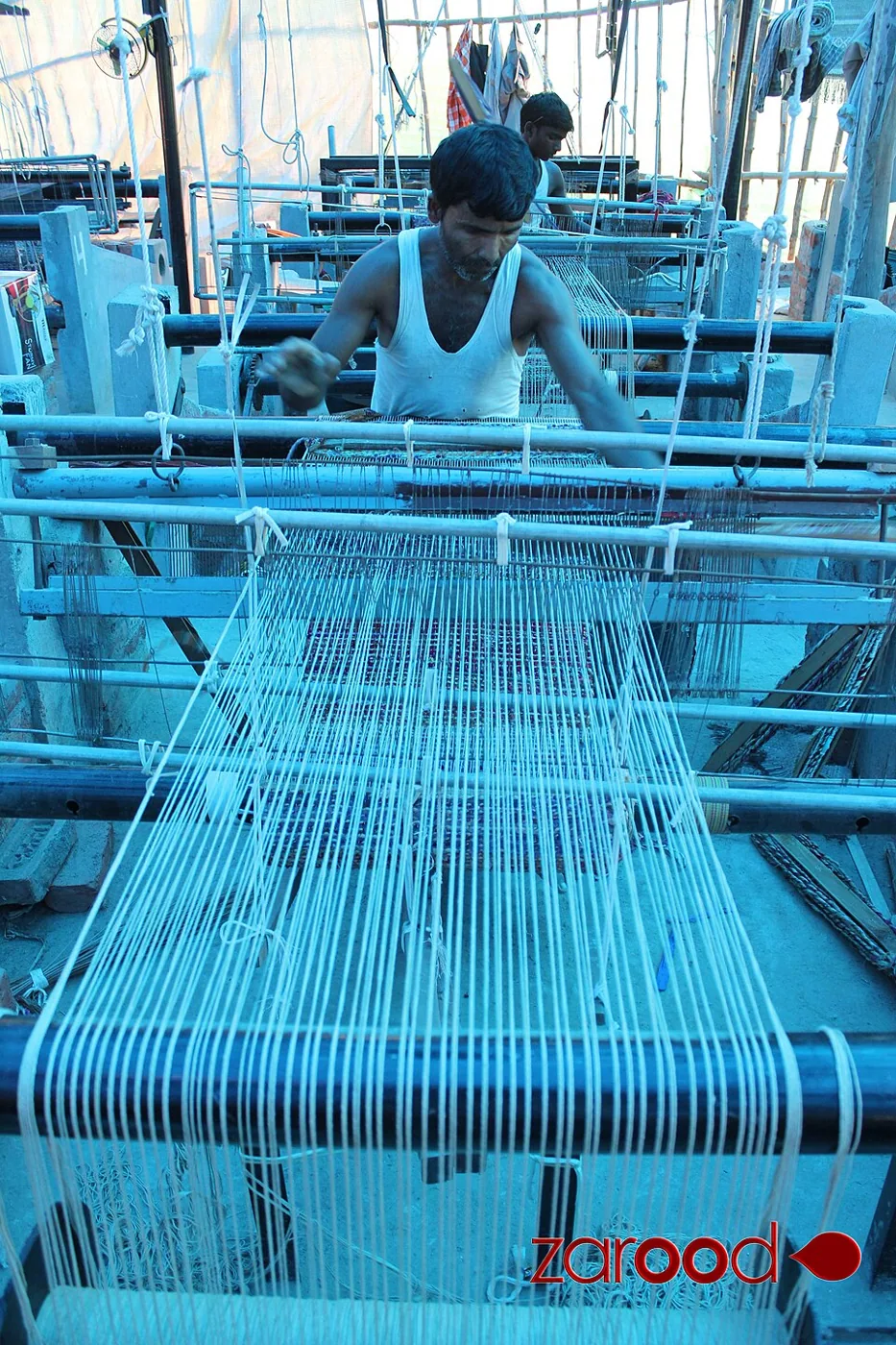
A hand-knotted rug has its knots tied directly onto the foundation threads, so the back of the rug is the foundation itself, with the base of the knots visible as a pattern. A flat-woven rug has weft and warp threads that interlace, with no pile to attach. These rugs have no coating or secondary layer, so they are flexible and breathable, and they do not release odor or crumble. They are also the most stable over time, since there is no glue to age.
The trade-off is that they offer no grip of their own. A handmade rug on a smooth floor needs a pad, usually a felt and rubber type that is safe for the floor, and the pad also protects the foundation from wear. Flat-weaves are also thin, which is why they benefit from a pad, as it helps them lie flat and cushions them. See our guide to hand-knotted versus machine-made rugs for how the constructions differ.
Some hand-tufted rugs have a cloth backing glued on over a latex coating, which is a hybrid. These are more stable than flatweaves but can show the issues of both types, so check the listing and, if possible, look at the back of the rug in photos.
Underfloor heating and heat
Heat is an area where information is thin. There is no widely published standard that tells you whether a given rug backing is safe over radiant heating, and makers differ. In general, a thick rug and pad insulate, reducing the warmth that reaches the room and raising the floor temperature beneath the rug, and latex and synthetic rubber backings can soften, yellow or break down faster when they are warm for long periods.
Practical guidance is to check the manufacturer's statement, to prefer thin, breathable rugs with natural or cloth backings over heated floors, and to avoid a thick pad over a heating system unless the pad is rated for it. Wool and cotton rugs with no latex are the safest choice. Keep the rug off any floor area marked as having a high temperature, and monitor the floor under the rug the first few weeks, looking for discoloration or smells.
The same principle applies near a fireplace or a radiator: heat accelerates the aging of latex and rubber, so place a rug away from direct heat sources, or choose a backing designed to resist it.
How to choose and pair with a pad
Start with the floor. On hardwood, laminate and vinyl, avoid direct contact with latex, PVC and cheap rubber, and use a felt and natural rubber pad, or a rug with a cloth or jute backing and a safe pad. On carpet, a rug with a coarse backing grips better than one with a smooth coating, and a thin, flat pad stops creep. On tile and stone, almost any backing is fine, but a pad adds comfort and keeps the rug from sliding.
Then look at the use. A rug in an entry or kitchen should be resistant to moisture and slip, so a rubber backing or a rubber pad makes sense, with care for the floor. A living room rug under a seating group benefits from a felt pad for cushion. In a bedroom, a soft backing is fine. If you plan to wash the rug, check that the backing can survive the machine and the dryer.
Last, trim and test. A pad should be an inch or so smaller than the rug on all sides. When the rug arrives, air it out for a few days to dissipate odors, and check the floor beneath after a few weeks for any marks. Our guide to stopping a rug from curling explains how a backing and a pad work together to keep the corners flat.
Frequently asked questions
Is latex backing bad for hardwood floors?
It can be, depending on the finish. Some finishes react with latex and develop a sticky residue or discoloration over time. Use a barrier pad that is safe for finished floors, or choose a rug with a cloth backing and a felt pad.
Why does my new rug smell like rubber?
New latex and rubber backings release odors from the manufacturing process. The smell usually fades over a few days to a few weeks if the rug is aired in a ventilated room. A persistent chemical smell suggests a poor-quality backing.
Do I need a pad if the rug has a non-slip backing?
Often, yes. A backing may grip a floor but offers little cushioning and may react with the finish. A pad protects the floor and the rug, and a barrier pad can prevent staining.
Can I put a rug with a latex backing over underfloor heating?
Check the maker's guidance first. Heat can make latex softer and age faster. A thin rug with a cloth or natural backing is a safer choice, and a thick pad can insulate the floor.
How can I tell what backing a rug has?
Look at the back. A woven fabric means a cloth backing, a rubbery or sticky surface means latex or rubber, a coarse brown weave means jute, and visible knots with no layer means hand-knotted. The listing should state it, and photos of the underside help.
Bottom line
Treat the backing as part of the rug's performance. Cloth and no-backing rugs are gentle and stable but need a pad. Latex and rubber grip but can mark floors, smell and age. Jute is traditional but dislikes water.
Choose the backing that suits your floor and your room, pair it with the right pad and check heat tolerance if you have underfloor heating. A little attention to what is under the rug protects both the rug and the floor.