A new rug that arrives rolled in a tube often refuses to lie flat for weeks. The corners rise like the ends of a scroll, the edges lift and the first person to walk past catches a toe. This is the commonest complaint about rugs bought online, and it is also the easiest to fix, if you know the cause. A curl is a memory in the backing, and memories can be erased with the right treatment.
This guide explains why rugs curl, the fixes in order of effort and risk, the grippers and pads that hold a rug down for good and how to handle a rental, a heated floor or a rug with a stubborn backing. It also covers when a curl signals a different problem, such as a poor rug or a wrong pad.
Why corners curl
Curling has three causes that often combine. The first is storage: a rug rolled tightly for weeks in a box takes on the shape of the roll, because the backing and the base fibers set in their curved position. The longer and tighter the roll, the stronger the memory. The second is the backing itself: a stiff latex or a woven jute backing resists flattening, while a flexible cotton backing relaxes faster.
The third is a lack of support at the edge. A rug rests on its center and the weight of the pile, and the edges, having no weight on them, curl up as the backing relaxes or shrinks. Humidity plays a part, too: a damp room swells natural backings and can pull the edges up, and a dry room shrinks them. The material of the pile, the weight of the rug and the condition of the floor all matter, and a lightweight flatweave curls more than a heavy wool rug.
Step one: unroll it and give it time
Many curls disappear on their own. Unroll the rug in the room where it will live, pile side up, and lay it flat. Leave it for 24 to 72 hours, and put weight on the corners, such as books or the legs of furniture. Warm room temperature helps, since a cold backing is stiffer. For a thick rug, give it a week.
If you can, unroll it in the opposite direction to the roll, as the next section describes, or lay it upside down for a day. The aim is to let the fibers settle. Check the rug after a day and press the corners, and if they stay down, the job is done. A rug that is still curling after a week needs a stronger intervention, but many do not, and patience costs nothing.
Step two: reverse rolling
Reverse rolling means rolling the rug the opposite way, so the pile faces outward, and leaving it for a day. The idea is to bend the backing against its memory. Roll it loosely, secure it with ties or a band, and leave it overnight. Then unroll it and lay it flat, again with weights on the corners.
For a stubborn curl, roll the rug tightly around a cardboard tube, with the pile out, and leave it for 24 to 48 hours. The result is often a flat rug. Avoid creasing the rug, and do not roll too tightly on a delicate or antique piece. If the rug has a stiff backing, the reverse roll can be repeated once or twice. Our dent guide shows how to treat marks that the weights leave.
Step three: steam, heat and pressing
Gentle heat softens the backing and lets it relax. Lay the rug flat, and hold a handheld steamer a few inches above the curled corner, or use a clothes steamer on the back, for 10 to 15 seconds. Then press the corner flat with a heavy book or a weight, and leave it until cool. For a synthetic rug, the heat setting should be low, since polypropylene can melt.
Do not iron a rug directly, and never use steam on jute, sisal, viscose or an antique piece, which can be damaged by moisture and heat. A hair dryer on low, held a few inches away, is a safer alternative for natural fibers, and the same cool-and-press method works. If you are not sure, test a hidden corner first, and keep the heat short and the distance generous.
Step four: weight and furniture
Weight at the corners holds the rug down while the backing settles. A heavy book works for a day or two, and furniture is a permanent version. A sofa leg placed on each corner of the rug can hold it flat, and a rug sized so that furniture legs sit on all four corners will not curl, as we describe in our guide to rug sizes.
If the layout does not allow furniture on the corners, use decorative weights, such as rug corner anchors, which are flat plates or pads fixed under the corner. They add weight and grip, and they are inexpensive. Avoid heavy items that can tear or stain the rug, and place a cloth under any weight on a pale rug. For a hallway runner, weights are impractical, so use grippers or a pad.
| Fix | Effort | Best for | Risk |
|---|---|---|---|
| Unroll and wait | None | New rugs, light curl | None |
| Reverse roll | Low | Rolled-in curl | Creasing if too tight |
| Steam and press | Medium | Stiff backing, synthetics | Heat damage on natural fibers |
| Weights and furniture | Low | Any, in a set layout | Marks on pale rugs |
| Rug pad | Low | Most rugs on hard floors | Wrong pad can stain floors |
| Corner grippers or tape | Low | Persistent curls, rentals | Residue if the tape is poor |
Step five: pads, grippers and tape
For a lasting fix, a rug pad does most of the work. A flat, grippy pad under the rug holds the backing against the floor, and a pad that is cut slightly smaller than the rug supports the edges. The details of materials and sizing are in our guide to rug pads. If a pad is not enough, corner grippers, which are small triangles with an adhesive or a grippy surface, hold the corner flat on the floor.
Double-sided rug tape is a more aggressive option. It sticks the rug to the floor along the edges, and it is effective, but it can leave residue on a hardwood floor and pull up a finish. For a rental, choose a removable, residue-free tape designed for finished floors, or a gripper that clamps without adhesive. Test the product in a hidden area, and remove it carefully, with a hair dryer to soften the adhesive.
Rentals, heated floors and delicate surfaces
In a rental, the priority is to avoid leaving marks. Use a pad or an adhesive-free gripper, and avoid tape or glue on the floor. If a landlord's floor has a delicate finish, put a thin felt pad under the rug and leave it unfixed, relying on weight and furniture. Photograph the floor before you start, in case of a dispute about marks.
On a heated floor, avoid thick pads and adhesives that may soften with heat, and check the floor's guidance. A rug on a floor with radiant heating can curl more, as the heat dries the backing. For a stone or tile floor, a rubber-backed pad grips well, and a damp floor needs a breathable pad. On carpet, the problem is creep and bunching more than curling, which we cover in our guide to rugs on carpet.
Choosing and storing a rug so it does not curl
Prevention starts at the purchase. A rug that ships flat or loosely rolled in a wide tube curls less than one tightly rolled in a narrow box, so check how the seller ships it. A heavier rug, with a dense backing and a weight of several pounds per square foot, resists curling better than a thin, light one. A flexible cotton backing relaxes faster than a stiff latex or a rigid jute one.
If you need to store a rug, roll it loosely with the pile facing out, around a wide tube of at least 4 inches in diameter, and keep it in a dry, ventilated place. Avoid folding, which creates creases that are far harder to remove than a curl. Rolling pile-side-out stretches the backing slightly and lets the corners lie flat when it is unrolled, and a short time in storage is much better than a long one.
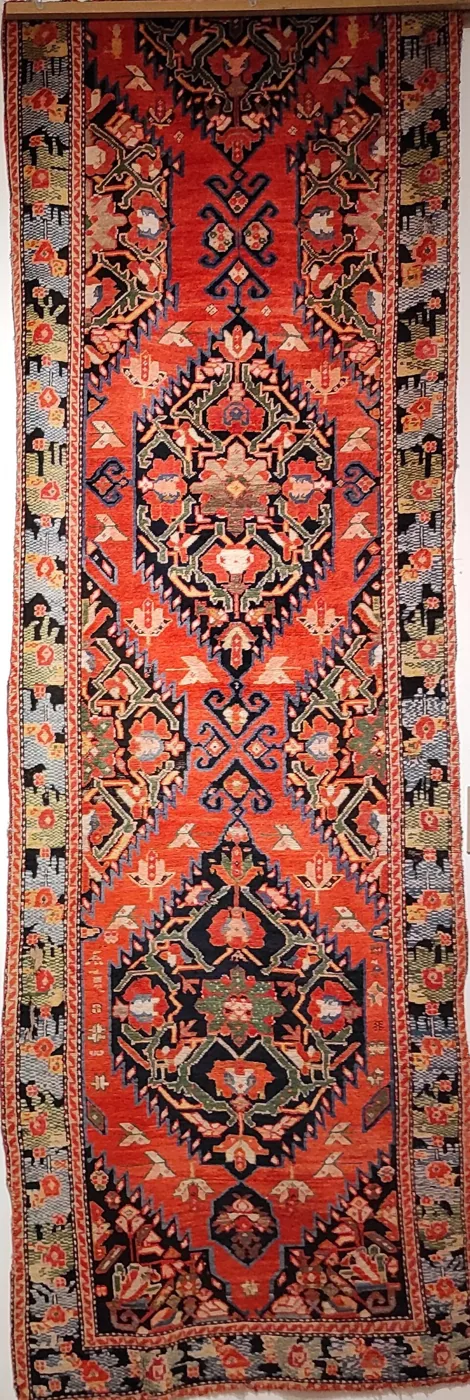
Fringed rugs need a small extra step. Keep the fringe out from under weights and tape, because it is attached to the rug's foundation and can be torn, and comb it flat once the body of the rug has settled. A rug with a binding on the edge usually lies flatter than one with a raw edge, because the stitching adds a small amount of structure along the border and holds the corners down.
Safety: lifted edges and trip hazards
A curled corner stands up one or two inches, which is exactly the height at which a toe catches. For older adults, children and anyone carrying something, a rug edge is a real fall risk. Treat any lifted corner as a hazard to fix at once, and do not leave it for a week. In a hallway, near stairs or at a doorway, the risk is higher.
If you cannot flatten a rug quickly, take it up, or place it where traffic does not reach until it settles. Use a pad with a thin profile and a bound edge on the rug, and keep cords and clutter off the edges. If someone in the household uses a walker or a cane, choose low-profile rugs or none in the main routes. Making the edge flat and firm is a small job that prevents a serious injury.
Also consider the season. Rugs relax faster in a warm, moderately humid room, so a rug that arrives in winter can be left near a heating vent, at a safe distance, to speed up settling. A cold backing is stiff and resists flattening, while a gentle warmth softens it, which is why the same rug that curls in January may lie flat by April without any treatment at all.
A short toolkit for the job
The tools for flattening a rug are cheap and familiar. A few heavy books or purpose-made corner weights hold the edges down. A handheld steamer or a clothes steamer softens a stiff backing. A cardboard tube or a rolled yoga mat makes a good form for reverse rolling. A rug pad, rug tape or corner grippers give a permanent hold. A soft brush restores the pile afterward.
Keep a few spare grippers on hand for the day the rug shifts, and check them seasonally, since adhesives weaken with dust and heat. Clean the floor under a gripper before replacing it, because dust defeats the adhesive. A small kit and a few minutes of attention each season prevent a trip, and they extend the life of the rug as well.
When the curl will not go away
If a rug curls again after every fix, look for a deeper cause. A poor-quality backing, a warped rug or a rug that was stored damp may never lie flat. A rug that has shrunk from a wet clean can be pulled back into shape, but not always. In that case, consider a smaller, heavier or better-made rug, or return it if it is new.
Consider the room, too. A rug that curls only in summer may be responding to humidity, and a dehumidifier or air conditioning can help. A rug under a door that catches the edge is being pushed up, so move it. A persistent curl is also a safety issue, since people trip on lifted corners, and a rug that cannot be fixed is better replaced than tolerated.
Frequently asked questions
How long does it take for a rug to flatten?
Most lie flat within 24 to 72 hours if left unrolled with weights on the corners. A stiff or thick rug may take a week. If it has not flattened after two weeks, use a reverse roll or steam.
Can I use heat to flatten a rug?
Gentle steam works on synthetic and wool rugs, held a few inches from the surface and followed by pressing. Avoid heat on jute, sisal, viscose and antiques. Always test a hidden area first.
Will a rug pad stop curling?
It helps a lot, because it holds the backing against the floor, but it may not cure a stubborn curl alone. Pair it with weights or grippers for the corners until the rug has settled.
What if my situation is different, such as a runner that curls on its long edges?
Use a thin, grippy pad cut slightly narrower than the runner, and add rug tape along the edges. Check that the runner is not too wide for the hallway, as the edges will be pushed up by the walls.
Is a curling rug a defect?
Not usually. It is typically a result of rolled storage and shipping. A rug that curls permanently after two weeks of treatment may have a poor backing and can be returned if it is new.
Bottom line
Start with time: unroll it, weigh the corners and wait a few days. If it persists, reverse roll it, steam it gently and press it flat. For a permanent result, add a pad cut a little smaller than the rug and use grippers or removable tape at the corners.
Fix it before someone trips, and choose a heavier, better-backed rug next time. For how we weigh practical details in our picks, see how we evaluate products.