Choosing between a power recliner and a manual one looks like a question about convenience, but it is really a question about what you are willing to maintain. A manual recliner is a mechanical linkage that you operate with your body weight or a handle. A power recliner adds a motor, a controller and a power supply, and each of those introduces a new way for the chair to stop working or to get in your way.
This guide explains how each mechanism operates, what the cord and the outlet mean for your room, how battery packs change the picture, which parts fail most often, how much clearance each type needs, and who should choose which. It is based on how reclining mechanisms are built and on patterns in owner feedback, not on any single model.
How a manual recliner works
A manual recliner is a set of steel linkages, springs and pivot points built into the frame. There are three common ways to operate it. A pull handle on the side, usually under the arm, releases a latch and lets the footrest rise. A pull tab or a lever on the front edge does the same. A push-back design has no handle: you push the footrest down with your legs to close it and lean back with your body weight to open it, and the mechanism locks at a set angle.
The strength of a manual mechanism is that it has very few failure points. There are no motors, circuits or switches. The usual wear is in the springs, the pivot bushings and the latch, and the symptoms are a squeak, a footrest that does not fully close, or a handle that feels loose. A simple fix, such as lubricating the pivots or replacing a spring, is often possible at home.
The limits are physical. You need enough leg strength to extend the footrest or to push it back, and you must be able to reach the handle. Most manual recliners offer two or three fixed positions: upright, partly reclined and fully reclined. You cannot stop at an arbitrary angle, which matters if your back or neck is sensitive to the exact lean.
How a power recliner works
A power recliner has the same type of linkage, but a motor drives it. The motor is a small electric actuator, a screw-driven arm that extends and retracts, and it is controlled by a button or switch on the arm. A power supply transformer, which looks like a laptop charger, converts household current to the low voltage the motor uses.
The benefit is control. A power recliner can stop at any angle, and many models have separate motors for the back and the footrest, so you can raise the footrest without reclining the back, which suits reading with your feet up. A model with a motorized headrest and lumbar support adds more adjustment. People with arthritis, weak legs or limited grip find the button far easier than a lever and a push.
The costs are complexity and weight. Each motor adds a part that can fail, the transformer adds a cable, and the frame is heavier because it carries the actuators. The chair also becomes dependent on electricity. When the power is out, a chair with no backup may stay in the position it was in, which can be a problem if it was left reclined.
| Factor | Manual | Power |
|---|---|---|
| Positions | Two to three fixed stops | Infinite between ends |
| Effort to operate | Lever or leg push | Button |
| Parts that can fail | Springs, latch, pivots | Motor, switch, transformer, wiring plus the mechanism |
| Weight | Lighter | Heavier |
| Needs an outlet | No | Yes, or a battery pack |
| Extra features | Few | Headrest, lumbar, heat, massage, USB |
| Typical price position | Lower | Higher |
| Home repair | Often easy | Usually replacement of a module |
Outlets, cords and room layout
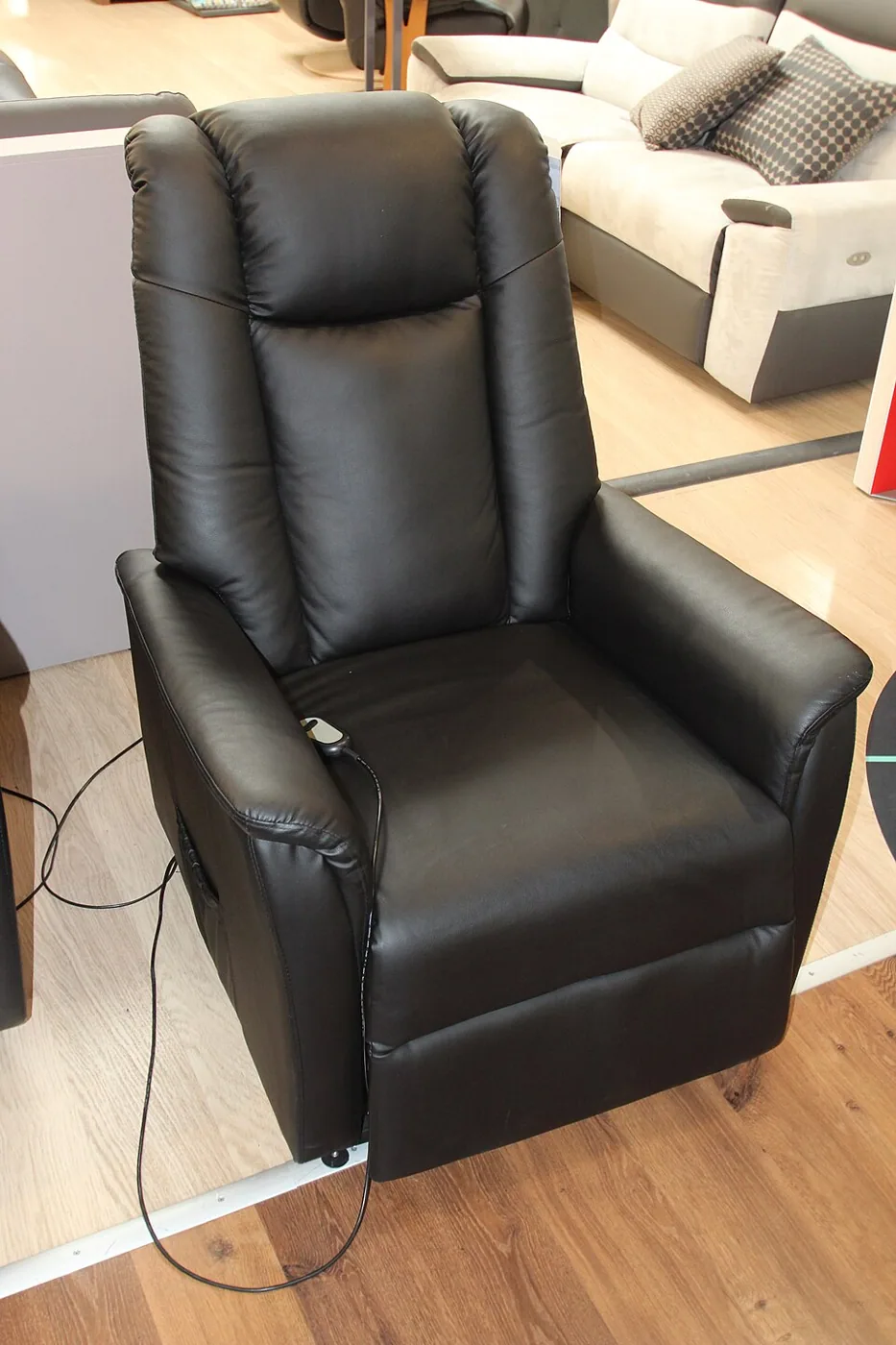
A power recliner has to plug into the wall, and that single fact shapes where the chair can sit. The cord from the chair to the transformer is usually around 6 to 8 feet, and the cord from the transformer to the wall is similar, so the chair has to be placed within about 10 to 12 feet of an outlet at most, and closer is better. An outlet on the far side of a walkway turns a cord into a trip hazard.
The common problem is a floating chair. If the recliner sits in the middle of the room, facing a television, the cord has to cross the floor. Run it along a wall or under the chair's frame, and use a cord cover or a low-profile flat extension cable rather than leaving the cable across a path. Never run a cord under a rug, where it can wear, overheat or be damaged by furniture.
Plan for the plug, too. A transformer is bulky, and it needs space behind the chair or beside it. Some chairs have a USB port on the arm, which uses the same supply. If you plan to put a power recliner at one end of a sofa group, our guide to arranging furniture in a living room explains how to keep walkways clear while meeting the outlet requirement.
Battery packs: the way to cut the cord
Most power recliners can run from a rechargeable battery pack, sold as an accessory by the maker. The pack plugs in where the transformer would, and it removes the cable from the floor. It is a practical fix for a chair in the middle of a room, a rental where you cannot reach an outlet, or a household that worries about trip hazards.
The trade-offs are charge, cost and compatibility. A pack typically supports a number of full cycles per charge, which means days of normal use for most households, but it must be recharged, and a forgotten pack leaves the chair stuck. The pack is an extra purchase in many cases, and it works only with the model it is designed for. Check that the specific recliner supports a pack, since some do not, and that the pack's connector matches.
A pack does not cure a failed motor, and it is not a backup for the chair's own supply in every design. If your priority is working during a power cut, read the listing for the words backup battery, and confirm whether the chair returns to upright on battery power.
Where each type fails
A manual recliner fails mechanically. The most common problems are a footrest that sags or will not fully extend, a squeak from the pivot points, and a handle that loses its grip on the cable. These are usually progressive and visible, so you can see the problem coming. The linkage is also the part that suffers when a heavy person drops into the chair or when a child jumps on the footrest.
A power recliner has more ways to fail, and the failures are often sudden. A motor can burn out, a switch can stop responding, the transformer can fail, and a wire can pull loose inside the frame. A chair that has stopped moving with a hum is often a failed motor, while a chair with no response at all points to the supply or the switch. Fortunately, many makers use replaceable modules for the motor, the switch and the transformer, and a replacement part can be fitted without reupholstering. Check whether the manufacturer sells these parts and for how long.
Two failures are easy to overlook. The first is the pinch point: a power recliner can close with force on a hand, a pet or a toy near the mechanism, and the footrest can trap a small child or a pet underneath. Keep the area under the footrest clear and do not let children play on or around the chair. The second is wear on the supply cable where it exits the chair, which can be damaged by a vacuum or by being dragged. Inspect the cord periodically and replace it if the insulation is damaged.
Read the warranty with the failure types in mind. Many makers give a longer term on the frame than on the mechanism, and a shorter term again on the electronics, so the part most likely to fail may be the one with the least cover. Ask whether replacement motors, switches and transformers are stocked, whether you can fit them yourself, and what the cost of a service call would be in your area. A chair whose listing names its parts and sells them separately is a better long-term purchase than a sealed unit with no spare parts, even at a higher price.
Leather and upholstery matter as well, because a recliner's mechanism pulls on the cover each time it moves. A thin cover over a moving linkage creases and splits along the folds that open and close, usually first at the base of the seat and on the inside of the arms. A thicker material, or a fabric with some stretch, handles the motion better than a stiff, thin covering.
Wall clearance and room size
A standard recliner pivots backward as it reclines, so the back of the chair moves toward the wall. A typical standard recliner needs roughly 12 to 18 inches of clearance behind it to recline fully, and the footrest needs about 30 to 40 inches in front to extend. A wall-hugger design slides forward as it reclines, so the back stays within roughly 3 to 6 inches of the wall, and is much better for tight rooms. We cover the mechanism in our guide to wall-hugger recliners.
Whether a recliner is power or manual does not change these numbers, since the geometry of the linkage decides how far the chair travels. What power adds is the ability to stop partway, which can solve a clearance problem: you can recline only as far as the wall allows. A manual recliner commits to the full motion once released.
Always measure the footprint in the fully reclined position, not the seated one. The length listed in many specifications is the closed length, and the reclined length can be 20 to 30 inches longer. Use painter's tape on the floor to mark the fully extended outline, and confirm that a door, a coffee table or a walkway does not intrude.
Who should buy which
Choose a manual recliner if you want a simple, durable chair with the least to go wrong, if you move often and want a lighter piece, or if the chair will sit in a spot without an outlet. A manual chair is also a sensible choice in a household where the main users are healthy adults who do not need fine adjustment, and where the budget is limited.
Choose a power recliner if the chair will be used by someone with reduced strength, a joint problem or balance concerns, since a button is easier than a lever and the controlled motion lowers the risk of an awkward fall. It is also the better choice for anyone who wants an exact angle for reading, watching television or sleeping, and for people who spend long periods in the chair and need to change position often.
If someone in the household needs help standing, a recliner is not the right tool, and a lift chair is built for the job; see our guide to lift chairs. A power recliner does not lift the user out of the seat, and the footrest and back motions are not a replacement for a lift mechanism.
Frequently asked questions
Are power recliners less reliable than manual ones?
They have more parts that can fail, so over a long period they are more likely to need a repair. The difference is smaller on well-built chairs with replaceable motor and switch modules. A manual recliner's failure is usually mechanical and gradual, while a power failure can be sudden but often fixable by swapping a part.
Can I use a power recliner without an outlet?
Yes, if the model supports a battery pack, which you buy separately. The pack plugs into the same port as the transformer and removes the cord. Check that the pack is compatible with your exact model and plan to recharge it regularly.
How far from the wall should a recliner sit?
A standard recliner needs about 12 to 18 inches behind it to recline fully. A wall-hugger needs about 3 to 6 inches. Always check the manufacturer's stated clearance for the model, since linkage geometry varies, and measure the fully reclined length as well as the seated one.
Does a power recliner use a lot of electricity?
No. The motor draws power only while it is moving, which is a few seconds at a time, and the transformer draws a small amount when idle. Unplug the chair if you want to eliminate the standby draw or if you will be away for a long period.
Is a power recliner safe for children and pets?
It needs supervision. The footrest and back can close with force, and a pet or a small child can be trapped under or beside the moving parts. Keep the area under the chair clear, use the lock or unplug the chair if children are present, and do not let anyone play on the mechanism.
Bottom line
Choose power if comfort, accessibility or an exact angle is the point, and accept the cord, the heavier frame and the higher repair risk. Choose manual if simplicity, weight and a low repair risk matter more, and accept that you will have fixed positions and need some strength to operate it. If you choose power, plan the outlet or buy a battery pack before the chair arrives.
Whichever you pick, measure the fully reclined footprint, check the clearance behind the chair, and look for replaceable parts and a clear warranty. A chair you can service is more likely to last than one sold as a sealed unit.