The two words are used as if they were interchangeable, and in the casual sense they often are. A shopper who types Persian rug is usually looking for the same ornate, richly colored, medallion-and-border rug that another shopper calls an Oriental rug. But the words are not the same, and the difference matters when you are deciding whether a rug is what it claims to be, how much to pay and what to expect from it on the floor.
This guide explains the terminology, the main weaving regions and design families, how knots and construction work, how to tell a handmade rug from a reproduction and how to choose one for a living room. It is based on how traditional rugs are made and sold, and it avoids brand claims. Where the trade has no firm standard, it says so, since the market is full of loose usage.
What the words mean
Oriental rug is a trade term, and it has no legal definition. In common usage it means a handmade rug, usually in wool or silk, made in the traditional manner in Asia, from Turkey and the Caucasus across Iran and Central Asia to Afghanistan, Pakistan, India, Nepal and China. The word Oriental points to the region and the tradition, not to a specific style, so a Turkish kilim, an Indian dhurrie and a Chinese silk rug can all be called Oriental.
Persian rug has a narrower meaning: a rug made in Iran, formerly Persia. The tradition goes back many centuries, and Persian weavers are known for fine knotting, refined designs and a wide range of regional styles. All Persian rugs are Oriental, but only some Oriental rugs are Persian. A rug made in India in a Persian design is an Indian rug, even if it looks like a Kashan.
The confusion is made worse by marketing. Persian-style, Persian design and Persian look usually describe the pattern, not the origin. A machine-made rug from Turkey, Egypt, Belgium or China may carry one of those labels and be a perfectly good rug, but it is not a Persian rug. If origin matters to you, look for the country of origin on the listing or the label, and ask directly whether the rug is handmade and where.
| Term | What it usually means | Handmade? | Check |
|---|---|---|---|
| Persian rug | Made in Iran | Usually, but not always | Country of origin, back of the rug |
| Oriental rug | Traditional-style rug from Asia | Often, but the term is loose | Country, construction method |
| Persian design or style | Pattern imitates Persian rugs | Often machine-made | Look for hand-knotted on the label |
| Oriental style | Any rug with an eastern look | Often machine-made | Back of the rug, price |
| Hand-knotted | Each knot tied by hand on a loom | Yes | Pattern visible on the back |
| Machine-made | Woven or tufted by a power loom | No | Uniform back, fringe sewn on |
Regions and design families
Persian rugs are named for the city, town or tribe where they were traditionally made, and the names are a shorthand for a style. Tabriz rugs are known for fine knotting and medallion or allover designs, and Kashan rugs for rich red and blue palettes and a central medallion. Isfahan rugs have intricate curvilinear patterns, Nain rugs are fine and use ivory and blue, and Qom rugs are very fine and often made with silk. Heriz and Serapi rugs are bold and geometric, with large medallions, and Hamadan rugs are sturdy village pieces. Sarouk, Kerman and Mashhad are other well-known names.
Tribal and nomadic rugs, such as Qashqai and Bakhtiari, are more geometric and often irregular in shape, with a more rustic look. They are woven by families and tribes using local wool and natural dyes in some cases, and are valued for their character.
Design families cut across regions. A medallion rug has a central motif, often surrounded by corner pieces. An allover or repeating design, such as the Herati pattern, covers the field with a regular repeat. Garden or vase designs include flowers, trees or water scenes, a pictorial rug shows figures or scenes and a prayer rug has a niche shape for the direction of prayer. Knowing the family helps you describe what you want when you shop.
Other Oriental rugs have their own traditions. Turkish rugs, including Oushak and Hereke, Caucasian rugs with bold geometric designs, Chinese rugs with sculpted pile and Indian rugs, many made in Persian patterns, are all part of the category. Names such as Tabriz or Kashan are used by weavers in several countries, so a Tabriz design does not guarantee a Tabriz origin.
Construction and knots
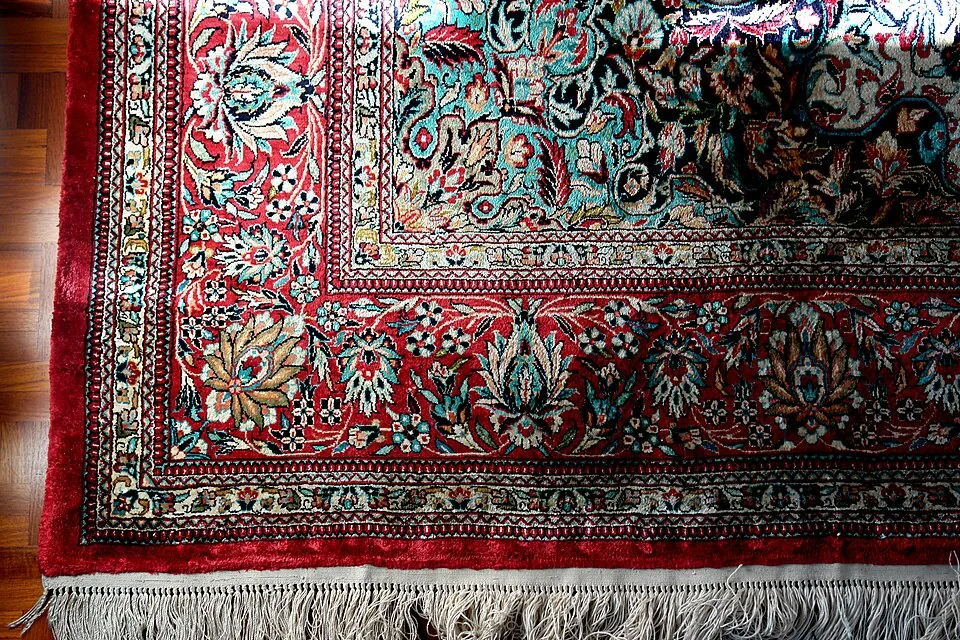
A hand-knotted rug is made on a loom with a set of vertical warp threads. A weaver ties short lengths of wool or silk yarn around pairs of warp threads, row by row, and each knot forms one point of the pile. Between rows, one or more weft threads are passed through and beaten down to lock the knots. The pile is then clipped to a uniform height and the rug is washed and finished. A room-size rug can take months or years.
Two knots are common. The symmetrical or Turkish knot, also called Ghiordes, loops the yarn around both warp threads of a pair. The asymmetrical or Persian knot, also called Senneh, loops around one warp thread and passes under the other, which allows a finer, more detailed pattern. In practice, both knots are used in Iran and elsewhere, and the type of knot does not by itself identify a rug's origin.
Knot density, expressed as knots per square inch or per square decimeter, is a rough measure of fineness. A finer rug has more knots and can carry more detail in its curves, and it is generally slower to make. But a higher count does not automatically mean a better rug, since wool quality, dye, wash and condition matter as much. Beware of listings that quote very high counts without a method, since there is no universal verification.
Materials matter too. Wool is the usual pile, with cotton or wool warp and weft, and silk appears in finer rugs, sometimes as highlights. A wool-on-cotton rug is firm and durable, and a silk rug is delicate and suited to low traffic. Our guide to hand-knotted versus machine-made rugs covers the contrast in detail.
Handmade or reproduction: how to tell
Turn the rug over. On a hand-knotted rug, the pattern appears on the back almost as clearly as on the front, because the knots are visible as small bumps in rows, and the back looks slightly irregular. On a machine-made rug, the back is uniform and often covered with a stiff coating or a woven fabric, and the pattern is less sharp, since it is woven in a different way.
Check the fringe. In a hand-knotted rug, the fringe is the continuation of the warp threads, and you can see that it comes out of the body of the rug. In many machine-made rugs, the fringe is sewn or glued on, and it ends at a hem. Look at the edges, which in a handmade rug are overcast by hand with a slightly uneven finish.
Irregularity is a clue, not a defect. A hand-knotted rug often has small variations in line and color, such as slight color changes in a field called abrash, which come from different dye lots of handspun wool. A machine-made rug is perfectly regular. A flawless, mathematically even pattern, a thin, flat feel and a low price for a large size are signs of a machine-made rug.
Not all reproductions are bad. A good machine-made rug in a Persian design is durable and affordable, and it can look beautiful in a living room. The issue is honesty: a buyer should know what the rug is. Ask for the construction, the fiber, the origin and the return policy, and a trustworthy seller will answer clearly. Be wary of dramatic going-out-of-business sales, inflated original prices and claims of antique status without documentation.
Color and dye are another place where origin and age leave a mark. Traditional rugs were dyed with plant and insect sources such as madder root for reds and indigo for blues, and these dyes soften as they age, which gives older rugs their mellow tone. Chemical dyes arrived in the nineteenth century and are common today, and good ones are stable and bright. Poorly fixed dyes can run when wet, so a rug that bleeds onto a white cloth in a damp test, done on a hidden corner, should not be cleaned at home. A wash, whether chemical or natural, can also be applied to a new rug to imitate age, which is a legitimate finish as long as the seller says so.
Age, value and condition
Value depends on several factors: origin, age, fineness, materials, condition and design. An antique rug, generally considered to be a century old or more, can be valuable if it is in good condition, but there is no single standard that sets a price, and an appraisal by an independent expert is the way to find out. A new hand-knotted rug in good wool has a lasting value, while a machine-made rug is a household item and loses value like any other.
Condition problems include worn pile, moth damage, dry rot in the foundation, stains, fading and repairs. Many old rugs have been repaired or re-fringed, which is normal if it is done well. Check for areas where the foundation is visible, brittle fringes and dye that has run. Do not buy a valuable rug without an inspection.
Be sober about the market. Rugs are sold with stories, and many of the stories are not verifiable. Treat claims about age, tribe and rarity as the seller's opinion unless supported by documents, and value the rug for how it looks and wears in your room.
Choosing and using one in a living room
Start with size and shape. A traditional rug usually comes in standard sizes, such as 5 by 8, 8 by 10 and 9 by 12 feet, though handmade rugs vary, and the choice depends on the seating arrangement, as we explain in our guide to what size rug for a living room. A runner suits a hall and a small rug an entry.
Think about wear. A wool Persian rug is among the more durable choices for a living room, since the fiber is resilient and the dense pile hides soil, and a busy pattern conceals spots and pet hair. Silk and fine rugs are best in low-traffic areas. Use a good pad, which protects the rug and the floor, and rotate the rug every year or so. Our guide to wool versus polypropylene rugs compares the fibers.
Pair it with the room. A traditional rug works with traditional and eclectic rooms, but it can also anchor a modern room as a contrast. A rug with a dominant color works as a focal point, and a more muted antique wash rug blends. Limit the number of patterns in the room, and let the rug be the main pattern, or choose solid upholstery and curtains.
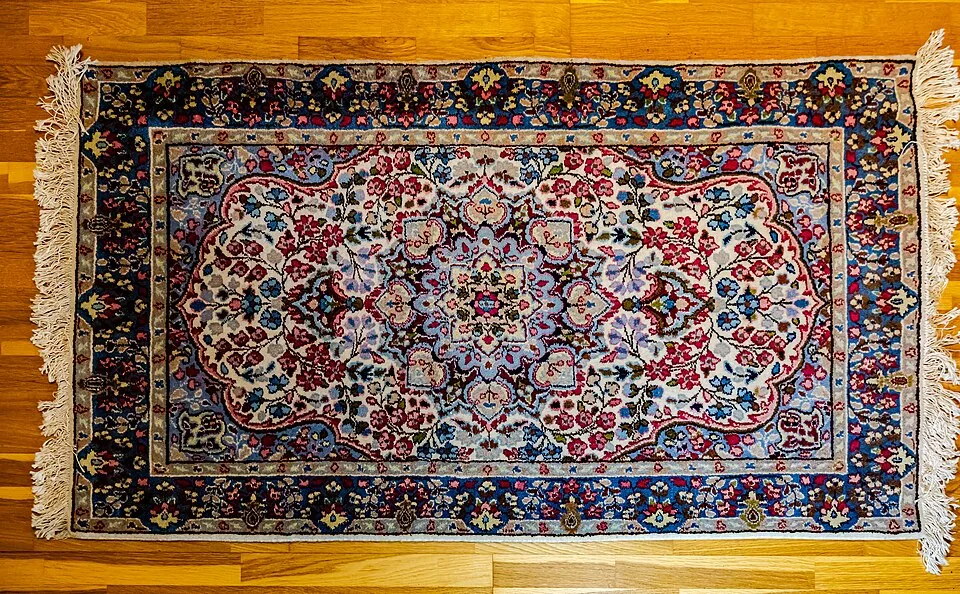
When you shop, compare like with like. A hand-knotted wool rug of a given size takes far longer to make than a machine-made one, so the price gap is real and legitimate, and a hand-knotted rug priced close to a machine-made rug of the same size deserves a closer look. Ask whether the rug is wool on cotton, wool on wool or silk, whether it has been washed and how, and what the seller's return window is. Request photos of the back and of a close view of the pile. A seller who is happy to provide these usually knows the product.
Care notes for traditional rugs
Vacuum regularly with suction and no beater bar, and avoid pulling the fringe. Rotate the rug and keep it out of direct sun, which fades dyes unevenly. Blot spills at once, and do not use strong cleaners, since some dyes can bleed, which is a particular risk in rugs colored with unstable dyes. Test in a hidden spot.
Have a handmade rug professionally washed every few years, depending on traffic, by a specialist who knows how to handle the fibers and dyes. Store a rug rolled, not folded, in a breathable cover, away from moths. Check regularly for signs of moth damage, such as small bald patches or fine webbing, and treat promptly. Our guide to cleaning an area rug at home explains basic care.
Frequently asked questions
Is every Oriental rug Persian?
No. Oriental covers handmade rugs from across Asia, including Turkey, India, Pakistan, China and the Caucasus, and Persian means made in Iran. So Persian rugs are a subset of Oriental rugs.
How can I tell if a Persian rug is real?
Look at the back for visible knots and a pattern that mirrors the front, check that the fringe is part of the rug and ask for the country of origin and construction. A very low price for a large size, a uniform pattern and a stiff coated back suggest a machine-made rug.
Are machine-made Persian-style rugs a bad buy?
Not necessarily. They can be durable and affordable, and the pattern is attractive. The issue is knowing what you are paying for. Compare them with other machine-made rugs, not with handmade pieces.
Do Persian rugs hold their value?
Some do, particularly fine, well-conditioned handmade rugs, and antiques can be valuable. There is no guarantee, and the market varies. Get an independent appraisal if value matters.
Are Persian rugs good for living rooms?
Yes, a wool hand-knotted rug is durable and hides wear. Use a pad and avoid direct sun. Keep silk rugs for lower-traffic spaces.
Bottom line
Treat Persian as a statement of origin and Oriental as a statement of tradition, and treat Persian design and Oriental style as descriptions of a pattern. Ask for the origin and construction, turn the rug over and be skeptical of a price that is too good for the size.
A wool hand-knotted rug will wear for decades in a living room, and a well-made machine reproduction can look good for years at a lower price. Decide which you want, buy it for what it is and give it a pad and regular care.