Ordering a sectional involves a decision that does not exist for a plain sofa: which side the chaise or the open end goes on. Get it right and the piece fits the room as if it were built for it. Get it wrong and you have a heavy, expensive piece that points the wrong way, blocks the door or leaves the chaise in a dead corner. The abbreviations used to describe the choice, LAF and RAF, confuse almost everyone the first time they see them.
This guide explains what the terms mean, how to read a listing without making the common mistake, how to choose the side from your room and traffic flow, how reversible chaises and modular pieces avoid the problem, and what to do if you have already ordered the wrong side. It is based on how retailers and manufacturers describe sectional components, and on the mistakes that show up most often in owner feedback.
What LAF and RAF actually mean
LAF stands for left-arm facing and RAF for right-arm facing. The word facing refers to your position as you look at the piece from the front. Imagine standing in the room, looking at the sofa the way a stranger would see it from across the coffee table. If the arm or the chaise is on your left side, that component is LAF. If it is on your right, it is RAF.
The key point is that the orientation is defined from the front looking in, not from the seated position looking out. When you sit on a sofa, your left is the stranger's right. Many people instinctively picture sitting down, which flips the answer and produces a sectional with the chaise on the wrong end. The safe habit is to ignore sitting entirely and imagine looking at the front of the piece.
These terms are an industry convention, not a formal standard that every retailer follows. Some listings use left-facing and right-facing, some use left-hand and right-hand, and a few use the seated viewpoint. Always check for a diagram that shows the finished layout, and read the description of the chaise position in words. When a retailer's diagram and text disagree, ask before ordering.
Reading a listing without errors
Sectionals are often sold as a set of components, such as a LAF chaise, a corner piece and a RAF armless chair, each with its own code. If you need to build the sofa from parts, the labels refer to each component, and the final shape depends on how they combine. The listing might say that a LAF chaise plus a RAF loveseat creates an L with the chaise on the left, but that is only true if both labels use the same viewpoint.
Use this process. First, find the diagram of the configuration you want, with the sofa drawn from above and the front clearly marked. Second, mark on your own floor plan which wall the back will sit against and which side the chaise should be on, looking at the front. Third, match the label to the side you marked and confirm it in the listing's text. Fourth, if the option names do not appear to match the diagram, contact the seller and ask in writing which side the chaise will be on when you face the front.
Also check whether the listing sells a pre-configured sectional. Many two-piece and three-piece sets ship with the sides fixed, so the choice is made at checkout with a dropdown that says left or right. A dropdown with no diagram is a risk. Take a screenshot of the page and the dropdown before you order, which gives you a record if the piece arrives on the wrong side.
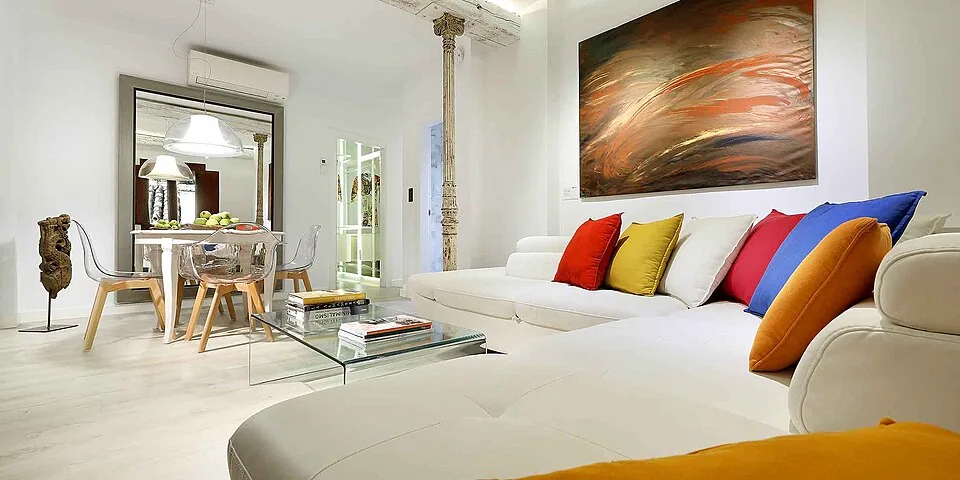
Choosing the side by traffic flow
The right side is the one that leaves the room easiest to use. Start with the doors. The chaise or open end should not point toward the main entrance, since it will stick into the walkway, and the long run of seats should face the focal point, usually the television or fireplace. A chaise that ends where people walk invites toe stubs and leaves one corner of the room unused.
Next, consider where people enter. If the main doorway is on the left side of the room as you face the front of the sofa, a chaise on the right keeps the walking path clear. Often the open end should point toward the center of the room or toward a window, where legs stretched out do not block anyone. If the room is narrow, the chaise should point along the long wall, not across the narrow dimension.
The final test is behavior. A right-handed person who reads with the book in the right hand often prefers the arm of the sofa on their right to rest on. Households that watch television from the chaise end should check the angle of the screen. A chaise that sits too close to the corner turns the viewer away from the television, and a chaise at the far end from the screen gives the best view.
For layout reasoning beyond the chaise, our guide to arranging furniture in a living room explains the 30-inch walkway rule and the effect of a sectional's depth on traffic.
Measure both orientations before you commit
It is easy to measure for one side and forget the other. Draw the sectional to scale on graph paper, or mark it on the floor with painter's tape, and then flip it. In a room with an off-center window, a radiator or a vent, one orientation may leave an end table blocked or a lamp outlet out of reach.
The chaise length is the dimension most likely to cause problems. A chaise typically extends the seat to roughly 60 to 70 inches in total length, which is about 20 to 30 inches beyond a regular seat. That extra length can hit a door swing, a coffee table or a radiator. Hold a tape measure at the point where the chaise would end and open any nearby door fully to confirm clearance. Our guide to measuring a living room for a sofa covers the four measurements that matter.
Corner-sectional dimensions also matter. An L-shaped sofa has two long sides, and in a small room one of them may run past the end of a wall. Measure the longer side against the wall length, and leave a few inches so the piece can be pushed back and does not touch a baseboard heater.
| Room situation | Good chaise side | Reason |
|---|---|---|
| Door on one short wall | Away from the door | Keeps the walking path clear |
| Window on one side, TV opposite | Toward the window | Chaise end has the best view |
| Corner of the room is open | Toward the open side | Avoids a long run into a dead end |
| Narrow room | Along the long wall | Preserves walkway width |
| Open plan with a dining area | Facing the living area, open end toward the dining table | Defines the zone without blocking |
Reversible chaises and modular options
The simplest way to avoid the mistake is to buy a sectional whose chaise can be switched. A reversible chaise is a separate ottoman or chaise unit that is not permanently attached to the frame on one side. It can be moved from the left to the right, either by unclipping it or by moving a loose cushion. The sofa is built with seats and a back on both sides, so either arrangement looks finished.
The benefit is flexibility for moves and room changes. If you rent, a reversible chaise means the sofa works in the next apartment even if the layout is mirrored. The cost is that the chaise is usually a separate piece with its own connectors, which means a seam and a joint that can shift, as we explain in our guide to modular sofa pros and cons. A reversible chaise tends to have a lighter frame and may feel less solid than a fixed one.
Check how the reversal works. Some reversible chaises simply move, and the sofa has an armless end that can be finished on either side. Others have one arm that must be removed and reattached. Where a part is bolted, the instructions should say how long the change takes, and whether you need a second person. A listing that says reversible without describing the mechanism deserves a question.
Fixed pieces and what they cost if you are wrong
A fixed sectional, with a chaise built into the frame, is stiffer and often cheaper, but a wrong choice is hard to correct. The frame cannot be mirrored. If you order a LAF set and need RAF, the return process involves the whole sofa, and many retailers charge for pickup, restock or both on large items. Read the return policy for oversize furniture before you order, particularly for items that ship by freight.
A mistake can sometimes be rescued without a return. If the sectional is modular, the chaise can be swapped for a matching RAF piece if the line sells one separately, though you will have two chaises and need to resell the spare. If the sofa is placed in a corner, you may be able to rotate the layout so the chaise sits on the other side of a different wall. And if the room allows, a mirror arrangement may work simply by moving the sofa to the opposite wall and re-aiming the television, which is a nuisance but cheaper than replacing the sofa.
Some people also solve the problem with a separate ottoman instead of a chaise, using a standard sofa with a movable ottoman. That is not a true sectional, but it gives the same lounging function without a side decision.
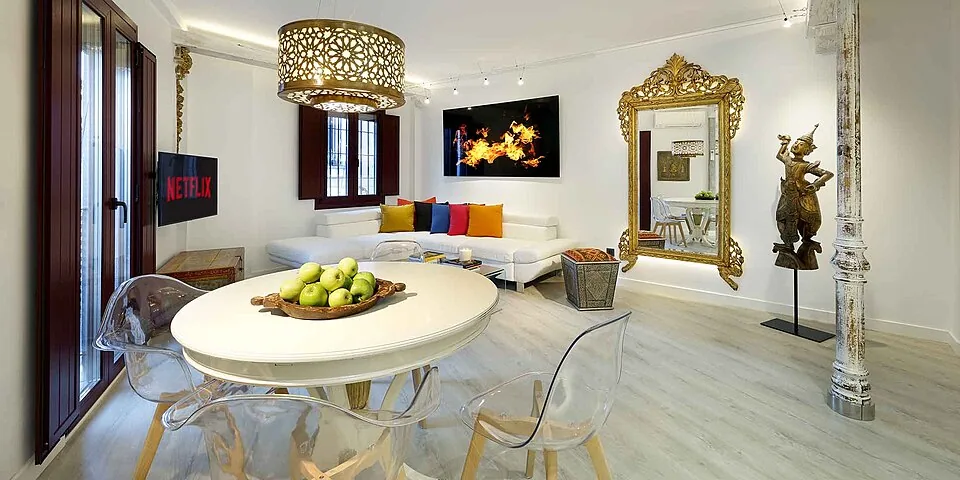
One more situation deserves a mention: a sectional that sits in the middle of the room as a divider, with its back to a dining area or a hallway. Here the LAF or RAF choice decides which end meets the wall and which end is open, and the open end becomes a passage. Leave at least 30 inches there, and remember that the finished back of the sofa faces the other zone, so check that the back panel and the rear legs are presentable, since many sectionals have an unfinished or lightly covered rear. Floating placement also needs a rug that anchors the front legs, and a console or narrow table behind the sofa can hide the back while giving a surface for lamps.
A short pre-order checklist
Before you pay, run through a few checks. Confirm in the listing's text, not only in the dropdown, whether the chaise will be on the left or right as you face the front. Mark the planned position on the floor with tape and stand at the doorway to see how it looks. Open nearby doors and drawers to check clearances. Confirm that the return policy covers a wrong side, and keep a screenshot of the configuration you selected.
If you ordered a multi-piece set, count how many components there are and what each is called. A common error is ordering matching pieces on both sides, for example two LAF components, and getting a layout that cannot connect. A good retailer will flag this, but a marketplace seller may not. Check that the corner piece is included, since some sets sell the chaise and the sofa without the connector.
Frequently asked questions
How do I know which side is left-arm facing?
Stand in front of the sofa as if you were looking at it from the coffee table. The arm on your left is the left arm. That is LAF. The arm on your right is RAF. Never use the view from sitting on the sofa, which reverses the answer, and confirm with the seller's diagram.
Does the chaise side affect comfort?
Slightly. It changes which seat has the leg support and which corner is open, so it affects who gets the lounging spot and where people walk. It does not change seat depth or firmness. The most noticeable effect is on the television view and on the walking path, not on the cushions.
Can I switch the chaise later?
Only if the sofa is built for it. Reversible and modular sofas allow a switch. A fixed frame does not, and moving the chaise would mean replacing the piece. If you expect to move house, a reversible or modular design is a safer buy than a fixed LAF or RAF set.
What if my room has two possible orientations?
Draw both to scale, mark the doors, windows, vents and outlets, and choose the one that leaves the walkway clear and the open end toward the center of the room. If both work, pick the one that puts the chaise nearest the wall outlet for a lamp or charging, and keeps the main seating facing the television.
Do left-handed people need a particular side?
Not as a rule, but the arm side can matter for reading or resting a drink. A left-handed person who uses an arm as a table may prefer the arm on the left. It is a personal choice, and traffic flow and door positions usually matter more.
Bottom line
Read LAF and RAF from the front of the sofa, looking at it, and confirm the result with a diagram and a sentence in the listing. Then choose the side that keeps the walkway clear, aims the open end at the center of the room and gives the chaise the best view. Draw both orientations before deciding, because the difference is often a door swing or a vent.
If you are unsure of the room, rent, or expect to move, buy a reversible chaise or a modular system and remove the risk. If you buy a fixed set, keep the screenshot and read the return policy first, since a wrong side on a heavy piece is expensive to correct.