Most people choose a ceiling fan by looking at the blades and the finish, then discover a year later that it wobbles, hums, barely moves the air or hangs so low that a tall guest ducks under it. The fan itself is a simple machine, but five numbers decide whether it works in your room: blade span, mounting height, airflow, motor type and noise. Get those right and the style is the easy part.
This guide works through each of them in the order you would use at the store or when reading a product listing, with figures for the typical living room. It also covers when the fan should carry a light and when it should not, because that choice affects both comfort and the rest of the room's lighting plan.
Blade span by room size
Blade span is the diameter of the circle the tips trace, and it is the single most important size choice. A fan that is too small for the room has to spin faster to move the same air, which increases noise and leaves the corners still. A fan that is too large in a small room can feel like a turbine overhead and may look cramped. The common guideline pairs span with floor area.
| Room size | Floor area | Fan span |
|---|---|---|
| Small | Up to 75 sq ft | 29 to 36 in |
| Medium | 76 to 144 sq ft | 36 to 42 in |
| Standard living room | 144 to 225 sq ft | 44 to 52 in |
| Large living room | 225 to 400 sq ft | 52 to 60 in |
| Great room | 400 sq ft and above | 60 in or two fans |
For a long, narrow living room, one fan in the middle serves a 15 by 15 foot area well, but a room that is 12 by 28 feet is better served by two smaller fans than one large one, each centered over a seating group. Air from a single fan fades with distance, and two fans give even coverage at lower speeds.
Check clearance too. The tips of the blades should be at least 18 inches from any wall, and ideally 24 inches. A 52 inch fan needs a room at least 8 feet across to meet that clearance on both sides.
Mounting height and downrod length
For safety and for air movement, the blades should hang between 8 and 9 feet above the floor. Lower than 7 feet and a raised arm can collide with the blade; higher than 9 feet and the airflow dissipates before it reaches people on the sofa. The distance from the ceiling to the blade plane is controlled by the downrod, the metal tube that connects the motor to the ceiling bracket.
The usual fan sold with a short closeup mount or a 3 to 6 inch downrod suits an 8 foot ceiling. As the ceiling rises, the downrod should lengthen so the fan hangs in the right range. A ceiling of 9 feet generally calls for a 6 inch rod, 10 feet for 12 inches, 12 feet for 24 inches and 14 feet for 36 to 48 inches. Longer rods can wobble if a cheap one is paired with a heavy motor, so buy the rod the manufacturer specifies for the fan.
| Ceiling height | Suggested downrod | Blade height |
|---|---|---|
| 8 ft | Flush mount or 3 to 4 in | About 7.3 to 7.8 ft |
| 9 ft | 6 in | About 8.2 to 8.5 ft |
| 10 ft | 12 in | About 8.9 ft |
| 12 ft | 24 in | About 9.5 ft |
On an 8 foot ceiling, a low-profile or hugger fan sits as close as possible, and the blades will hang near 7.5 feet, below the ideal. That is acceptable in most living rooms where no one stands directly under it, but it is not the place for a very tall household or a fan over a play area. Sloped ceilings need a fan rated for angled installation and often a downrod with a ball joint.
Airflow: CFM is the number that counts
Airflow is measured in cubic feet per minute, or CFM. A listing that gives only blade span or speed settings tells you very little, because two fans of the same size can move very different amounts of air depending on blade pitch and motor power. Look for the CFM at high speed, and the efficiency in CFM per watt. For a living room of 150 to 250 square feet, a fan that delivers about 4,000 to 6,000 CFM on high is a sound range; larger rooms need 6,000 to 8,000 or more.
Blade pitch, the angle of the blade, is the quiet driver of airflow. A pitch of around 12 to 14 degrees moves air efficiently. A fan with flat blades of 5 or 6 degrees looks sleek but barely moves anything, a trap in decorative fans sold on appearance. Blade count matters less than people think. Three or four blades often move more air than five or six because each blade has less turbulence from the one ahead, while extra blades mainly add visual fullness and quieter running at low speed.
Direction also changes how a fan serves you. In summer the fan turns counterclockwise when viewed from below, pushing air downward to create a breeze that cools skin by evaporation. In winter, a reverse switch makes it turn clockwise at low speed, drawing air up along the walls and gently redistributing warm air that has collected near the ceiling. The fan does not cool the room itself, it cools people, so turn it off when no one is in the room.
AC versus DC motors
Most traditional fans use AC motors, which are inexpensive and robust. A DC motor uses less electricity, often by 50 to 70 percent at the same airflow, runs much more quietly and typically offers more speed settings, often six rather than three. It is also usually paired with a remote. The tradeoff is cost: DC fans sit higher in price, but in a living room that runs a fan for hours each day, the lower power draw and silence pay back in comfort.
For a space where you watch television or hold conversations, noise is the deciding factor. A fan that hums at 45 decibels at medium speed is audible over quiet dialogue, while a good DC fan often stays near 30. Manufacturers do not always publish noise ratings, so reading owner feedback for the words hum, wobble or click is a useful substitute.
Fan with a light kit or without
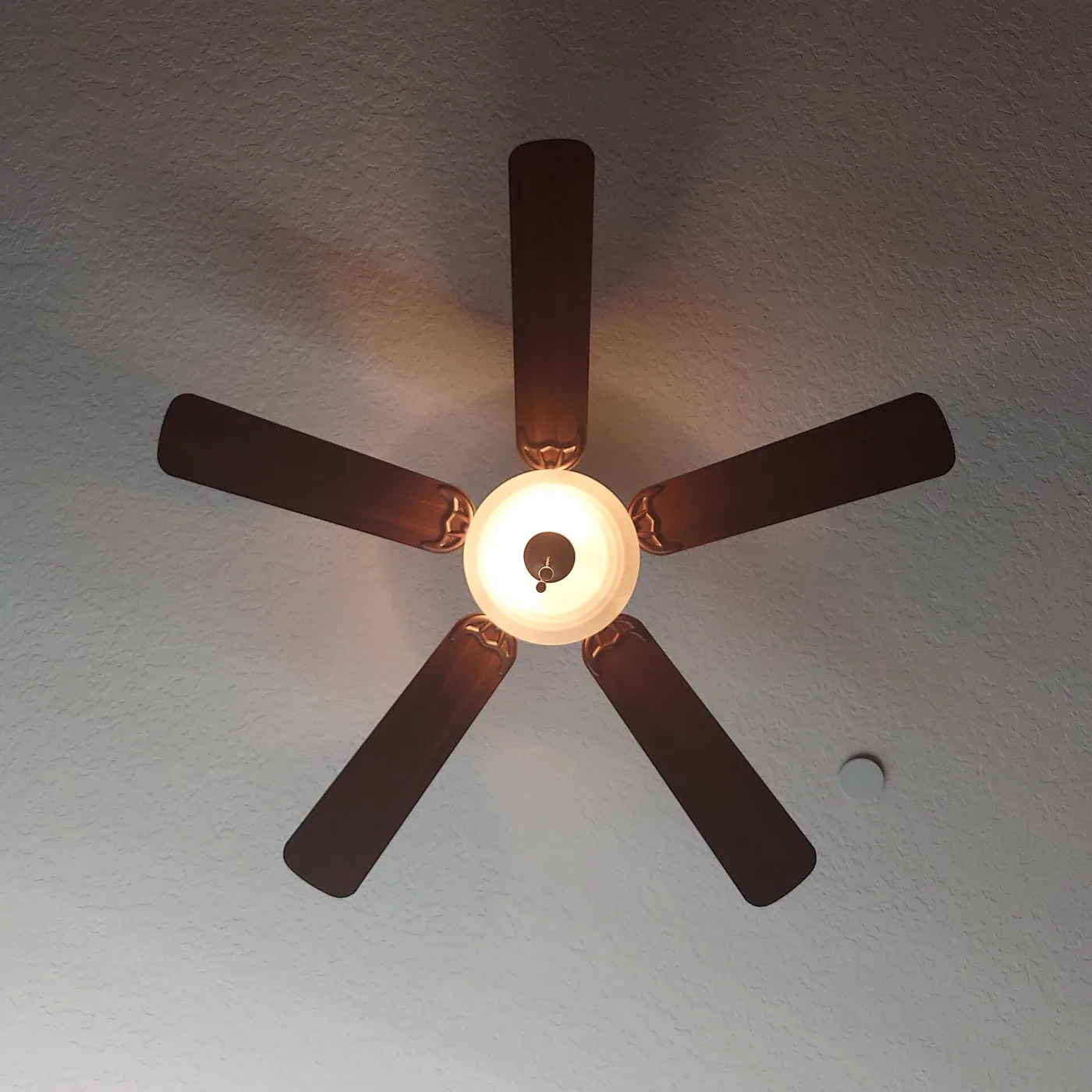
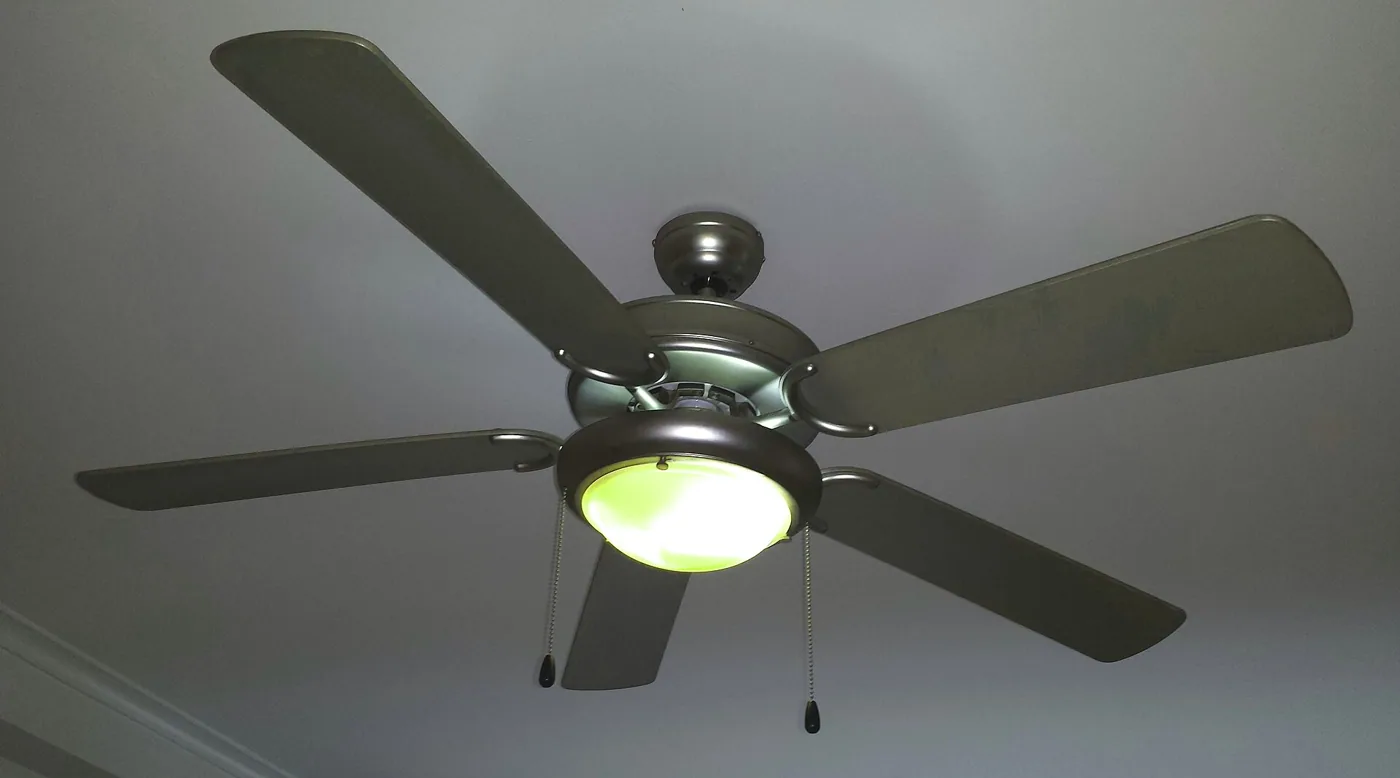
A fan with a light kit saves a ceiling box when only one fixture position exists, which is common in older homes. The compromise is that a fan casts a flickering shadow from the blades when its light is on, and the integrated light is usually a single point of illumination, poorly placed for a living room. If your living room already has recessed lights or lamps, a plain fan with no light keeps the ceiling clean and lets you choose lighting separately.
If you need the integrated light, choose LED with a dimmable driver and a color temperature of 2700K to 3000K to match the rest of the room. Confirm the fan's light dimming and its fan-speed control are separate. A wall control that adjusts both from one switch on an incompatible dimmer can cause the fan to hum, so use the fan-rated control that comes with it. Our guide to dimmer switch types explains why mismatched dimmers fail.
Think of the fan light as ambient lighting only. Reading, screens and conversation are better handled by table and floor lamps, which the layered lighting guide describes. Where a ceiling already holds a grid of cans, see the recessed lighting layout guide to keep the fan out of their light paths.
Noise, wobble and installation
Wobble is the most common complaint and almost always comes from installation, not the fan. The ceiling box must be rated for a fan and secured to the framing, not just the drywall. A standard light fixture box is not rated for the weight and rotating forces of a fan, so replace it with a fan-rated box or a brace that spans two joists. Tighten all blade screws, check that every blade weighs the same with the balancing kit included in the box, and make sure the blade arms are straight.
Clicking at high speed usually comes from loose switch housing screws or a light kit rattling. Humming with a remote or wall control is often from a control that is not designed for the motor type. Use the supplied control, and avoid using a standard light dimmer to slow a fan, since that damages the motor over time.
Running cost and how to use the fan well
A modern fan is cheap to run, and the difference between motor types is mostly about comfort. An AC fan on high commonly draws 60 to 90 watts, while a DC fan delivering comparable airflow draws 20 to 35 watts. Even at the higher figure, a fan costs only a small fraction of what it saves if it lets you raise the thermostat a few degrees. The saving disappears if the fan runs in an empty room, because it changes how warm you feel, not the air temperature itself.
Use speeds with intent. High speed suits a hot afternoon when people are sitting under the fan. Low speed, in reverse, helps in winter in rooms with ceilings above 9 feet, where warm air gathers out of reach. Medium speed is enough for most evenings. If you notice papers lifting off the coffee table or a candle flickering, the fan is too strong for the seating position, and moving the sofa or dropping a speed is the fix.
Cleaning is the maintenance task people forget. Dust builds up on the leading edge of each blade, adds weight unevenly and can contribute to wobble. Wipe the blades twice a year with a damp cloth, or use a pillowcase slipped over each blade to catch the dust. While you are up there, check that the mounting screws are snug, since the motion of a fan loosens hardware slowly over years.
Open plans, sloped ceilings and low rooms
A living room that flows into a kitchen and dining area usually needs the fan sized to the whole open volume, not just the seating corner. In that case a 60 inch fan, or two 52 inch fans spaced evenly along the long axis, gives better coverage than one fan over the sofa. Keep the fan away from the kitchen end if cooking draws a smoky draft, because a fan will push those smells straight into the seating area.
For sloped ceilings, check that the fan is rated for the pitch, which is usually up to 30 degrees for a standard downrod and a canopy that tilts. Steeper slopes need an angle-mount kit. The downrod should be long enough that the blades clear the slope at their highest tip, which on a 12:12 roof pitch can need 36 inches or more.
Low rooms, with ceilings under 8 feet, are the hardest case. A hugger fan with a flush mount and blades at least 7 feet above the floor is the only safe option, and some builders avoid fans entirely under 7.5 feet. In these rooms, consider a wall-mounted or oscillating pedestal fan as an alternative, or a low-profile fan with blades that fold upward to clear taller occupants.
Style, finish and the practical details
Once the numbers are settled, choose style that suits the room. Blades in wood, white or matte black suit most living rooms. Reversible blades offer two finishes. Wet-rated or damp-rated models are only needed for covered porches, not the living room. A remote or smart controller is useful because the pull chain of a high fan is hard to reach and easy to ignore. If a room has a vaulted ceiling, a remote is nearly a necessity.
Frequently asked questions
What size ceiling fan do I need for a 15 by 15 foot living room?
That room covers 225 square feet, which sits at the boundary between a 52 inch and a 60 inch fan. A 52 inch fan with good airflow is usually enough if the ceiling is 8 to 9 feet. Pick 54 to 60 inches if the ceiling is high or the room is open to another space.
Is a ceiling fan worth it if I have air conditioning?
Yes, because moving air lets you raise the thermostat by roughly 4 degrees Fahrenheit with similar comfort, which reduces cooling use. The fan only helps when someone is in the room, so use it with occupancy rather than leaving it on all day.
Can I install a ceiling fan on an existing light fixture box?
Only if the box is marked as fan-rated or you replace it with a fan-rated box or brace. A normal fixture box can loosen under the rotating load and may fail. Treat this as a safety check, not an optional upgrade.
Do more blades make a fan stronger?
No. Blade pitch and motor power have more effect than count. Many five-blade fans are quieter and look fuller, but three and four-blade designs often move more air for the same motor.
How do I reduce fan noise?
Tighten the screws, balance the blades with the included kit, confirm the box is secure and use the correct control. Choosing a DC motor for new purchases gives the largest quiet improvement.
Bottom line
Start with the room: measure floor area for the blade span, measure ceiling height for the downrod, and keep the blades 8 to 9 feet above the floor with 18 to 24 inches of clearance from walls. Then look at CFM and the pitch of the blades before looking at the finish.
For a living room where you spend hours, buy a DC motor fan with a remote, and treat the light kit as optional. Install it on a fan-rated box. Do those four things and the fan will move air quietly for years instead of wobbling and humming through every film night.