Furniture listings use the word wood generously. A cabinet described as wood may be a solid timber piece, a plywood box with a veneer front or a particleboard carcass wrapped in a printed paper that looks like oak. All three are sold under the same word, and they behave very differently over ten years: how they take a spill, how they carry weight, whether they can be repaired and whether the screws hold after the second move.
This guide explains what solid wood and each type of engineered wood actually are, how they compare on strength, moisture, refinishing, weight and repair, how to read labels and listings and where each material is a sensible choice. It is based on how the materials are made and on patterns in owner feedback, and it avoids brand claims. The conclusion is not that one is always better, but that the right one depends on the part of the furniture and the way you use it.
What solid wood is
Solid wood is timber sawn from a tree and used as a board, with the grain running through the whole piece. A solid-wood tabletop is one or several boards joined edge to edge. Hardwoods, such as oak, maple, walnut, cherry and ash, come from broad-leaved trees and are generally denser and harder, and softwoods, such as pine, fir and cedar, come from conifers and are lighter and softer. Hardness varies widely, and pine dents easily where oak does not.
Its main advantages are strength, repairability and longevity. A solid board holds screws and joints firmly, and a scratch, a ring or a worn finish can be sanded out and refinished, usually several times. Solid wood ages in a way people like, developing a patina, and a well-made piece can last for generations. It also feels different, warm and substantial, and has a real grain that continues through the thickness.
The disadvantages are weight, cost and movement. Wood is heavy, so large solid pieces are hard to move, and solid wood is generally more expensive than engineered alternatives because good timber costs more and the construction takes more skill. Wood expands and contracts across the grain as humidity changes, so wide solid panels can warp, cup, split or shrink if they are not designed to move. Good makers allow for this with joinery, and poor ones do not.
The engineered types
Engineered wood is a family of materials made by breaking wood into thinner pieces or fibers and bonding them with adhesives under heat and pressure. The types differ greatly, and lumping them together as engineered is a mistake that costs buyers.
Plywood is made of thin sheets of wood, called veneers or plies, glued with the grain of each layer at right angles to the next, with an odd number of layers. The cross-grain construction makes it strong and stable, since the layers resist each other's movement, and it holds screws well. Good plywood, such as birch or hardwood plywood, is used in quality furniture carcasses, drawers and shelves, and it can be nearly as good as solid wood for many uses. Cheap plywood can have voids and thin layers, and the edge shows the layers.
Medium-density fiberboard, MDF, is made of fine wood fibers, wax and resin pressed into a dense, smooth board with no grain. It takes paint extremely well and machines cleanly, so it is used for painted cabinet doors and shaped panels. It is heavy for its size, but it holds screws poorly, especially in the edge, and swells and breaks down when it gets wet. A chip in the surface that exposes the core is a weak point.
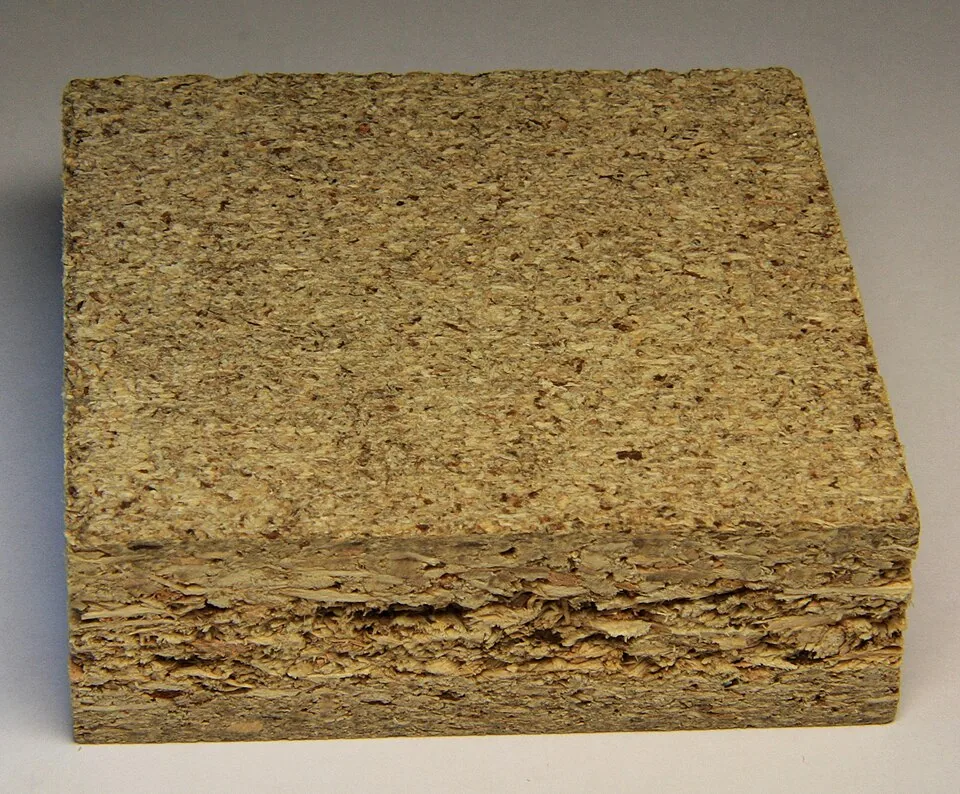
Particleboard, also called chipboard, is made of wood chips and sawdust glued together and is the cheapest of the group. It is light and flat, but it is weak, crumbles at the edges, holds screws poorly and swells with moisture. It is the usual core of flat-pack furniture and kitchen units, and it is covered with melamine, laminate or veneer. High-density versions are stronger. Our guide to sofa frame materials explains why particleboard is a poor choice for a load-bearing frame.
| Material | What it is | Strength | Moisture | Holds screws | Refinish |
|---|---|---|---|---|---|
| Solid wood | Sawn timber | High | Moves with humidity | Very well | Many times |
| Plywood | Cross-laminated thin plies | High, stable | Good, edges vulnerable | Well | Surface veneer limited |
| MDF | Fibers, wax and resin | Medium, no grain | Poor, swells | Poorly | Paint only |
| Particleboard | Chips and resin | Low | Poor, swells | Poorly | Not practical |
| Veneer over a core | Thin slice of real wood on a core | Depends on core | Depends on core | Depends on core | Very lightly |
| Laminate or melamine | Printed plastic layer on a core | Depends on core | Surface resists, core does not | Depends on core | No |
Veneer, laminate and what is on the surface
The surface of engineered furniture can be a real wood veneer, a printed laminate or a melamine coating, and the surface matters less than the core, though it is the part you see. A veneer is a thin slice of real wood, often a fraction of a millimeter to a couple of millimeters thick, glued to a core. A good veneer looks and feels like solid wood, because it is, on the surface, and it can show genuine grain. It can be lightly sanded and refinished, but not deeply, because the layer is thin.
A laminate is a layer of paper printed with a wood grain or a color, sealed under a hard plastic coating, and bonded to the core. High-pressure laminate is tough, resistant to scratches and heat, and easy to wipe, and is used on kitchen counters and desks. Melamine, a cheaper low-pressure surface, is softer and chips at the edges. Both can imitate wood convincingly in photos, but they cannot be sanded or refinished, and a deep scratch or burn is permanent.
A common trap is a piece that is described as solid wood but has veneered panels. Many good pieces use solid wood for the frame and legs and veneered plywood or MDF for the large flat panels, since wide solid panels warp. That is a legitimate construction, and a sign of competent design, but the label should say what is solid and what is not. See our guide to coffee table materials compared for how these surfaces behave on a table.
Moisture, humidity and movement
Moisture is where the materials differ most. Solid wood absorbs and releases moisture with the air, so it moves seasonally. In a dry winter it shrinks, and in a humid summer it swells, and a well-made piece allows for it with floating panels and sliding joints. A piece used in a room with big humidity swings, such as a basement or a room with a humidifier, needs to be well designed to avoid cracks.
MDF and particleboard are the most vulnerable to liquid water. The fibers or chips absorb it and swell permanently, so a spill that gets to the core through a chipped edge or an unsealed hole can destroy the piece, and the swelling cannot be reversed. Plywood handles moisture better, especially exterior-grade types with water-resistant glue, but its edges still absorb water and can delaminate. A laminate or veneer surface protects the core as long as it is intact.
The practical advice is to keep engineered pieces out of damp places, wipe spills quickly, seal any cut edges or holes, and avoid placing them on a damp floor. For a bathroom, kitchen or entryway, solid wood with a good finish or a moisture-resistant plywood is a better choice than MDF or particleboard.
Strength, weight and fasteners
Strength differs most under load and with repeated assembly. A solid wood shelf of a given thickness carries a heavy load, and a particleboard shelf of the same thickness sags, since the material has less bending strength and creeps under a sustained load. Plywood is much better than particleboard, and a thick plywood shelf can span a long distance. Our guide to bookshelf shelf sag explains how span, thickness and material interact.
Fasteners are another test. Screws grip solid wood and plywood by cutting threads into a dense material, and they hold well, even after being removed and reinserted. In particleboard and MDF, the screw threads crush the fibers, and a screw that is removed and replaced a few times loses its grip, because the hole wears. That is why flat-pack furniture that is disassembled and reassembled for a move often feels looser afterward, and why makers use cam locks, dowels and metal inserts to improve the hold.
Weight is the final factor. Solid hardwood is heavy, plywood is somewhat lighter, MDF is dense and heavy, and particleboard is relatively light. A large piece of solid wood may need two people to move it, and a particleboard wardrobe weighs less, which is a plus for renters and a minus for sturdiness. A heavy piece is more stable, and a light one can wobble.
Refinishing and repair
Solid wood can be repaired. Scratches and dents can be sanded or steamed, a ring can be removed, a chip can be filled and a whole piece can be stripped and refinished. A well-made solid wood table can be restored several times over its life. Joints can be reglued, and legs replaced.
Engineered wood is much less forgiving. A veneered surface can be lightly sanded and recoated, and small chips can be repaired with filler and a touch-up marker, but a deep scratch or a burn goes through the veneer. Laminate and melamine cannot be repaired beyond filling a chip. MDF can be repainted, which is a benefit for a painted piece, but a swollen area cannot be fixed. Particleboard that has crumbled at a joint is generally not repairable.
If a piece is likely to be used hard, moved often or passed on, repairability argues for solid wood or good plywood. If it is a temporary or low-use piece, an engineered one may be good enough. Think of the cost per year of use, not the price on the day you buy.
Health and emissions
Engineered wood uses adhesives, and some of them, particularly urea-formaldehyde resins, release formaldehyde gas, which is an irritant and, in sustained exposure, a health concern. Emissions are highest when the product is new and fall over weeks and months. In the United States, composite wood products such as MDF, particleboard and hardwood plywood are subject to federal limits on formaldehyde emissions, and compliant boards are labeled, and other regions have their own standards. A label does not mean zero emissions.
If you are sensitive, or the piece is going into a bedroom or a nursery, look for a compliance label or low-emission claims backed by a named standard, ventilate the room when the piece is new, and let it air before bringing it into a small room. Solid wood has no added adhesive, but finishes and glues used in the piece can also emit compounds. Because the evidence is complex, there is no simple claim that one is safe and the other is not.
How to read a listing
The key is to find the core. Look for words such as solid wood, solid hardwood, all-wood construction, plywood, MDF, particleboard, engineered wood, wood veneer and wood composite, and read them carefully. Solid wood construction on a listing often means the frame is solid, with other parts engineered. Wood products and manufactured wood usually mean composite. Real wood veneer means a thin layer on a core, and wood finish or wood grain can mean a printed paper.
Check the details. The listing should say what the top, the sides, the back, the drawers and the legs are made of, and what the thickness is. A back panel of thin fiberboard is normal and acceptable, and a particleboard shelf over a long span is a red flag. Look at the edges in photos: a solid wood edge shows continuous grain, plywood shows layers and a laminate shows a thin line. Look at the weight, since a heavy piece suggests dense material.
If the listing is vague, ask the seller. A seller that cannot say what a piece is made of is not a reliable source. For specific products, see our roundup of bookshelves and our other roundups for how materials are described.
Where each one makes sense
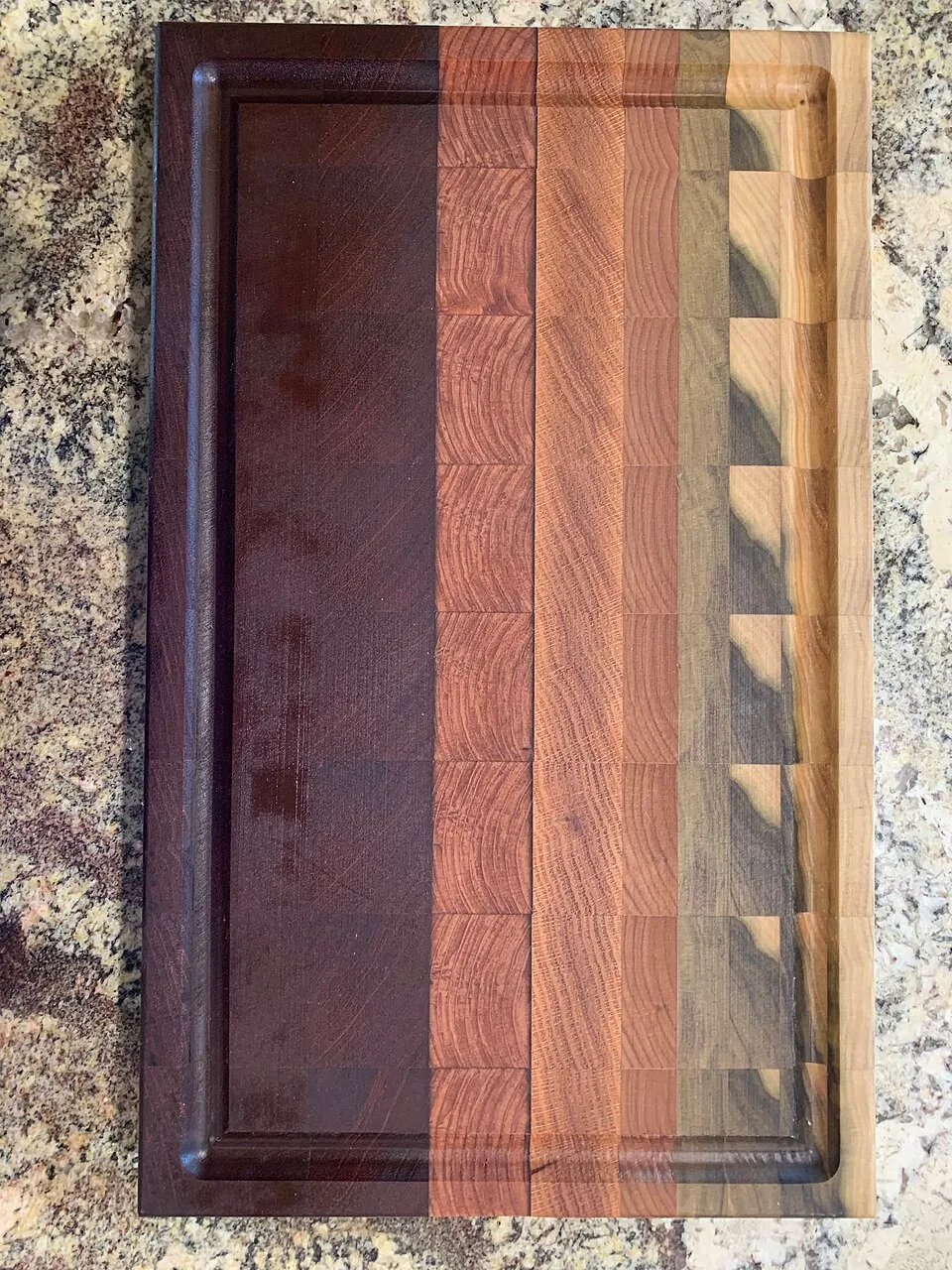
Choose solid wood for pieces that carry load, take daily abuse or should last decades: dining tables, coffee tables, bed frames, desks and chair frames. Choose good plywood for carcasses, shelves and drawers where you want strength and stability at a lower weight and cost. Choose veneer over a good core for large panels that should look like real wood without warping.
Choose MDF for painted pieces, cabinet doors and decorative panels where a smooth finish matters and the piece will stay dry. Choose particleboard for low-cost, light-duty, temporary furniture, such as a small shelf or a wardrobe in a rental, and accept a shorter life. Mix materials sensibly: a solid frame with plywood panels is a well-regarded construction.
And be wary of price signals in either direction. A very cheap piece described as solid wood is probably a soft wood with poor joinery or not solid at all, and a very expensive piece in particleboard is a bad deal. Look at the construction, not the story.
Frequently asked questions
Is engineered wood the same as fake wood?
No. Engineered wood is made of real wood fibers, strands or layers bonded with adhesives. It is not solid timber, and its properties differ, but plywood in particular can be excellent. The term fake is better applied to a printed laminate imitating a grain.
Which is better, solid wood or plywood?
It depends on the use. Solid wood is better for visible, load-bearing, refinishable parts, and plywood is better for wide panels and carcasses because it is stable. Many good pieces combine them.
Is MDF bad?
Not inherently. It is smooth, stable and good for painted surfaces, but it swells when wet and holds screws poorly. It suits dry, painted, low-load uses, and is a poor choice for shelves with heavy loads or damp places.
How can I tell if furniture is solid wood?
Look at the edges and the back for continuous grain, check the weight, and read the listing for the description of each part. A veneer shows a repeating grain pattern at corners, and a laminate shows a uniform printed pattern. Ask the seller if unsure.
Can I refinish veneered furniture?
Lightly. A veneer is thin, so only a very light sanding and recoat is safe, and sanding through it exposes the core. Clean and polish it, and have a professional assess a damaged piece.
Bottom line
Judge furniture by its core and its joints, not its surface. Solid wood and good plywood are the materials to pay for in pieces that carry weight or should last. MDF and particleboard have their places in painted, dry, light-duty pieces, and veneer is a sound way to get a real wood face on a stable panel.
Read the listing for what each part is made of, keep engineered pieces dry and ask the seller when the description is vague. A piece that is honest about its construction is usually a better buy than one that only says wood.