A swatch is a small, clean square that tells you the color and the hand feel. It does not tell you what the fabric will look like after two years of spilled coffee, a cat's claws and a south-facing window. The material is the part of a sofa you live with most directly, and it is also the part where a buyer's assumptions are most often wrong, because the words on a listing, "performance", "linen look", "velvet", cover very different constructions.
This guide compares the common sofa fabrics by how they behave in daily life, explains what the cleaning codes on the tag really permit, and gives a way to choose by household instead of by trend. It is based on published fabric specifications and recurring patterns in owner feedback, not on testing.
What decides how a fabric ages
Four properties explain most of what owners experience. The first is the weave: a tight, flat weave resists snagging, since there are few loops for a claw or a zipper to catch. The second is the fiber: synthetics such as polyester and olefin resist stains and fading, while natural fibers such as cotton and linen absorb liquid. The third is the finish: many fabrics carry a stain-repellent treatment that makes liquid bead up for a few minutes, buying time to blot. The fourth is abrasion resistance, measured in double rubs on a standard test, where about 15,000 double rubs is a common minimum for residential use and 30,000 or more is heavy-duty.
Treat the double-rub figure as a ceiling for wear, not a guarantee of looks. A fabric can survive 40,000 rubs and still pill, fade in the sun or hold onto odors. Use the figure to rule out the weakest fabrics, then judge the rest by weave and fiber.
Performance weaves
Performance fabric is a marketing category, and it usually refers to a polyester or olefin weave made to resist stains, fading and abrasion. The better versions are solution-dyed, meaning the color is in the fiber itself, so sunlight and cleaning do not bleach it. They have a tight weave and a flat or slightly textured surface, and they clean with water in most cases.
The strengths are practical: spills lift off, pets' claws slide across the surface instead of hooking, and the color holds. The weaknesses are mainly aesthetic and sensory. Some performance weaves feel slightly synthetic, and a polyester surface can generate static that attracts pet hair. They suit families, pets and anyone who eats on the sofa, and they are the safest default when you cannot predict how the sofa will be used.
Linen and linen blends
Pure linen has a relaxed, slightly rumpled look that suits casual rooms. It is a strong fiber, but it has a poor recovery from creasing, so the surface wrinkles every time someone sits and stays wrinkled. It also stains easily, because linen absorbs liquid quickly and the fiber holds dye from whatever lands on it. Sunlight fades it over a few years, especially in darker colors.
Linen blends with polyester or cotton reduce these problems at the cost of some of the natural look. A blend of about 50 percent or more polyester behaves closer to a performance weave while keeping the textured appearance. Check the cleaning code on any linen sofa. Many are S or X, meaning water is not recommended, which makes a spill a serious problem. Linen suits adults, low-traffic rooms and households without pets or small children.
Cotton and cotton blends
Cotton is soft, breathable and cheap, which explains its popularity in mid-range sofas and slipcovered designs. It is comfortable to sit on in summer and does not trap heat. It absorbs spills like a sponge, however, and light colors show stains quickly. A cotton slipcover can be removed and machine-washed, which helps, but some cotton covers shrink by 3 to 5 percent in a hot wash.
Cotton blends with polyester improve wrinkle and stain resistance, and the blend often wears longer than pure cotton because the polyester reinforces the yarn. Look for a blend that includes at least 30 percent synthetic fiber if you want the comfort of cotton without its worst tendencies. Slipcovered cotton is a good option for families who accept that the cover will need washing, and who value being able to restore it to a clean state.
Velvet
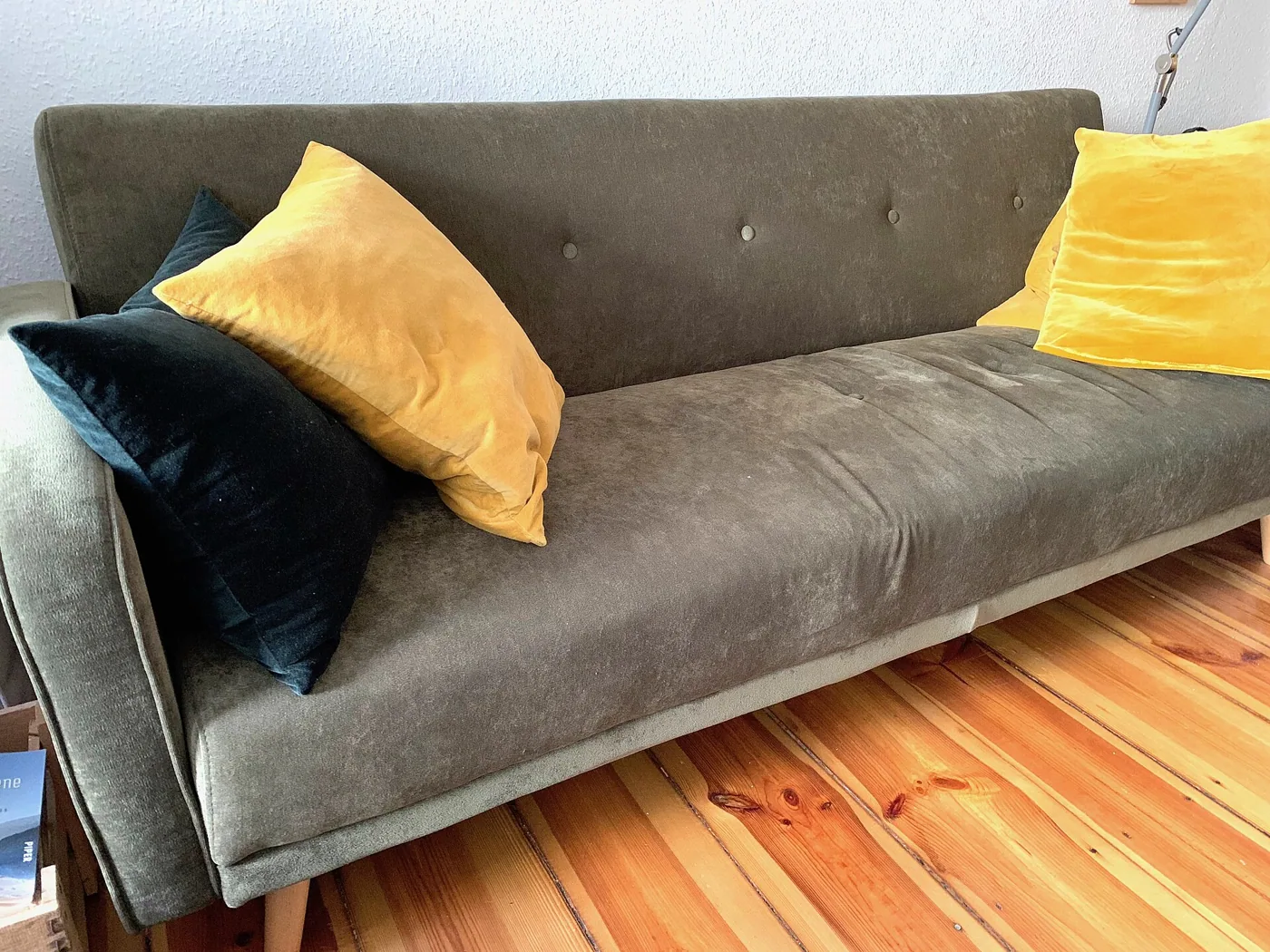
Velvet is a pile fabric, with a dense layer of short fibers that gives it depth and sheen. Modern velvets are usually polyester, which makes them far more durable than the silk and cotton velvets of the past. Polyester velvet resists abrasion well, with figures often above 30,000 double rubs, and it cleans reasonably well because the fiber does not absorb liquid.
The quirks are visual. Pile reacts to pressure and direction, so the fabric shows marks where someone sat or brushed against it, and the color appears to shift with the light. Lighter shades show body oils and pet hair, and darker ones show lint and dust. Velvet is a strong choice for adults who like its look and are willing to brush the pile occasionally. Cats find it appealing to knead, though a tight pile gives claws less to grip than a loop weave.
Leather: top-grain, bonded and faux
Leather is its own category and deserves a distinction that listings blur. Top-grain leather is the outer layer of the hide with the natural surface sanded to remove blemishes, and it develops character over time. Full-grain is the untouched outer surface, and it is the most durable and most expensive. Both age well, and scratches can often be buffed out. The care routine is in our leather sofa care guide.
Bonded leather is made from leather scraps ground and glued to a fabric backing, with a polyurethane surface layer. It looks like leather when new, but the surface layer cracks and peels, usually within two to four years of regular use. Faux leather, made of polyurethane or vinyl on a fabric base, behaves similarly: easy to wipe and affordable, but prone to peeling once the top film wears through. A listing that says "leather match" or "leather look" is not describing leather.
| Fabric | Pets and kids | Main weakness | Best for |
|---|---|---|---|
| Performance weave | Very good | Can feel synthetic, static | Busy households |
| Linen | Poor | Wrinkles, stains, fades | Low-use adult rooms |
| Cotton blend | Fair | Absorbs spills, can shrink | Slipcovers that can be washed |
| Polyester velvet | Good | Shows pile marks and hair | Style-led rooms |
| Top-grain leather | Good | Scratches, heat, sun | Long-term owners |
| Bonded or faux leather | Fair | Peels after a few years | Short-term, budget needs |
Cleaning codes: W, S, WS and X
The tag under a cushion or on the frame carries a one-letter code, and ignoring it is how people ruin a sofa. W means the fabric can be cleaned with water-based cleaners and detergents. S means solvent only, using a dry-cleaning product, and water can leave rings or shrink the fabric. WS means either a water-based product or a solvent is safe. X means vacuum or light brushing only, with no liquids, which is the code that most often surprises owners.
Cleaning codes describe the finished upholstery, including backing and dye, not only the face fiber. A polyester velvet can carry an S code because the dye bleeds when wet. Always test a cleaner on a hidden area, such as the underside of a cushion, and let it dry fully before deciding. For step-by-step technique, see how to clean a fabric sofa.
Pets, sunlight and pilling
Pets are the most common reason to change fabric. A loop or bouclé weave snags on claws, while a flat tight weave does not. Microfiber and performance weaves resist hair clinging better than loose, nubby fabrics, though static can hold hair on a synthetic surface. Our guide to protecting a sofa from pets covers weave and cover options in more detail.
Sunlight is the slow killer. Ultraviolet light breaks down dye and weakens fibers, and a sofa in front of a south-facing window can fade noticeably within one to two years. Solution-dyed fabrics resist it best, and blinds, UV film or a quarter-turn of the cushions help. Pilling, the small balls of fiber that form on the surface, comes from short staple fibers working loose with friction. It is common on soft knits and some chenilles, and a fabric shaver removes it, but a high-pill fabric will need that treatment for as long as you own it.
How to test a swatch properly
A swatch is only useful if you abuse it. Order a piece of at least 8 by 8 inches, because a postage-stamp sample hides the weave pattern and the way the color shifts across a larger area. Look at it in the room where the sofa will live, in morning and evening light, since a fabric that looks warm in a showroom can look green or grey under a north window. Then run a fingernail across it to see whether threads lift, and drag it over a rough surface to check for snagging.
Next, spill on it. Put a teaspoon of coffee on one corner and a teaspoon of water on another, wait ten minutes, and blot. Notice how much liquid soaked in, how much came back out, and whether a ring remained when it dried. A fabric that holds a ring after a plain water spill will be unforgiving in daily life. Rub a damp white cloth on the face to check for dye transfer, which matters most with dark velvets and denim-like cottons.
Cost over the life of the sofa
The cheapest fabric to buy is rarely the cheapest to own. A sofa that needs a replacement cover after three years, or one that is retired because of a permanent stain, costs more per year of use than a sturdier fabric that lasts ten. Performance weaves and top-grain leather carry a higher purchase price relative to basic cotton, but they spread it over a longer life, and they avoid the cost of professional cleaning that fabrics with an X or S code often require.
Slipcovers shift the calculation. A removable, washable cover on a plain frame lets you replace the fabric alone, which is a fraction of replacing the sofa, and some makers sell spare covers. If your household is hard on furniture, a slipcovered sofa with a spare cover in the cupboard is often the most economical option, even if the base fabric would not survive without the cover.
Choosing by household
Match the fabric to your most demanding user, not your average day. A household with a dog and young children should start with a performance weave or top-grain leather. A couple without pets who value texture can choose linen blend or velvet and accept the maintenance. A rental or short-term sofa suits a washable cotton slipcover, and someone who wants a sofa for fifteen years should compare top-grain leather against a quality tight weave.
Color matters nearly as much as fiber. Mid-tone, mottled or heathered colors hide stains, crumbs and hair far better than pure white or black. A flecked oatmeal or a grey-brown tone forgives more than any fabric treatment. When in doubt, order a large swatch, tape it to the old sofa, and spill a drop of coffee and water on it before you decide.
Frequently asked questions
What is the most durable sofa fabric?
Top-grain or full-grain leather and tight-weave synthetic performance fabrics are the most durable in general use. A figure above 30,000 double rubs marks heavy-duty upholstery, though abrasion is only one measure of how a fabric ages.
Does a stain-resistant treatment last?
It wears. Topical treatments fade with cleaning and friction, usually over a year or two, and can be reapplied with a spray made for upholstery. Solution-dyed and inherently resistant fibers do not rely on a coating and keep their properties longer.
Is velvet a bad choice with a cat?
Not necessarily. A tight polyester velvet has little for a claw to hook, and many owners find it holds up better than loop weaves. The problem is that cats often knead the pile, flattening it, and light colors show hair. Test with a swatch if you can.
What if my sofa is code X, and it gets a spill?
Blot gently with a clean cloth and do not rub or saturate it. For a stubborn mark, use a small amount of a solvent-based upholstery cleaner on a hidden patch first, or call a professional. Avoid water, because it can leave rings on X-coded fabrics.
Is bonded leather ever a good buy?
It can be a reasonable short-term choice if you know it will not last, because the surface layer tends to crack within a few years. If you want leather for longer, choose top-grain, and treat any listing that avoids naming the grade as suspect.
Bottom line
If you cannot decide, choose a tight-weave, solution-dyed performance fabric in a mid-tone, mottled color. It gives up a little softness and some character for a lot of forgiveness. Choose linen or light velvet only if you accept the upkeep, and choose top-grain leather if you want a sofa that improves with age and will be kept a decade or more.
Whatever you pick, read the cleaning code before you buy and the care tag after you unwrap, and keep a small cleaning kit that matches the code. For how we weigh upholstery in our picks, see how we evaluate products and pair this advice with our sectional roundup.