
Amazon affiliate links - we earn a commission.Affiliate disclosure

Buying guide · 14 min read · Updated 2026-11-26

Best Subwoofers Under $300 (2026)

Home theater subwoofers under $300 compared on driver size, RMS power, ports, controls and room fit, with plain notes on peak watts, boom and placement.

Elena Hart, Lead Home EditorBy Elena HartLead Home Editor6 picks comparedSpec-sheet verified
Best Subwoofers Under $300

At a glance

Our top picks

Side by side

Spec comparison

A subwoofer adds the bottom octaves that a TV, a soundbar or bookshelf speakers cannot reproduce, and it is the single most useful addition to a home theater on a modest budget. The useful choices are driver size, continuous power, port design and the controls that let you blend it into your room.

This guide covers powered home subwoofers, not the car under-seat subs that dominate the search results. The cap reflects listing prices on the day we updated the guide, and prices move often. We have not handled any of these subwoofers, so our judgments rest on specifications and patterns in owner feedback, including how bass behaves in typical rooms and how peak watts mislead.

Before you buy

6 Criteria to Look For Before Buying a Subwoofer Under $300

  1. 01

    What the cap buys

    At this cap a home subwoofer adds a 10 inch driver, a real amplifier, a ported cabinet and tuning controls. The Klipsch and Monoprice state continuous power, and the Dayton and Elimavi offer cabinet detail. Cheaper units skimp on the amp. Run a test with a favourite film scene that has low rumbles and a favourite song with a clean bass line, because a sub that sounds good on one and boomy on the other needs its crossover adjusted. Plan for the cable run to the receiver or amp before you buy, since a long RCA lead should be shielded and kept away from power cords. Take photographs of your current setup, including the speakers and the receiver's back panel, so you can double-check the connections you need before the sub arrives. If your receiver has automatic room correction, run it after the sub is in place, since it can set the level, the distance and the crossover for you in a few minutes.

  2. 02

    RMS vs peak watts

    RMS or continuous watts show what an amplifier can sustain, and peak watts show a brief burst. A 100 watt peak sub may be only 50 watts RMS. Look for stated continuous figures, as on the Klipsch and Monoprice. Measure the available floor space, and remember that the cabinet needs a few inches of clearance for the port and the amplifier vents. Think about the room's other bass sources: a hollow floor, a large window or a thin wall can add rattles, and a rug or a bookcase can reduce them.

  3. 03

    Driver size and room

    A 10 inch driver suits rooms up to about 300 square feet, and a 12 inch suits larger rooms. A small room can be overwhelmed by a large sub. Match the sub to your room and your speakers.

  4. 04

    Ported or sealed

    Ported subs play lower and louder but are bigger and can boom, and sealed subs are tighter and smaller. Most budget subs are ported. Check the cabinet size against your space.

  5. 05

    Controls and connections

    A subwoofer needs a level, a crossover and ideally a phase control to blend with your speakers. RCA inputs connect to a receiver's sub output. High-level inputs are needed for some stereo amplifiers.

  6. 06

    Placement and room

    Bass behaves differently in each room. Corners increase output and boom, and the middle of a wall is smoother. Try several spots and listen. A rug and furniture soften reflections.

Detailed reviews

The 6 best subwoofers under $300, explained

01
Klipsch Synergy Black Label Sub-100, 10 inch front-firing, 150 W continuous, 300 W dynamic
10 in driver150 W continuous300 W dynamic
Check price on Amazon
Best for: A living room home theater that wants a polished 10 inch front-firing sub.

This subwoofer lists a 10 inch front-firing driver with a spun copper Cerametallic cone, 150 watts of continuous power and 300 watts of dynamic power. Stating both continuous and dynamic figures is more honest than a lone peak number, and a copper-faced cone gives a stiff, light driver. Front-firing means the driver faces you, which makes placement easier than a down-firing sub.

The tradeoff is that a 10 inch sub reaches about as low as a good small room needs, but it will not shake a large room like a 12 or 15 inch sub, and the compact data does not give its frequency response. Compared with the Monoprice, it has a more polished brand and a named driver, but fewer listed controls. Match the sub to your speakers' crossover for the best blend.

Place it near the front wall or a corner of the room, then walk around to find where bass sounds even. Set the crossover so the sub takes over where your speakers roll off. Raise the volume slowly and avoid boom.

What works

  • Lists 150 W continuous and 300 W dynamic, not just a peak
  • Copper-faced 10 inch driver is stiff and light
  • Front-firing design makes placement easy
  • Established brand with good parts support

Watch out for

  • 10 inch driver will not shake a very large room
  • Compact data does not give frequency response

Specs

Driver
10 in front-firing, spun copper Cerametallic
Power
150 W continuous, 300 W dynamic
Type
Powered subwoofer
Brand
Klipsch
Cost position
Twelfth of 15
02
Monoprice SW-10 10 inch Powered Subwoofer, 150 W RMS, 300 W peak, ported, phase and crossover controls
150 W RMSPortedPhase control
Check price on Amazon
Best for: A shopper who wants tunable controls and an honest RMS figure at a low cost.

This subwoofer pairs a 10 inch long-throw front-firing driver with a 150 watt Class D amplifier and gives its peak at 300 watts, so the RMS figure is clear. A ported design plays lower and louder than a sealed one for the same driver. Rear panel controls let you tune the variable phase and variable low-pass crossover, which are the two knobs that decide how well the sub blends with your speakers.

The compromise is that a ported cabinet is bigger and can sound boomy in a small room, and a Class D amp is efficient but not audiophile. Compared with the Klipsch, the Monoprice is a plainer, more utilitarian unit. RCA inputs connect to a receiver's subwoofer output.

Start with the phase at zero and the crossover near 80 hertz, then adjust by ear. Put the sub on a hard floor away from corners at first. Use a wall in front or beside it if you want more output.

What works

  • 150 W RMS is stated clearly
  • Variable phase and low-pass controls help integration
  • Ported design plays lower than a sealed one
  • RCA inputs connect to a receiver's sub output

Watch out for

  • Ported cabinet can sound boomy in a small room
  • Plain styling and a utilitarian finish

Specs

Driver
10 in long-throw, front-firing
Power
150 W RMS, 300 W peak, Class D
Design
Ported
Controls
Variable phase, variable low-pass
Inputs
RCA
03
Dayton Audio Classic CS1000 10 inch 180 W Powered Subwoofer, Class-D amp, swappable grille
10 in driver180 WSwappable grille
Check price on Amazon
Best for: A living room where the subwoofer needs to look good as well as sound good.

This sub lists a 10 inch driver, a 180 watt Class D amplifier and a rigid, braced cabinet designed to keep the bass tight and accurate. The listing says the grille is swappable to match your decor. A braced cabinet means less box resonance, which gives cleaner bass.

The tradeoff is that the compact data does not say whether the power is RMS or peak, and does not give frequency response or port details. Compared with the Monoprice, it offers a more design-friendly cabinet. Check the listing for controls.

Place it where it blends into the room, and adjust the crossover. Avoid putting it on a thin cabinet floor. Keep the grille on to protect the driver from pets.

What works

  • 180 W Class-D amplifier
  • Rigid, braced cabinet for tighter bass
  • Swappable grille to match decor
  • Compact enough for a living room

Watch out for

  • Compact data does not state RMS or frequency response
  • Fewer listed controls than the Monoprice

Specs

Driver
10 in
Power
180 W Class-D
Cabinet
Rigid, braced
Look
Black, swappable grille
Cost position
Thirteenth of 15
04
Elimavi 10 inch Powered Subwoofer, 300 W, wooden case, copper driver, aluminium heat sink
10 in driver300 W claimWooden case
Check price on Amazon
Best for: A shopper who wants a wooden cabinet and a Class AB amplifier at a low position.

This subwoofer lists a 10 inch driver with a rigid composite cone and a copper driver assembly, a 300 watt claim, a HiFi Class AB amplifier with a rear aluminium heat sink and a wooden case. Class AB amplifiers run warmer than Class D but can be smoother. The listing targets medium to large spaces.

The compromise is that the 300 watt figure is not labeled as RMS or peak, and the brand is less established. Compared with the Klipsch, it is more of a claim than a spec. A wooden case is a good sign for resonance, but the listing gives no weight.

Test it with familiar music and a movie in the return window. Check the heat sink for clear space. Adjust the crossover and level by ear.

What works

  • Wooden cabinet is described
  • Class AB amplifier with a rear heat sink
  • 10 inch copper driver with a rigid cone
  • Aimed at medium to large rooms

Watch out for

  • 300 W claim is not labeled RMS or peak
  • Less established brand

Specs

Driver
10 in copper driver, rigid composite cone
Power
300 W claimed
Amp
HiFi Class AB with rear heat sink
Cabinet
Wooden case
Cost position
Eleventh of 15
05
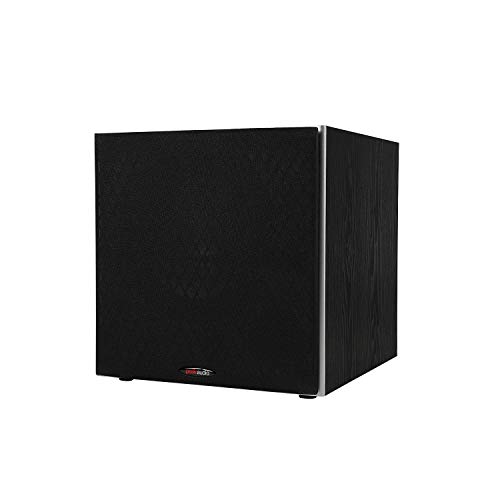
Polk Audio PSW10 10 inch Subwoofer, up to 100 W, 50 W RMS amp, Power Port technology
10 in driver100 W peak50 W RMS
Check price on Amazon
Best for: A small room or apartment where a compact sub is enough.

This is a compact 10 inch subwoofer with a 50 watt RMS amplifier that peaks at 100 watts, a Dynamic Balance woofer and a directed Power Port the maker says reduces port noise. It is a modest-output sub intended for a small to medium room and for easy integration with a TV or a bar. It is also in our general subwoofer guide.

The tradeoff is that 50 watts RMS is the lowest here, and it will not fill a large room. Compared with the Monoprice at 150 watts RMS, it is a gentler, smaller option. For a small apartment, it is enough.

Place it near the front and adjust the level. Use the crossover to blend it with your speakers. Keep the port clear.

What works

  • Compact 10 inch design
  • 50 W RMS and 100 W peak are both stated
  • Power Port reduces port noise
  • Easy to integrate with a TV or soundbar

Watch out for

  • Lowest output in the guide
  • Also appears in our general subwoofer guide

Specs

Driver
10 in Dynamic Balance woofer
Power
100 W peak, 50 W RMS amp
Port
Directed Power Port
Design
Compact
Cost position
Fourteenth of 15
06
Yamaha NS-SW100BL 10 inch 100 W Powered Subwoofer, Twisted Flare Port, YST II
10 in driver100 WYST II
Check price on Amazon
Best for: Music and film listening where tight, controlled bass matters.

This Yamaha sub lists a 10 inch driver, 100 watts, a twisted flare port that contributes to clear, tight bass and Yamaha Active Servo Technology II, which uses feedback to control the driver. The styling is simple, and the sub is designed for easy integration in a room. It is the most expensive of the group by position.

The compromise is that 100 watts is modest, and the compact data does not say RMS or peak. Compared with the Klipsch, it focuses on clean, controlled bass and less on output. It is also in our general subwoofer guide.

Place it in the front of the room and set the crossover. Use the servo's tight bass for music and films. Do not push it beyond what the room can use.

What works

  • Twisted flare port is described for clear, tight bass
  • Yamaha servo technology controls the driver
  • 10 inch driver suits a small to medium room
  • Simple styling suits many rooms

Watch out for

  • 100 W is modest output
  • Also appears in our general subwoofer guide

Specs

Driver
10 in
Power
100 W
Port
Twisted Flare Port
Technology
YST II servo
Cost position
Fifteenth of 15

Spec decoder

What the listing measurements really mean

The numbers brands lead with, translated into what they tell you about fit, comfort and wear at home.

RMS power

The continuous power an amplifier can deliver. It is more meaningful than peak power. A subwoofer that lists only peak power should be treated as more modest than the number suggests.

Watch forThe Monoprice lists 150 W RMS, Klipsch 150 W continuous and Polk 50 W RMS.

Peak or dynamic power

A short burst the amplifier can deliver. It is a marketing number. A dynamic power figure is a brief burst the amplifier can supply for transients such as an explosion.

Watch forThe Monoprice and Klipsch list 300 W peak or dynamic.

Ported cabinet

A cabinet with a tuned opening that boosts low frequencies. It is bigger and can boom. A rear port can boom if it sits against a wall, so leave several inches of space unless the maker says otherwise.

Watch forThe Monoprice, Polk and Yamaha use ports.

Crossover

A control that sets the frequency where the sub takes over from the main speakers. A crossover set near 80 hertz is a common starting point, and you adjust it by ear.

Watch forThe Monoprice lists a variable low-pass.

Class D amplifier

An efficient amplifier design that runs cool. It is common in modern subs. A Class D amplifier runs cool and light, which helps in a compact cabinet.

Watch forThe Monoprice and Dayton list Class D, and the Elimavi lists Class AB.

Methodology

How We Evaluated These Subwoofers Under $300

Power honesty

We evaluated each subwoofer on the power figures stated in its listing. The Klipsch and Monoprice state continuous power. We have not handled any of these subs. We read each listing to see whether it names the amplifier class and the cabinet, because those details signal how seriously the maker takes bass. We kept all six lineup entries to 10 inch units so the comparison is about amplifier, cabinet and controls and not driver size. We looked at how each listing describes its cabinet, because a rigid, braced cabinet is the quiet hero of a clean-sounding sub.

Controls and integration

We compared phase, crossover and level controls. The Monoprice lists the most. Owner feedback patterns often mention boom and poor blending. We also noted which subs have rear controls and which rely on a hidden dial. We noted that none of the listings state an in-room frequency response, so we avoided comparing how low each one plays.

Cabinet and driver

We considered cabinet design and driver size. All six are 10 inch units, so differences are in cabinet and amplifier.

Home only

We left out car under-seat subs and soundbar bundles, which appeared in the search. We kept two carry-overs from our general guide. We do not publish ratings or review counts.

Honest limits

Subwoofer performance depends on your room. We say so.

Decision guide

How to Choose the Right Subwoofers Under $300

By Room Size

RoomPickWhy
Small roomPolk PSW10Compact 10 inch
Small to mediumYamaha NS-SW100BLTight, controlled bass
MediumKlipsch Sub-100150 W continuous
Medium to largeMonoprice SW-10150 W RMS and ported
Design-consciousDayton CS1000Swappable grille

By Budget

SituationPickWhy
Lower endMonopriceTenth of 15
Lower-middleElimaviEleventh of 15
MiddleKlipschTwelfth of 15
Upper-middleDaytonThirteenth of 15
UpperPolk or YamahaFourteenth and fifteenth

Ported vs Sealed

Ported, like Monoprice

Plays lower and louder. Bigger and can boom in a small room.

Sealed

Tighter and smaller. Plays less loudly at the lowest frequencies.

Choose ported for movies and sealed for music in a small room.

By Use

UsePickWhy
MoviesMonopriceOutput and controls
MusicYamahaServo control
TV and soundbarPolkCompact and simple
StyleDaytonClean design
Big roomElimavi300 W claim

For a Living Room Specifically

Look for

A stated continuous power, a crossover and level control, and a size that fits near the front of the room.

In this comparison

The Klipsch and Monoprice are the best all-round picks.

When to Spend More

Spend more if

You want a 12 inch or larger driver, room correction, a sealed design that plays deeper or dual subs.

Save if

You mainly want movie bass in a small room. A 10 inch ported sub is plenty.

Ownership

Maintenance schedule

The upkeep that decides whether a piece still looks good in year five.

TaskIntervalWhy it matters
Check the cablesTwice a yearLoose RCA leads cause hum. Keep pets and children away from the driver, since poking the cone can tear it. Wipe the cabinet with a dry cloth, and avoid polish that can mark vinyl or veneer.
Dust the driver and portEvery 3 monthsDust and toys can block the port.
Re-tune the crossoverAfter changing speakersDifferent speakers need a different blend.
Move and re-listenAfter rearranging furnitureBass changes with the room.
Check the amplifier ventsTwice a yearBlocked vents overheat the amp.

FAQ

Frequently Asked Questions

Do I need a subwoofer?

For bass that a TV or bookshelf speaker cannot make, yes. Use a quality RCA cable and keep it away from power cords to avoid hum. Keep a small gap between the sub and the wall for the port, unless the manual says it can go flush. Turn the sub's own volume to about half and set the final level from the receiver, since that gives you more range to adjust.

What size should I choose?

A 10 inch sub suits most living rooms. Larger rooms may want 12 inches. Raise the volume gradually over a few days as you learn how the bass sounds in your room. Wooden floors transmit bass to neighbours, so a rug or a platform under the sub helps.

Why do peak watts not matter?

They are a brief burst. Look for RMS or continuous power. If bass disappears at certain seats, move the sub rather than raising the level.

Where do I put it?

Near the front of the room, then try a few spots and listen.

Do prices change?

Yes. The cap reflects listing prices when we updated the guide, and prices move often.

Can I use a car subwoofer at home?

Not easily. They need a car amplifier and an enclosure.

Bottom line

The short version

Browse more subwoofers under $300on Amazon →
Elena Hart, Lead Home Editor

About the author

Elena Hart

Lead Home Editor, SweetLivingRoom

Elena Hart leads SweetLivingRoom's buying guides, turning product dimensions, material specs and owner feedback into clear verdicts on sofas, rugs, lighting, storage and decor.

More from Elena →

Keep reading

Related guides