
Amazon affiliate links - we earn a commission.Affiliate disclosure

Buying guide · 14 min read · Updated 2026-11-28

Best AV Receivers Under $500 (2026)

Six receivers under $500, from Yamaha and Denon 5.2 channel models to a JBL, a Pyle and a Yamaha stereo option, compared on power, HDMI, Atmos and setup.

Elena Hart, Lead Home EditorBy Elena HartLead Home Editor6 picks comparedSpec-sheet verified
Best AV Receivers Under $500

At a glance

Our top picks

Side by side

Spec comparison

An AV receiver is the hub of a home theater. It takes the video from your streaming box, console and disc player, sends it to the TV, decodes the surround sound and powers the speakers. A good one makes a system simple, and a poor one makes it frustrating. Choosing well saves a lot of cable-swapping later, because the receiver is the one box every other part plugs into.

This guide looks at receivers that fit under a $500 cap, from true surround receivers to a stereo model for music. Listing prices move, and the cap reflects Amazon listing prices when this guide was last updated. We pay close attention to real power ratings and HDMI features, because that is where budget listings are least honest.

Before you buy

6 Criteria to Look For Before Buying an AV Receiver Under $500

  1. 01

    Real power per channel

    Receiver power is quoted in watts per channel, ideally with a test condition such as 8 ohms. Peak or total figures like 2000W are marketing and do not tell you how loud the receiver plays. The Denon lists 70W x 5 and the JBL lists 60W x 5, which are far more useful. If a listing quotes only a total such as 2000W or 3000W peak, divide by the channel count and then assume the real figure is a small fraction. A 70 watt per channel receiver paired with efficient speakers is plenty for a living room of around 15 by 20 feet.

  2. 02

    HDMI version and features

    4K120 and 8K features matter for current consoles and TVs, and HDR formats such as Dolby Vision matter for movies. Check that HDMI inputs support the signal you need and that one is ARC or eARC. A receiver can pass video only as far as its chipset supports. A receiver with 4K120 on one HDMI input only helps if the console is plugged into that port. Check the port labels and keep the most demanding source on the best input.

  3. 03

    Channels and Atmos

    A 5.2 receiver has five speaker channels and two subwoofer outputs, and it cannot add overhead speakers. A 7.2 receiver can add height or rear speakers. Atmos on a 5.2 unit is a virtual effect. If you want true overhead Atmos, you need at least a 7.2 receiver and height speakers, which sit above this cap. A 5.2 receiver with Atmos processing is a way to get some of the effect with a front-height or soundbar approach.

  4. 04

    Inputs and outputs

    Count your sources before buying, including streaming box, console, disc player and turntable. Four HDMI inputs suit most setups. Add a phono input if you own a turntable. Also check whether the receiver has a dedicated subwoofer output, a zone output and an optical input for older gear.

  5. 05

    Room calibration

    Auto setup with a microphone measures speaker distance and level. It helps in a room with awkward layouts. Cheaper receivers may lack it. Room calibration sets distance, level and sometimes equalisation, which smooths bass in awkward rooms. Even on a basic receiver, setting distances and levels by hand with a tape measure helps.

  6. 06

    Heat and placement

    Receivers run warm and need several inches of space above and around. Never stack heavy items on top. A closed cabinet needs ventilation or a fan. A receiver in a closed media cabinet needs a vent or a small fan, or the protection circuit may shut it down in summer.

Detailed reviews

The 6 best av receivers under $500, explained

01
Yamaha RX300A 5.2 Channel AV Receiver, Dolby Atmos, 4K120 and 8K HDMI, Bluetooth
5.2 channelsDolby Atmos4K120 / 8K HDMIBluetooth multipoint
Check price on Amazon
Best for: Modern TVs and consoles in a medium living room.

The Yamaha RX300A is a 5.2 channel receiver with Dolby Atmos and DTS Virtual:X, 4K120 and 8K HDMI and Bluetooth multipoint. The 4K120 and 8K support means it can pass the video signals current consoles and TVs use, and multipoint Bluetooth lets two devices stay paired. Atmos on a 5.2 receiver is a virtual or height-processed effect, since five channels cannot include overhead speakers.

The trade-off is channel count. A 5.2 layout suits a classic surround setup, but you cannot add overhead speakers or a 7.1 rear pair, and the receiver's power is modest. Compared with the Denon AVR-S570BT, the Yamaha offers newer HDMI features and Atmos processing, but the Denon lists more clearly stated power.

In practice, place the receiver on a ventilated shelf with at least a few inches above it, run the auto setup with the supplied microphone and use HDMI ARC or eARC to the TV. Dust the vents every few months and update the firmware if the maker issues one. Check that your TV's HDMI port supports the signal you want. Owners of recent consoles should confirm which HDMI port carries the highest signal.

What works

  • 4K120 and 8K HDMI suit current consoles and TVs
  • Dolby Atmos and DTS Virtual:X processing
  • Multipoint Bluetooth keeps two devices paired
  • Yamaha reputation for reliable amplifiers

Watch out for

  • 5.2 layout cannot add overhead speakers
  • Atmos effect is virtual on five channels
  • Modest power for a very large room

Specs

Channels
5.2
Formats
Dolby Atmos, DTS Virtual:X
Video
4K120 and 8K HDMI
Wireless
Bluetooth multipoint
Use
Home theater and gaming
02
Denon AVR-S570BT 5.2 Channel AV Receiver, 8K Video, 70W x 5, Bluetooth
5.2 channels70W x 54 HDMI inputs8K video
Check price on Amazon
Best for: Medium rooms that want clear power ratings and four HDMI inputs.

The Denon AVR-S570BT is a 5.2 channel receiver rated at 70 watts for each of five channels, with four HDMI inputs and 8K video support. The listing says it handles HDR, HLG and Dolby Vision, which matters for a modern 4K TV, and it adds Bluetooth for wireless music. A clearly stated power figure per channel is more useful than a peak total.

The compromise is gaming. Compared with the Yamaha RX300A, the Denon lists 8K video but is not described with the same 4K120 detail, so if you play on a console at high frame rates, check the HDMI specifications before buying. It sits at a mid rung on the pricing ladder.

In practice, four HDMI inputs cover a streaming box, console, disc player and a spare. Run the auto room calibration and place the speakers at ear height. Keep the vents clear and avoid stacking other devices on top. Heat management matters, so leave space above it.

What works

  • 70W per channel is a clear power rating
  • Four HDMI inputs and 8K video support
  • Supports HDR, HLG and Dolby Vision
  • Denon is an established receiver brand

Watch out for

  • 5.2 layout limits expansion
  • Gaming HDMI features are less detailed than the Yamaha
  • No Atmos in the listing

Specs

Channels
5.2
Power
70W x 5 as listed
HDMI
Four inputs, 8K video
HDR
HDR, HLG, Dolby Vision
Wireless
Bluetooth
03
Yamaha RX-V385 5.1 Channel 4K Ultra HD AV Receiver With Bluetooth
5.1 channels4K Ultra HD4 HDMI inBluetooth
Check price on Amazon
Best for: Classic 5.1 theaters with a 4K TV and modest gaming needs.

The Yamaha RX-V385 is a 5.1 channel receiver with 4K Ultra HD support, four HDMI inputs and one output, Bluetooth and an adjustable audio delay of 0 to 500 milliseconds. The audio delay is a useful feature if a TV's picture processing makes the voices lag behind the lips. It is a straightforward, older design that does the basic job.

The trade-off is age. It has fewer modern HDMI features than the RX300A, and it lacks Atmos, so it suits a classic 5.1 setup and a 4K TV without gaming demands. It sits at a lower rung of the pricing ladder in this guide.

In practice, use it for a traditional home theater with five speakers and a sub. Place it on a ventilated shelf and run the speaker setup. It is a sensible low-cost starting point. It is a sensible fit for a first home theater.

What works

  • Four HDMI inputs cover most sources
  • Audio delay fixes lip-sync issues
  • 4K Ultra HD pass-through
  • Straightforward Yamaha operation

Watch out for

  • No Dolby Atmos
  • Fewer modern HDMI features
  • Older design

Specs

Channels
5.1
Video
4K Ultra HD
HDMI
4 inputs, 1 output
Delay
Audio delay 0 to 500 ms
Wireless
Bluetooth
04
JBL MA310 5.2 Channel 4K AV Receiver, 60W x 5, 4 HDMI Inputs
5.2 channels60W x 54K4 HDMI inputs
Check price on Amazon
Best for: Modest 5.1 systems that value a clear power rating.

The JBL MA310 is a 5.2 channel receiver with 60 watts per channel, 4K video and four HDMI inputs, and it advertises native five-channel decoding of Dolby formats. It integrates with smart TVs, consoles and streaming boxes through HDMI, and the 60W figure is clearly stated. It is a less common choice than Yamaha or Denon, but it comes from a major audio brand.

The trade-off is power and features. At 60W per channel it has less headroom than the Denon's 70W, and it lacks the newest HDMI features. Compared with the RX-V385, the JBL offers a clearer power rating but fewer tuning options.

In practice, it suits a modest living room with a 5.1 speaker set. Run the auto setup and check the HDMI ARC connection to the TV. It is simple, which some buyers prefer.

What works

  • Clearly stated 60W per channel
  • Four HDMI inputs and 4K support
  • Native Dolby decoding
  • Comes from a major audio brand

Watch out for

  • Less power than the Denon
  • Lacks the newest HDMI features
  • Fewer tuning options

Specs

Channels
5.2
Power
60W x 5 as listed
Video
4K
HDMI
4 inputs
Decoding
Native 5-channel Dolby
05
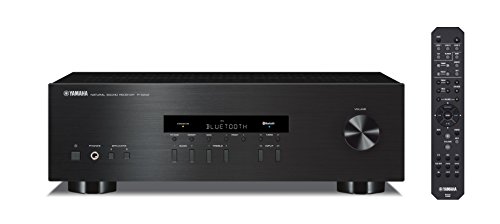
Yamaha R-S202BL Stereo Receiver With Phono Input, Bluetooth and AM/FM Tuner
2 channelsPhono inputBluetoothAM/FM tuner
Check price on Amazon
Best for: Music-first setups with a turntable and a pair of speakers.

The Yamaha R-S202BL is a stereo receiver, not an AV receiver, with a phono input, a subwoofer output, Bluetooth and a 40-station AM/FM tuner. A speaker selector lets you drive two pairs. It is the right choice for a music-first setup that includes a turntable.

The trade-off is that it has no surround sound and no HDMI, so it cannot be the hub of a home theater. Compared with the AV receivers here, it is simpler and purer for music.

In practice, pair it with a pair of bookshelf speakers and a turntable. The phono input removes the need for a separate preamp. Keep the vents clear and use quality speaker wire. Add a subwoofer later through the sub output.

What works

  • Built-in phono input for a turntable
  • Speaker selector drives two systems
  • Bluetooth and AM/FM tuner
  • Simple, music-focused design

Watch out for

  • No HDMI or surround sound
  • Cannot serve as a home theater hub
  • Limited power for large rooms

Specs

Channels
2 stereo
Inputs
Phono, CD and line
Wireless
Bluetooth
Tuner
AM/FM with 40 presets
Speakers
Selector for two systems
06
Pyle 5.2 Channel Hi-Fi Home Theater Receiver, 2000W Max, Bluetooth, 4K
5.2 channels2000W maxBluetooth4K support
Check price on Amazon
Best for: Tight budgets with efficient speakers and low expectations.

The Pyle 5.2 receiver lists 2000W maximum power, Bluetooth and 4K support in a low-cost package. The 2000W number is a marketing peak figure, and real continuous power per channel is far lower, so it should not be read like the Denon's 70W. It is the cheapest surround receiver in this guide.

The trade-off is trust. Pyle is a budget brand with limited transparency on power, HDMI features and support, so expect modest build quality and be careful with demanding speakers. Compared with the JBL MA310, the Pyle offers the same channel layout at a lower rung of the pricing ladder, but with less clarity.

In practice, use it only for an inexpensive system with efficient speakers, and keep expectations modest. Check the return policy. If the receiver fails, replacement support may be limited.

What works

  • Lowest rung on the pricing ladder
  • 5.2 channels with Bluetooth
  • 4K support listed
  • Simple connection set

Watch out for

  • 2000W figure is marketing only
  • Less transparent on real power
  • Budget build and support

Specs

Channels
5.2
Power
2000W max as listed
Video
4K support
Wireless
Bluetooth
Use
Budget surround

Spec decoder

What the listing measurements really mean

The numbers brands lead with, translated into what they tell you about fit, comfort and wear at home.

5.2 channels

Five speaker channels and two subwoofer outputs. It is a classic surround layout.

Watch forThe Yamaha RX300A, Denon S570BT and JBL MA310 are 5.2. A 5.2 receiver cannot drive rear or height speakers beyond five.

Watts per channel

Power delivered to each speaker, ideally at 8 ohms. It is the honest number.

Watch forThe Denon lists 70W and the JBL lists 60W. Per-channel figures are quoted with only one or two channels driven in some listings, so read the fine print.

4K120

4K at 120 frames per second, a gaming signal. It needs HDMI 2.1 on both ends.

Watch forThe RX300A lists it. Both the TV and the console must support it.

Dolby Vision

A dynamic HDR format that adjusts picture scene by scene. The TV must support it.

Watch forThe Denon lists it. The TV also needs to support the format.

Phono input

An input with a built-in preamp for a turntable. It removes the need for a separate box.

Watch forThe R-S202BL has one. A turntable with a built-in preamp does not need a phono input.

Methodology

How We Evaluated These AV Receivers Under $500

Power and honesty

We evaluated how clearly each listing states power. The Denon and JBL give per-channel figures and the Pyle gives only peak. We favoured clear numbers. Listings that hid power behind a peak number were marked down.

HDMI and features

We researched HDMI features and Atmos support. The RX300A led on modern features. We noted when listings were vague. We also checked how many HDMI inputs each unit offers.

Channels and use

We compared channel counts for home theater and stereo use. The R-S202BL suits music and the 5.2 models suit movies. Stereo and surround use cases were kept separate.

Owner feedback patterns

We looked at recurring themes in owner feedback, such as setup complexity and heat. We never count stars. These patterns shaped our cons. Heat, menus and remote design were the recurring complaints.

Budget band

We favoured the upper band of the $500 cap and excluded larger Denon and Pioneer models above it. Prices move, so check before buying. Receivers above the cap, such as larger Denon and Pioneer models, were excluded.

Decision guide

How to Choose the Right AV Receivers Under $500

By Use

SituationPickWhy
Modern TV and consoleYamaha RX300A4K120 and 8K HDMI
Clear power ratingDenon AVR-S570BT70W x 5
Classic 5.1Yamaha RX-V385Simple and proven
Modest systemJBL MA31060W x 5
Music with turntableYamaha R-S202BLPhono input

By Budget

TierPickWhat you get
LowestPyle 5.2Budget surround
LowerYamaha R-S202BLStereo with phono
MidYamaha RX-V385Classic 5.1
Upper-midJBL MA3105.2 with clear power
Top of capDenon S570BT and Yamaha RX300AModern HDMI and Atmos

AV Receiver vs Stereo Receiver

AV receiver (Yamaha RX300A, Denon)

Handles video and surround sound. More inputs and features, but more complex. It is the right tool when you want one box to switch every source and power five or more speakers.

Stereo receiver (Yamaha R-S202BL)

Pure music focus with a phono input. No video and no surround. It is the right tool when music, a turntable and a pair of speakers are the whole point.

Choose an AV receiver for movies and a stereo receiver for music.

By Gaming Needs

NeedPickWhy
4K120 consoleYamaha RX300ALists 4K120
8K readyDenon S570BT8K video
Basic 4KJBL MA3104K support
Older TVYamaha RX-V3854K Ultra HD
No gamingYamaha R-S202BLStereo only

For Movie Nights Specifically

Look for

A clear power rating, HDMI ARC, Dolby support and a microphone for auto setup. Also check that the receiver supports the audio format of your streaming box, such as Dolby Digital Plus.

In this comparison

The RX300A and Denon lead for movies.

When to Spend More

Spend more if

You want 7.2 channels, true Atmos with overhead speakers or more power. Those cost more than this cap.

Save if

You want a simple 5.1 receiver for a living room. These receivers do that. Add a good subwoofer before you upgrade the receiver, because bass changes a small room more than extra amplifier power.

Ownership

Maintenance schedule

The upkeep that decides whether a piece still looks good in year five.

TaskIntervalWhy it matters
Dust the ventsEvery 3 monthsReceivers run warm. Dust blocks airflow. Never block the top of the receiver.
Update firmwareEvery few monthsUpdates fix HDMI bugs. Check the maker's app or site. Some receivers update over the network.
Check speaker wireEvery 6 monthsLoose strands can short and damage the amplifier. Tighten binding posts by hand.
Rerun room setupWhen you move furnitureLayout changes affect sound. Recalibrate. Keep the microphone for later use.
Check HDMI cablesEvery 6 monthsLoose HDMI causes dropouts. Reseat the cable. Label the cables so you can find them again.

FAQ

Frequently Asked Questions

Do I need an AV receiver?

For surround sound with separate speakers, yes. A soundbar kit does not need one. A receiver also gives you more HDMI inputs.

Is 2000W real?

No. It is a marketing peak figure. Look for watts per channel. Check the amplifier's power per channel into 8 ohms.

What does 5.2 mean?

Five speaker channels and two subwoofer outputs. A 7.2 layout adds rear or height speakers.

Do I need 4K120?

Only for high frame rate console gaming on a compatible TV. Only if you play at 120 frames per second.

Can I connect a turntable?

Only with a phono input or a separate preamp. The R-S202BL has one. A separate phono preamp also works.

What does a $500 cap buy?

A 5.2 channel receiver with HDMI and Bluetooth. Higher-end features cost more. Prices move, so check before you buy.

Bottom line

The short version

Browse more av receivers under $500on Amazon →
Elena Hart, Lead Home Editor

About the author

Elena Hart

Lead Home Editor, SweetLivingRoom

Elena Hart leads SweetLivingRoom's buying guides, turning product dimensions, material specs and owner feedback into clear verdicts on sofas, rugs, lighting, storage and decor.

More from Elena →

Keep reading

Related guides