
Amazon affiliate links - we earn a commission.Affiliate disclosure

Buying guide · 12 min read · Updated 2026-11-27

Best WiFi Extenders (2026)

Six WiFi extenders compared on Wi-Fi generation, band design, Ethernet ports and honest coverage claims, from a budget AC1200 to a Wi-Fi 7 tri-band unit.

Elena Hart, Lead Home EditorBy Elena HartLead Home Editor6 picks comparedSpec-sheet verified
Best WiFi Extenders

At a glance

Our top picks

Side by side

Spec comparison

PieceStandardTotal bandwidthStated coverageAntennasWired
TP-Link AX3000 Wi-Fi 6 Dual-Band Range Extender with Ethernet PortBest OverallTP-Link AX3000 Wi-Fi 6 Dual-Band Range Extender with Ethernet PortWi-Fi 6 dual band3 GbpsUp to 2,400 sq ftTwo directional with beamformingEthernet port
TP-Link AC1200 Dual-Band WiFi Extender RE315Best ValueTP-Link AC1200 Dual-Band WiFi Extender RE315Wi-Fi 5 (AC1200)1.2 GbpsUp to 1,500 sq ftTwo adjustable externaln/a
TP-Link AC1900 WiFi Range Extender RE550 with Gigabit PortBest Mid-RangeTP-Link AC1900 WiFi Range Extender RE550 with Gigabit PortWi-Fi 5 (AC1900)1.9 GbpsUp to 2,100 sq ftThree adjustable externalGigabit Ethernet port
NETGEAR EX5000 WiFi Extender, 1.2 Gbps, up to 1,500 sq ftBest for Easy SetupNETGEAR EX5000 WiFi Extender, 1.2 Gbps, up to 1,500 sq ftWi-Fi 51.2 GbpsUp to 1,500 sq ftn/an/a
Amazon eero 6+ Mesh Wi-Fi Extender, up to 1,500 sq ftBest for Eero NetworksAmazon eero 6+ Mesh Wi-Fi Extender, up to 1,500 sq ftWi-Fi 6n/aUp to 1,500 sq ft per extendern/an/a
TP-Link RE653BE Wi-Fi 7 Tri-Band Range Extender with 2.5G PortBest Wi-Fi 7TP-Link RE653BE Wi-Fi 7 Tri-Band Range Extender with 2.5G PortWi-Fi 7 tri-band10 GbpsUp to 2,800 sq ftFour directional with beamforming2.5 Gbps Ethernet port

A WiFi extender is a small device that listens to your router and rebroadcasts the signal further into the house. It is the cheapest way to fix a weak spot, and it is also the most misunderstood, because an extender can only repeat what it receives, and a poorly placed one repeats a poor signal.

The practical question is not the headline speed on the box but how the extender links back to the router, whether it has a wired port, and what coverage claim you can trust. This guide compares six extenders and explains where each belongs, including the cases where you should buy something else.

Before you buy

6 Criteria to Look For Before Buying a WiFi Extender

  1. 01

    Backhaul and band design

    The link between the extender and the router is called backhaul. A dual-band extender uses the same radios for backhaul and for serving your devices, so throughput drops. A tri-band extender like the RE653BE can dedicate a band to the link, which helps in busy homes. Understanding this explains why a cheap extender can feel slower than the router it extends.

  2. 02

    Wi-Fi generation

    Wi-Fi 5, Wi-Fi 6 and Wi-Fi 7 differ in efficiency with many devices. A Wi-Fi 6 extender like the AX3000 handles a crowded living room better than the AC1200 models. Match the extender to your router, because a newer extender on an older router gains little, and an older extender on a newer router becomes the bottleneck.

  3. 03

    Coverage claims

    Square footage ratings are maker figures from open-space conditions, such as up to 2,400 sq ft for the AX3000. Real walls, floors and appliances reduce them. We treat coverage as a rough class and not a promise, and we advise placing the extender where it still gets a strong signal.

  4. 04

    Ethernet port

    A wired port lets you connect a TV, console or streaming box directly, which is often the biggest benefit of an extender. The AX3000, RE550 and RE653BE list one, and the RE315 and EX5000 do not state one in the data we reviewed. If a stable video call or game matters, wired is best.

  5. 05

    Compatibility and ecosystem

    Most standalone extenders work with most routers, but some are brand locked, such as the eero 6+ extender. Check whether you need an app, a matching router or a WPS button, and avoid buying a locked unit for the wrong network.

  6. 06

    Extender versus mesh

    A single extender fixes a single weak area. A large house with several dead zones usually does better with a mesh system or a moved router. If you will need more than one extender, price a mesh kit before you buy.

Detailed reviews

The 6 best wifi extenders, explained

01
TP-Link AX3000 Wi-Fi 6 Dual-Band Range Extender with Ethernet Port
Wi-Fi 63 Gbps totalUp to 2,400 sq ftEthernet port
Check price on Amazon
Best for: A Wi-Fi 6 router and a house with one weak area that also has a device to wire in.

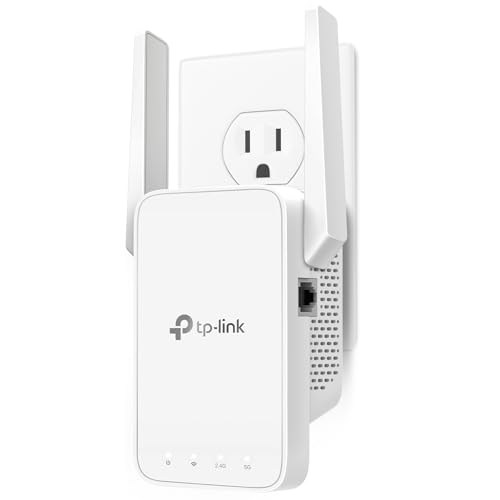
The TP-Link AX3000 is a dual-band Wi-Fi 6 extender with a stated 3 Gbps of combined bandwidth and coverage of up to 2,400 square feet. It has two high-gain directional antennas with beamforming and an Ethernet port. The Wi-Fi 6 standard handles many devices better than older generations, which matters in a living room full of phones, TVs and speakers.

The Ethernet port is the practical feature. It lets you plug a streaming box or a console straight into the extender, which gives those devices a stable wired link to the extended network. Compared with the RE315, which is a basic AC1200 unit, the AX3000 offers a newer standard and more headroom, though the coverage claim is a best-case maker figure that real walls and floors will cut.

As with any dual-band extender, the link back to the router shares radio capacity with the devices it serves, so throughput drops. Place it roughly halfway between the router and the dead zone, where it still receives a strong signal. It suits a router that is also Wi-Fi 6 or newer and a house with one problem area.

What works

  • Wi-Fi 6 standard handles many devices better than older generations
  • Ethernet port gives a streaming box or console a wired link
  • Directional antennas with beamforming aim signal at devices
  • Stated coverage of up to 2,400 sq ft is the second largest here

Watch out for

  • Dual-band design means the wireless link back to the router costs throughput
  • Coverage claim is a best-case figure that walls will reduce

Specs

Standard
Wi-Fi 6 dual band
Total bandwidth
3 Gbps
Stated coverage
Up to 2,400 sq ft
Antennas
Two directional with beamforming
Wired
Ethernet port
02
TP-Link AC1200 Dual-Band WiFi Extender RE315
AC12001.2 Gbps totalUp to 1,500 sq ftTwo antennas
Check price on Amazon
Best for: A single weak room in an apartment or small house on a tight budget.

The TP-Link RE315 is a dual-band AC1200 extender with two adjustable external antennas and a stated coverage of up to 1,500 square feet. It combines a total of 1.2 Gbps across the 2.4 GHz and 5 GHz bands. It is the lowest-cost extender in this guide.

It is a Wi-Fi 5 device, so it suits an older or mid-range router and a home where the problem is one weak bedroom or a back room. Compared with the AX3000, it offers older technology, less headroom and no Ethernet port in the data we reviewed, but for browsing and video on a couple of devices it is enough.

Adjustable antennas help you aim the signal, and the plug-in design keeps it tidy. Treat the 1,500 square foot claim as a ceiling in open space, not a guarantee through walls. Placement matters more than model here, so use the signal light and put it where it still sees a good signal from the router. For a single dead room on a modest budget, it is a sensible purchase.

What works

  • Lowest cost in this guide, so it is a low-risk fix
  • Dual-band AC1200 covers 2.4 GHz and 5 GHz
  • Adjustable external antennas help you aim the signal
  • Compact plug-in design is easy to install

Watch out for

  • Wi-Fi 5 standard has less headroom for many devices
  • Stated 1,500 sq ft is a best-case figure, not a promise

Specs

Standard
Wi-Fi 5 (AC1200)
Total bandwidth
1.2 Gbps
Stated coverage
Up to 1,500 sq ft
Antennas
Two adjustable external
Bands
2.4 GHz and 5 GHz
03
TP-Link AC1900 WiFi Range Extender RE550 with Gigabit Port
AC19001.9 Gbps totalUp to 2,100 sq ftGigabit port
Check price on Amazon
Best for: A mid-size house with a Wi-Fi 5 router and a TV or console that can be wired.

The TP-Link RE550 is an AC1900 dual-band extender with three adjustable external antennas, a stated coverage of up to 2,100 square feet and a gigabit Ethernet port. The combined bandwidth is 1.9 Gbps. It sits between the RE315 and the AX3000 on both capability and cost.

Its wired port is the main step up from the RE315. A gigabit connection to a smart TV or a game console removes wireless variability for that one device, which is often the biggest win an extender can deliver in a living room. Compared with the AX3000, it is Wi-Fi 5, so it handles fewer devices gracefully, but it is a solid performer if your router is also Wi-Fi 5.

Three antennas give it a broader reach than the two-antenna models. Like all single-link extenders, it will cut the speed of its own wireless link, and the claimed coverage will shrink through brick or dense walls. Place it midway and check the signal indicator before finalising the spot. It is a sound middle choice for a mid-size house with one problem area.

What works

  • Gigabit Ethernet port gives a TV or console a wired link
  • Three adjustable antennas cover a larger area than two
  • AC1900 bandwidth gives headroom for streaming
  • Stated coverage of up to 2,100 sq ft

Watch out for

  • Older Wi-Fi 5 standard than the AX3000
  • Wireless backhaul still shares capacity with client devices

Specs

Standard
Wi-Fi 5 (AC1900)
Total bandwidth
1.9 Gbps
Stated coverage
Up to 2,100 sq ft
Antennas
Three adjustable external
Wired
Gigabit Ethernet port
04
NETGEAR EX5000 WiFi Extender, 1.2 Gbps, up to 1,500 sq ft
AC12001,500 sq ft25 devicesApp setup
Check price on Amazon
Best for: A household that wants guided app setup and a stated device limit.

The NETGEAR EX5000 is a Wi-Fi 5 extender with a stated 1.2 Gbps of combined bandwidth and coverage of up to 1,500 square feet. The listing gives a device count of 25, which is one of the few device limits stated in this category, and it offers guided setup through the Nighthawk app or by pressing WPS on the router.

The guided setup is its main selling point. Many extender problems come from the wrong placement and confusing setup, and an app that tells you where to put the unit and checks the signal avoids that. Compared with the RE315, it has the same capability class and coverage claim, so you are buying NETGEAR's setup experience and support.

Twenty-five devices is a sensible number for a modest household, though busy homes with many smart devices will approach it. The wireless link back to the router costs throughput, as it does for any single-link extender. If your router is NETGEAR, the match is natural, and if it is another brand, the extender still works with most routers. It suits someone who wants an easy, guided install.

What works

  • Guided setup through the Nighthawk app or WPS
  • Listing states a device count of 25, which is rare
  • Dual-band AC1200 covers common needs
  • Compact plug-in design

Watch out for

  • Same Wi-Fi 5 class as the cheaper RE315
  • 25 devices can fill up quickly in a smart home

Specs

Standard
Wi-Fi 5
Total bandwidth
1.2 Gbps
Stated coverage
Up to 1,500 sq ft
Device count
25 devices
Setup
Nighthawk app or WPS
05
Amazon eero 6+ Mesh Wi-Fi Extender, up to 1,500 sq ft
Wi-Fi 61,500 sq ft75+ devicesNeeds eero
Check price on Amazon
Best for: An existing eero owner who wants to add coverage without a separate network.

The eero 6+ extender adds up to 1,500 square feet of Wi-Fi 6 coverage per unit to an existing eero network. The listing says it supports 75 or more devices and suits internet plans up to 1 Gbps. The critical fine print is that it requires an existing eero network, so it is not a universal extender.

If you already own an eero router, this is the cleanest way to grow coverage. It joins the mesh and the app manages it, so devices roam between nodes without you handling a separate network name. Compared with a standalone extender such as the TP-Link AX3000, it needs a particular router but delivers a much more integrated experience.

If you do not own an eero, do not buy this by mistake, because it will not work alone. Adding more extenders is easy, and the listing says you can add as many as you need. Place each unit within good range of the previous node rather than at the edge of coverage. It is the right choice only if you are already in the eero ecosystem.

What works

  • Joins an existing eero mesh, so roaming is seamless
  • Wi-Fi 6 standard and 75 plus device support per the listing
  • App management through the eero app
  • Can add several extenders as needed

Watch out for

  • Requires an existing eero network and is useless on its own
  • Coverage per unit is stated at only 1,500 sq ft

Specs

Standard
Wi-Fi 6
Stated coverage
Up to 1,500 sq ft per extender
Devices
75 plus
Requirement
Existing eero network
Speed class
Plans up to 1 Gbps
06
TP-Link RE653BE Wi-Fi 7 Tri-Band Range Extender with 2.5G Port
Wi-Fi 710 Gbps totalTri-band 6 GHz2.5G port
Check price on Amazon
Best for: A Wi-Fi 7 router and a large house where wireless backhaul matters.

The TP-Link RE653BE is a Wi-Fi 7 tri-band extender with a 6 GHz band, 320 MHz channels, a stated 10 Gbps total bandwidth and coverage of up to 2,800 square feet. It has four high-gain directional antennas with beamforming and a 2.5 Gbps Ethernet port. It is the most advanced and the most expensive extender here.

Tri-band matters because one band can be used for the link back to the router while the others serve devices, which reduces the throughput penalty that dual-band extenders suffer. The 2.5 Gbps port also future-proofs a wired connection to a media server or a console. Compared with the AX3000, it is a generation ahead, but it only delivers its best if your router also supports Wi-Fi 7.

Check your router before paying for this, because a Wi-Fi 6 router will not unlock the full benefit and the 10 Gbps figure is a combined total across bands, not a single connection speed. Placement still decides most of the result. For a new Wi-Fi 7 setup with a large or multi-storey living space, it is the strongest extender here.

What works

  • Tri-band design reduces the throughput penalty of wireless backhaul
  • Wi-Fi 7 with 6 GHz band and 320 MHz channels
  • 2.5 Gbps Ethernet port suits fast wired devices
  • Stated coverage of up to 2,800 sq ft is the largest here

Watch out for

  • Highest cost in this guide and only pays off with a Wi-Fi 7 router
  • 10 Gbps is a combined total, not a single connection speed

Specs

Standard
Wi-Fi 7 tri-band
Total bandwidth
10 Gbps
Stated coverage
Up to 2,800 sq ft
Antennas
Four directional with beamforming
Wired
2.5 Gbps Ethernet port

Spec decoder

What the listing measurements really mean

The numbers brands lead with, translated into what they tell you about fit, comfort and wear at home.

Backhaul

The wireless or wired link between an extender and the router.

Watch forDual-band extenders share radios between backhaul and devices.

Dual-band versus tri-band

Dual-band has 2.4 and 5 GHz radios. Tri-band adds a third radio, often used for backhaul.

Watch forThe RE653BE is tri-band, and the others here are dual-band.

Wi-Fi 6 and Wi-Fi 7

Newer standards handle more devices efficiently and add features such as 6 GHz in Wi-Fi 7.

Watch forCheck that your router matches the extender generation.

Beamforming

A technique that aims signal at a device rather than broadcasting evenly.

Watch forThe AX3000 and RE653BE list beamforming antennas.

Stated coverage

The area an extender is rated for in ideal open conditions.

Watch forReal coverage through walls is lower, so treat the figure as a ceiling.

Methodology

How We Evaluated These WiFi Extenders

Standard and bands

We evaluated each extender by its Wi-Fi generation and band design, from the AC1200 RE315 to the tri-band Wi-Fi 7 RE653BE.

Wired options

We checked which units list an Ethernet port and at what speed.

Coverage claims

We recorded stated coverage and treated it as a maker figure rather than a measurement.

Compatibility

We read whether each unit works with any router or only with a matching ecosystem.

Owner feedback patterns

We looked at patterns in owner feedback on setup and speed loss. Scores are editorial assessments and not measurements.

Decision guide

How to Choose the Right WiFi Extenders

By Router

RouterPickWhy
Wi-Fi 7 routerTP-Link RE653BETri-band Wi-Fi 7
Wi-Fi 6 routerTP-Link AX3000Matches the standard
Wi-Fi 5 routerTP-Link RE550Gigabit port
Older or basic routerTP-Link RE315Simple and low cost
eero routereero 6+ extenderJoins the mesh

By Budget

TierPickWhy
Lowest costTP-Link RE315Basic AC1200
Low to midNETGEAR EX5000Guided setup
MidTP-Link RE550Gigabit port and three antennas
Upper midTP-Link AX3000Wi-Fi 6
Highest costTP-Link RE653BEWi-Fi 7 tri-band

Dual-Band vs Tri-Band

Dual-band

Cheaper and common. It shares radios between the link to the router and your devices, so speed drops.

Tri-band

Adds a third radio that can carry the link to the router. It is more expensive and needs a matching router to pay off.

Choose dual-band for one weak room and tri-band for a large, busy house.

By Wired Device

DevicePickWhy
Smart TVTP-Link RE550Gigabit port
Game consoleTP-Link AX3000Wi-Fi 6 and Ethernet
Media serverTP-Link RE653BE2.5 Gbps port
Wireless onlyNETGEAR EX5000Simple setup
Mesh networkeero 6+ extenderApp managed

For Living Rooms Specifically

Look for

An Ethernet port for the TV, a design that does not block outlets and a signal light to help placement.

In this comparison

The RE550, AX3000 and RE653BE give you a wired port for a TV or console, which is often the biggest living room benefit.

When to Spend More

Spend more if

You have a Wi-Fi 6 or 7 router and many devices. A newer extender with more bandwidth and a wired port pays off.

Save if

You have one weak room and an older router. A basic AC1200 extender is enough.

Ownership

Maintenance schedule

The upkeep that decides whether a piece still looks good in year five.

TaskIntervalWhy it matters
Reboot the extenderEvery few monthsExtenders can slow with long uptime. A restart clears memory and resets the link.
Update firmwareEvery 3 monthsUpdates fix bugs and security issues. Check the app or web page for new versions.
Check placementYearlyFurniture and new devices change the signal. Recheck the signal light and move the unit if it fell.
Keep vents clearMonthlyHeat shortens electronics life. Dust the vents with a dry cloth and avoid covering the unit.
Review connected devicesEvery 6 monthsOld devices linger on the network. Remove ones you no longer use to free capacity.

FAQ

Frequently Asked Questions

Do WiFi extenders slow down my connection?

Yes, single-link extenders reduce throughput on the extended side because they share radio capacity. A wired or tri-band option reduces the effect.

Where should I place an extender?

Roughly halfway between the router and the weak area, where it still gets a strong signal. Placing it in the dead zone repeats a poor signal.

Is an extender better than mesh?

For a single weak area, an extender is cheaper. For a large house or several dead zones, mesh gives a more consistent result.

Will any extender work with my router?

Most standalone ones do, but brand-locked units like the eero 6+ extender need a matching network. Check compatibility before buying.

Do I need Wi-Fi 6 or 7?

Only if your router and devices support it. Match the extender generation to the router and the devices you use most.

Can I plug a TV into an extender?

Yes, if it has an Ethernet port. The AX3000, RE550 and RE653BE list a wired port, and a cable gives a TV a stable connection.

Bottom line

The short version

Browse more wifi extenderson Amazon →
Elena Hart, Lead Home Editor

About the author

Elena Hart

Lead Home Editor, SweetLivingRoom

Elena Hart leads SweetLivingRoom's buying guides, turning product dimensions, material specs and owner feedback into clear verdicts on sofas, rugs, lighting, storage and decor.

More from Elena →