
Amazon affiliate links - we earn a commission.Affiliate disclosure

Buying guide · 12 min read · Updated 2026-11-21

Best TV Antennas (2026)

Six indoor TV antennas compared on honest range, amplifier design, cable length, placement and reception reality, with a warning about inflated mile claims.

Elena Hart, Lead Home EditorBy Elena HartLead Home Editor6 picks comparedSpec-sheet verified
Best TV Antennas

At a glance

Our top picks

Side by side

Spec comparison

PieceCableChannelsCost tierVideo
Channel Master FLATenna Indoor Digital HDTV Antenna, 35 Mile Range, 12 Foot CoaxBest OverallChannel Master FLATenna Indoor Digital HDTV Antenna, 35 Mile Range, 12 Foot Coax12 ft coaxialABC, CBS, FOX, NBC, PBS, Univision and moreUpper end of the groupn/a
DAANT Indoor Long Range TV Antenna with Smart IC Chip and 16 Foot Coax CableBest Value Cable LengthDAANT Indoor Long Range TV Antenna with Smart IC Chip and 16 Foot Coax Cable16 ft coaxial with shieldingLocal broadcastsLowest of the groupSupports 4K and 1080p broadcasts
HIDB Indoor Digital HD TV Antenna with Magnetic Base and Omnidirectional ReceptionBest Magnetic MountHIDB Indoor Digital HD TV Antenna with Magnetic Base and Omnidirectional Receptionn/an/aLower middle of the groupHD digital
URIIU Indoor TV Antenna with Magnetic Base, Smart IC Chip and Signal AmplifierBest Plug and PlayURIIU Indoor TV Antenna with Magnetic Base, Smart IC Chip and Signal Amplifiern/aABC, CBS, NBC, FOX and PBSMiddle of the groupn/a
Yaslahut Indoor TV Antenna with Dual Signal Boosters and 32 Foot Coax CableBest Dual-BoosterYaslahut Indoor TV Antenna with Dual Signal Boosters and 32 Foot Coax Cable32 ft coaxialn/aUpper middle of the groupSupports 4K and 1080p broadcasts
A8cyc8R Indoor TV Antenna, 33 Foot Cable, Weather-Resistant Shell, High-Gain ChipBest Weather-Resistant ShellA8cyc8R Indoor TV Antenna, 33 Foot Cable, Weather-Resistant Shell, High-Gain Chip33 ft thickened coaxn/aUpper end of the group8K, 4K and 1080p

An indoor TV antenna pulls free over-the-air channels from broadcast towers, which means local news, network shows and sports without a monthly fee. For many households it is the cheapest way to keep local channels after cutting cable.

Antennas are also the most exaggerated product category on the shelf. Claims of thousands of miles are not physically meaningful, and what actually matters is your distance to the towers, where you place the antenna and whether any amplifier helps or hurts. This guide compares six models with that reality in mind.

Before you buy

6 Criteria to Look For Before Buying a TV Antenna

  1. 01

    Distance to the towers

    Your distance to broadcast towers decides almost everything. A flat antenna like the FLATenna suits within about 35 miles with a clear line of sight. Beyond about 40 or 50 miles, hills, buildings and trees matter and an outdoor antenna usually wins. Look up your local tower locations before you buy.

  2. 02

    Honest range claims

    Claims of 2,500 or 5,000 miles on boxes like the URIIU and A8cyc8R are not meaningful, since TV signals travel in straight lines and fade with distance. Prefer a stated range of 35 to 60 miles. A believable number is a mark of a seller who knows the product.

  3. 03

    Amplified or not

    A booster can help when the signal is weak, but it also amplifies noise and can overload the tuner near the towers. The FLATenna has none, while the Yaslahut has two. If you live close, an unamplified antenna may give a cleaner picture.

  4. 04

    Cable length and loss

    Longer cables like the 32 and 33 foot models let you reach a window far from the TV, but every foot loses a little signal. Keep the run as short as practical. Quality shielding, as the DAANT lists, reduces interference.

  5. 05

    Placement and mounting

    Height and a clear line to the towers beat any feature. A window facing the towers is best, and metal bases like the HIDB need a steel surface. Avoid placing the antenna beside routers or microwaves.

  6. 06

    Channel scanning and upkeep

    Stations change frequencies and channels move. Rescan every few months, and rescan after moving the antenna. A TV that remembers stale channels is the most common reason people think an antenna has stopped working.

Detailed reviews

The 6 best tv antennas, explained

01
Channel Master FLATenna Indoor Digital HDTV Antenna, 35 Mile Range, 12 Foot Coax
35 mile range12 ft coaxUltra thinReversible
Check price on Amazon
Best for: Households within about 35 miles of the towers that want a thin window antenna.

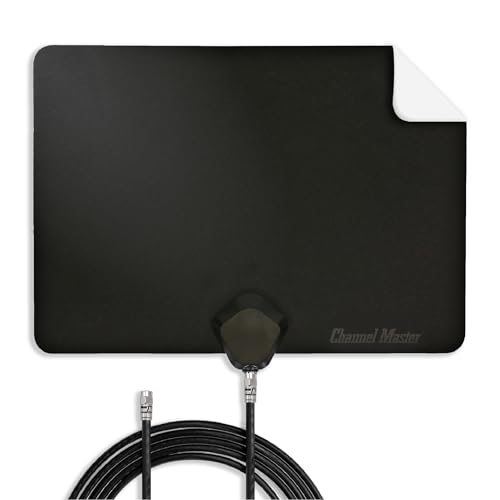
Channel Master's FLATenna is a thin, flat antenna with a stated 35 mile range, a 12 foot coaxial cable and a reversible black and white face so it can blend with a wall or window. It receives the main networks and digital sub-channels, including ABC, CBS, FOX, NBC, PBS and Univision where they broadcast in your area.

The tradeoff is that a 35 mile range is honest and short: if the nearest tower is farther away, it will struggle without a rooftop antenna. Compared with the amplified models in this guide, the FLATenna has no booster, which avoids overload near towers but gives less help far away. Against the DAANT, it has a shorter cable but a more believable range claim.

Stick it to a window facing the towers with the supplied adhesive or tape, then run a channel scan on the TV. Move it a few inches and rescan if channels drop, since placement matters more than any feature. In year three, check the coax connector for looseness and rescan every few months, because stations change frequencies.

What works

  • States a realistic 35 mile range instead of an inflated claim
  • Ultra-thin and reversible, so it blends with a wall or window
  • A 12 foot coax cable reaches most living room windows
  • Made by a company that specialises in antennas

Watch out for

  • No amplifier, so it will not help in weak signal areas
  • Upper end cost tier for an unamplified flat antenna

Specs

Stated range
35 miles
Cable
12 ft coaxial
Design
Ultra-thin, lightweight, reversible black and white
Channels
ABC, CBS, FOX, NBC, PBS, Univision and more
Cost tier
Upper end of the group
02
DAANT Indoor Long Range TV Antenna with Smart IC Chip and 16 Foot Coax Cable
16 ft coaxSmart IC chip4K and 1080pLocal channels
Check price on Amazon
Best for: Buyers who want to test over-the-air TV at the lowest cost tier.

DAANT's indoor antenna uses a smart IC chip to filter and amplify signals, with a 16 foot coaxial cable that has multiple layers of shielding. At the lowest cost tier in the group, it is the cheapest way to try over-the-air TV and the extra cable length gives more freedom to place it at a window.

The tradeoff is that the listing says long range without a mile figure that you can check, so treat the claim carefully. Compared with the FLATenna, it adds four feet of cable and a booster chip at a much lower cost, but gives less certainty on range. Against the HIDB, it has a longer cable but no magnetic base.

Place it by a window or high on a wall facing the towers, then scan channels. If reception is patchy, try a different spot before you blame the antenna. In year three, check the cable for kinks, rescan channels and consider turning off the booster if you live close to the towers and see pixelation.

What works

  • A 16 foot shielded cable gives flexible placement
  • A smart IC chip filters out some interference
  • Lowest cost tier makes it an easy trial purchase
  • Supports 4K and 1080p broadcasts where stations offer them

Watch out for

  • Long range claim has no checkable mile figure
  • An amplifier can overload near a tower and cause pixelation

Specs

Cable
16 ft coaxial with shielding
Chip
Smart IC chip
Video
Supports 4K and 1080p broadcasts
Channels
Local broadcasts
Cost tier
Lowest of the group
03
HIDB Indoor Digital HD TV Antenna with Magnetic Base and Omnidirectional Reception
OmnidirectionalMagnetic baseOTA HDIndoor
Check price on Amazon
Best for: Quick setups where aiming is a nuisance and a metal surface is handy.

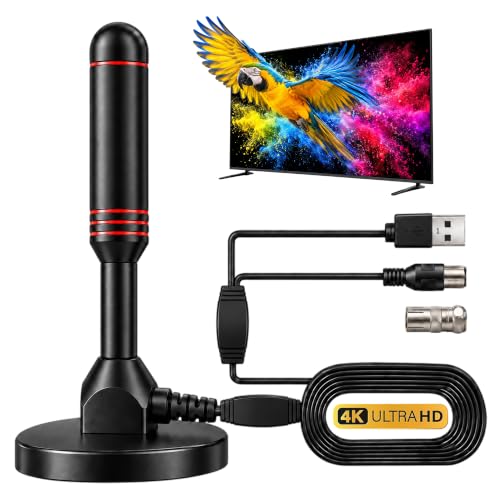
HIDB's indoor antenna uses an omnidirectional design and a magnetic base so it can sit on a metal surface such as a fridge or a steel shelf. The pitch is that you never pay a monthly bill for local channels, and omnidirectional reception means you do not have to aim it at one tower.

The tradeoff is that an omnidirectional design picks up noise from every direction, so a household with lots of electronics may see interference. Compared with a directional model, it is easier to place but may reach fewer distant stations. Against the DAANT, it adds a magnetic base but has no stated cable length in the highlights.

Place it on a window frame or metal surface and run a scan. Keep it away from routers, microwaves and LED lamps that add noise. In year three, check the base magnet and the cable for wear, and rescan channels each season. It suits a quick, low-effort setup.

What works

  • Omnidirectional reception removes the need to aim
  • A magnetic base mounts on steel surfaces without tape
  • Free local channels remove a monthly bill
  • Lower middle cost tier for a simple antenna

Watch out for

  • Omnidirectional designs pick up noise from all sides
  • May reach fewer distant stations than a directional antenna

Specs

Reception
Omnidirectional
Mount
Magnetic base
Use
Local OTA channels, no monthly bill
Video
HD digital
Cost tier
Lower middle of the group
04
URIIU Indoor TV Antenna with Magnetic Base, Smart IC Chip and Signal Amplifier
Smart IC chipSignal amplifierMagnetic baseANT IN plug
Check price on Amazon
Best for: Buyers who want a simple plug and scan antenna for the main networks.

URIIU's indoor antenna combines a smart IC chip and amplifier with a magnetic base, and plugs into the TV's ANT IN port before a quick channel scan. It is aimed at the five main networks, ABC, CBS, NBC, FOX and PBS, which cover most of what people want from over-the-air TV.

The tradeoff is the marketing: the listing promotes a 5000 mile figure, which is not something a real antenna can deliver, since reception depends on line of sight and tower power. Compared with the FLATenna, it adds a booster and a magnet, but is less transparent about range. Against the HIDB, it adds an amplifier.

Connect the cable, scan, and fine-tune the position by a window. If pictures break up, try turning off or reducing the amplifier if the model allows it, because a booster can overload near the tower. In year three, rescan for channel changes and check the cable ends.

What works

  • A smart chip and amplifier help in marginal reception
  • A magnetic base mounts on steel surfaces
  • Plugs into the ANT IN port with a quick scan
  • Covers the main networks of ABC, CBS, NBC, FOX and PBS

Watch out for

  • The 5000 mile claim is not physically meaningful
  • A booster can overload near the towers

Specs

Electronics
Smart IC chip and amplifier
Mount
Magnetic base
Connection
TV ANT IN port
Channels
ABC, CBS, NBC, FOX and PBS
Cost tier
Middle of the group
05
Yaslahut Indoor TV Antenna with Dual Signal Boosters and 32 Foot Coax Cable
Dual boosters32 ft coax4K and 1080pSmart TV ready
Check price on Amazon
Best for: Rooms where the best reception window is far from the TV.

Yaslahut's antenna uses two signal boosters and a 32 foot coaxial cable, which lets you place the antenna at a window far from the TV. The long cable is the practical advantage, since the best reception spot is often a window or high wall that is far from the media console.

The tradeoff is that a long cable loses a little signal over its length, and two boosters can overload the tuner if you live close to the towers. Compared with the DAANT, the Yaslahut offers twice the cable length and a second booster, at a higher cost tier. Against the FLATenna, it trades a believable range figure for more boosting.

Run the cable neatly along a baseboard or behind furniture, and place the antenna at the best window. Scan, then rescan after small movements. If pictures pixelate near the towers, try a shorter run or disable a booster if possible. In year three, check the cable and connectors, and rescan seasonally.

What works

  • A 32 foot coax cable reaches distant windows from the TV
  • Dual boosters can help in weaker signal areas
  • Supports 4K and 1080p broadcasts where available
  • Works with smart TVs and standard TVs alike

Watch out for

  • Two boosters can overload the tuner near the towers
  • A long cable adds clutter and a little signal loss

Specs

Boosters
Two signal boosters
Cable
32 ft coaxial
Video
Supports 4K and 1080p broadcasts
Use
Smart TVs and standard TVs
Cost tier
Upper middle of the group
06
A8cyc8R Indoor TV Antenna, 33 Foot Cable, Weather-Resistant Shell, High-Gain Chip
33 ft cableWeather resistantHigh-gain chip8K and 4K
Check price on Amazon
Best for: Attic or balcony trials where a sealed shell and long cable help.

This antenna pairs a high-gain chip with a reinforced weather-resistant shell and a thickened 33 foot cable, which suggests it can be placed outdoors or in an attic as well as inside. The long cable gives the most reach in the group, and the sealed shell is a rare feature among indoor models.

The tradeoff is that the listing quotes a range figure in thousands of miles, which is not physically achievable, and the upper end cost tier is high for an unbranded product. Compared with the Yaslahut, it has a similar cable and a sturdier shell. Against the FLATenna, it trades believable claims for more cable and weatherproofing.

If you try it outdoors or in an attic, seal the connector with weatherproof tape and keep the cable out of puddles. Aim it toward the towers, scan and adjust. In year three, check the connector for corrosion and the shell for cracks, and rescan channels each season.

What works

  • A weather-resistant shell allows attic or balcony placement
  • A 33 foot thickened cable is the longest in the group
  • A high-gain chip helps in marginal reception
  • Supports 4K and 1080p broadcasts where stations offer them

Watch out for

  • A range claim in thousands of miles is not credible
  • Upper end cost tier for an unbranded antenna

Specs

Cable
33 ft thickened coax
Shell
Weather-resistant with lightning, wind and rain shielding
Chip
High-gain signal chip
Video
8K, 4K and 1080p
Cost tier
Upper end of the group

Spec decoder

What the listing measurements really mean

The numbers brands lead with, translated into what they tell you about fit, comfort and wear at home.

Stated range in miles

This is the maker's guess at how far the antenna can pick up signals in ideal conditions. Real range depends on terrain.

Watch forThe FLATenna lists 35 miles; others list thousands of miles, which is not meaningful.

Omnidirectional

An omnidirectional antenna accepts signals from all directions. It avoids aiming but also picks up noise.

Watch forThe HIDB is omnidirectional; flat window antennas are more directional.

Amplifier or booster

A booster raises signal strength after the antenna. It cannot create signal that is not there.

Watch forThe Yaslahut lists two boosters, which can overload near the towers.

Coax cable length

The cable runs from the antenna to the TV. Longer cables offer placement freedom and lose some signal.

Watch forThe A8cyc8R lists 33 feet, the DAANT 16 feet and the FLATenna 12 feet.

VHF and UHF coverage

Broadcasts use VHF and UHF bands. Antennas need to cover the bands your stations use.

Watch forSome listings mention both bands; check yours with a signal map.

Methodology

How We Evaluated These TV Antennas

Range honesty

We compared stated ranges, from 35 miles on the FLATenna to claims of thousands of miles on others. We scored believable claims higher. We did not measure any reception.

Amplifier design

We read booster descriptions, from no amplifier on the FLATenna to two boosters on the Yaslahut. We weighed how each helps and where it can hurt. We noted overload risk near towers.

Cable and placement

We compared cable lengths from 12 to 33 feet and mounting options such as magnetic bases. We favoured models that let you reach a good window.

Build and shell

We looked at the thin FLATenna, the magnetic models and the weather-resistant A8cyc8R. Each suits a different spot. We favoured durable connectors.

Owner feedback patterns

We researched common themes: inflated range claims, pixelation near towers and missing channels after a move. These shape our cons. We did not use ratings or review counts.

Decision guide

How to Choose the Right TV Antennas

By Distance to Towers

SituationPickWhy
Under 20 milesChannel Master FLATennaUnamplified avoids overload
20 to 35 milesFLATenna or DAANTBelievable range or booster chip
35 to 50 milesYaslahut dual-boosterBoosters and a long cable
Weak signalA8cyc8R with weather shellOutdoor or attic trial
Over 50 milesOutdoor antenna insteadIndoor antennas struggle

By Budget

SituationPickWhy
Lowest tierDAANTCheapest way to try OTA
Lower middleHIDBSimple magnetic antenna
MiddleURIIUBooster and magnet
Upper middleYaslahutDual booster and long cable
Upper endFLATenna or A8cyc8RBrand or weather shell

Amplified vs Unamplified

Unamplified

The FLATenna avoids overload near the towers and gives a clean picture when the signal is strong.

Amplified

The Yaslahut, URIIU and DAANT help when the signal is weak, but a booster can hurt near towers.

Pick unamplified if you live close to the towers and amplified if you are far or the window is poor.

By Placement

SituationPickWhy
Window facing towersFLATennaThin and sticks to glass
Metal shelf or fridgeHIDB or URIIUMagnetic bases
Far from the TVYaslahut32 foot cable
Attic or balconyA8cyc8RWeather-resistant shell
Moderate runDAANT16 foot cable

For Living Room Use Specifically

Look for

A believable range, a cable that reaches the best window, a mount that suits your wall and an amplifier only if your signal is weak.

In this comparison

The FLATenna suits a clean window install near towers, while the Yaslahut and A8cyc8R suit awkward layouts.

When to Spend More

Spend more if

You want a clear range figure and a known brand like the FLATenna, or a sealed shell for an attic trial.

Save if

You live close to the towers and only want local news, where the DAANT is enough.

Ownership

Maintenance schedule

The upkeep that decides whether a piece still looks good in year five.

TaskIntervalWhy it matters
Rescan channelsEvery few monthsStations change frequencies. A rescan restores missing channels.
Check the coax connectorTwice a yearLoose connectors cause dropouts. Hand-tighten the nut.
Reposition after changesWhen furniture or windows changeNew obstacles block signals. Small moves help.
Keep away from noise sourcesAlwaysRouters, microwaves and LEDs add interference.
Inspect the cableYearlyKinks and cuts cause loss. Replace damaged cable.

FAQ

Frequently Asked Questions

Do indoor antennas really work?

Yes, if you are within range and have a decent line to the towers. In cities near towers, a flat antenna can deliver clear HD channels for free. In rural areas, indoor models often struggle.

How much does a TV antenna cost?

Prices move, so check the current listing. The DAANT sits at the low end and the FLATenna and A8cyc8R at the upper end. Brand and cable length drive cost.

Is a 5000 mile antenna real?

No. TV signals travel in straight lines and fade with distance, so claims of thousands of miles are marketing. Look for a stated range of 35 to 60 miles.

Do I need an amplifier?

Only if your signal is weak. Near towers, an amplifier can overload the tuner and cause pixelation, so try without one first.

Why am I missing channels?

Common causes are poor placement, a stale channel list, interference or distance. Rescan, move the antenna and check a signal map.

Can I use one antenna for several TVs?

A splitter can share one antenna but loses signal with each split. A distribution amplifier helps, though you may do better with one antenna per room.

Bottom line

The short version

Browse more tv antennason Amazon →
Elena Hart, Lead Home Editor

About the author

Elena Hart

Lead Home Editor, SweetLivingRoom

Elena Hart leads SweetLivingRoom's buying guides, turning product dimensions, material specs and owner feedback into clear verdicts on sofas, rugs, lighting, storage and decor.

More from Elena →