
Amazon affiliate links - we earn a commission.Affiliate disclosure

Buying guide · 13 min read · Updated 2026-11-28

Best Space Heaters Under $50 (2026)

Five ceramic space heaters under $50 compared by wattage settings, thermostat, oscillation, noise and safety features, with notes on circuit limits.

Elena Hart, Lead Home EditorBy Elena HartLead Home Editor5 picks comparedSpec-sheet verified
Best Space Heaters Under $50

At a glance

Our top picks

Side by side

Spec comparison

A small ceramic heater warms the person and the corner they sit in, which is why it suits a desk, a bedside or a small living room better than a whole house. The 1500W ceiling is the same on every model here, because a standard household circuit cannot supply more, so the differences come down to control, noise and safety features.

Price caps move, and the cap in this guide reflects listing prices when the guide was last updated. We favoured heaters in the upper band of the cap, where the extra spend buys a better thermostat, a timer and a quieter fan. Each pick says plainly what the listing states, and the safety notes are the most important part of this guide.

Before you buy

6 Criteria to Look For Before Buying a Space Heater Under $50

  1. 01

    Wattage and circuit limits

    A standard 15 A household circuit supports a maximum of about 1500W, so every portable electric heater is capped there. Lower steps such as 700W or 1000W, as on the JIBUFI and OLIXIS, draw less power in a mild room. Sharing a circuit with a microwave or a kettle can trip a breaker. Plug the heater directly into a wall outlet, never an extension cord or power strip. A quick way to check your circuit is to look at the breaker label, since a 15 A circuit that also feeds lights and a television has less spare capacity than the wall outlet suggests.

  2. 02

    Room size and heat

    A 1500W heater provides roughly the same heat as a hair dryer, enough to warm a small bedroom or a desk area, but it will not heat a large open room. Heat output does not change with price, so a cheaper heater gives the same warmth as a dearer one at the same wattage. Match the heater to the space, and use it to warm people rather than the whole house. Close doors to hold heat in. Closing the door and sealing obvious draughts under it raises the effect of any small heater more than a change of model does.

  3. 03

    Thermostat and timer

    A thermostat cycles the heater on and off to hold a temperature, which saves energy and avoids overheating the room. The DREO uses an NTC chip for precise control, and the OLIXIS spans 50 to 95 F. A 12 hour timer lets you set an automatic shut off for overnight use. Do not rely on a timer instead of supervision. The timer is a convenience for waking to a warm room, but it should never be the only safety feature in the room.

  4. 04

    Safety features

    Look for tip over shut off, overheat protection and flame retardant materials. A certification such as ETL, as listed on the FNIOP, shows the product has been listed to a safety standard. Keep the heater at least 3 ft from curtains, bedding and furniture. Never leave a heater running in an unattended room or near children and pets. If a heater smells of burning dust on its first day, unplug it, let it cool and wipe the intake, because most of that smell is dust and factory residue.

  5. 05

    Noise

    A heater with a fan makes noise, and a figure like the DREO's listed 34 dB is quieter than a typical fan heater. Oscillation adds a motor sound. Noise matters most in a bedroom or office. Compare the listed decibels, but remember that makers measure at different distances. A decibel figure from the maker is a guide only, and a fan heater on a hard floor sounds louder than the same unit on a rug.

  6. 06

    Oscillation and remote

    Oscillation spreads warmth over a wider area and suits shared rooms, but reduces the heat in one direction. A remote lets you adjust from the sofa but is easy to lose. The JIBUFI and WINHL both list 70 degree oscillation and remotes. Keep a physical control as a backup. If you keep the remote on the sofa, put a small label on the back with the model name so a replacement is easy to find.

Detailed reviews

The 5 best space heaters under $50, explained

01
DREO 1500W Ceramic Space Heater, Thermostat, 34 dB, 12H Timer
1500W PTC ceramic34 dB listedThermostat12H timer
Check price on Amazon
Best for: Bedrooms and home offices that want a quiet heater with a precise thermostat.

DREO builds its heater around a PTC ceramic element rated at 1500W, with a thermostat driven by an NTC chip for more precise temperature control and a 12 hour timer. The listing quotes a noise level of 34 dB, which is quiet enough for a bedroom and well below the whir of many small fan heaters. It is the most refined heater in the lineup and the one most likely to be left on overnight with the timer set.

The tradeoff is that a quiet heater has a smaller fan, so it moves less air and warms a smaller area than a louder one, and 1500W is still 1500W, so it will not heat a large room. Compared with the JIBUFI, it has fewer power steps but a more precise thermostat. Compared with the OLIXIS, it lacks a flame effect, but it is quieter and simpler.

Place it on a hard, level floor, at least 3 ft from curtains and furniture, and plug it directly into a wall outlet rather than an extension cord or power strip. Dust the intake monthly. It is a good fit for a bedroom or a desk.

What works

  • Listed noise of 34 dB suits a bedroom
  • NTC chip thermostat for more precise temperature control
  • 12 hour timer for overnight or workday use
  • Overheat and tip over protection listed

Watch out for

  • Small fan means a smaller warmed area
  • 1500W will not heat a large open room
  • Fewer power steps than three level models

Specs

Power
1500W PTC ceramic
Noise
Listed at 34 dB
Thermostat
NTC chip thermostat for temperature control
Timer
12 hour timer
Safety
Overheat and tip over protection
02
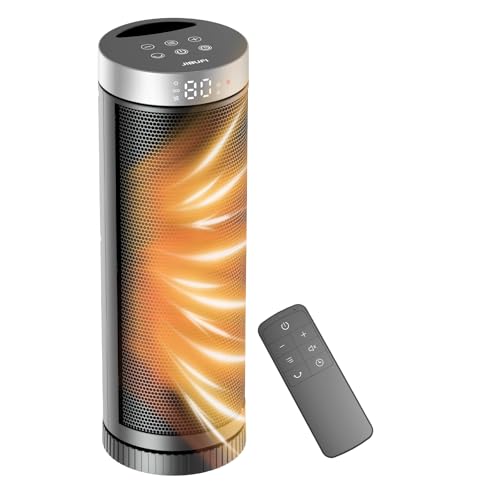
JIBUFI 17 in Space Heater, 700W 1000W 1500W, Remote, 70 Degree Oscillation
700, 1000, 1500W70 degree oscillationRemote12H timer
Check price on Amazon
Best for: Living rooms and bedrooms that want three power levels and wide oscillation.

JIBUFI stands 17 in tall and offers three power levels of 700W, 1000W and 1500W, a built in thermostat, an ECO mode, a 12 hour timer and a remote. A 70 degree oscillation spreads warm air across a wider area than a fixed heater. The three steps matter because you can run it at 700W or 1000W in a mild room and draw less power than a fixed 1500W unit.

It ranks second because it gives the most control among the compact heaters. The tradeoff is size and noise: a fan driven oscillating heater makes more noise than the DREO, and the oscillation adds a moving part that can wear. Compared with the OLIXIS, it is smaller and lacks the cool air mode and flame effect. Compared with the FNIOP, it adds the power steps and the remote.

Keep the cord clear and the outlet unshared. Use the remote to tune the temperature from the sofa. A heater like this is best placed to blow across a seat, not at a wall. Check that the oscillation does not push it into a curtain.

What works

  • Three power steps from 700W to 1500W
  • 70 degree oscillation covers more of the room
  • Remote, thermostat and ECO mode
  • 12 hour timer for automatic shut off

Watch out for

  • Fan and oscillation add noise
  • Oscillation motor is a moving part that can wear
  • Still limited to 1500W on a standard circuit

Specs

Power steps
700W, 1000W and 1500W
Height
17 in
Oscillation
70 degrees
Controls
Remote, thermostat and ECO mode
Timer
12 hour timer
03
OLIXIS 24 in Space Heater, 1500W, 4 Modes, 50 to 95 F Thermostat
24 in tall4 modes50 to 95 F thermostat60 degree oscillation
Check price on Amazon
Best for: Bedrooms and small living rooms that want a tower heater with a fan only mode.

OLIXIS is a 24 in tower heater with four modes, including a natural air mode that moves air without heat and a 750W low heat step, plus a thermostat that spans 50 to 95 F and a 60 degree oscillation. It adds a flame effect for ambience and a portable handle. A fan only mode makes it useful in summer, and the tower shape suits a bedroom or a small living room corner.

The tradeoff is that a tall, narrow tower needs a stable base, and tip over protection matters. Compared with the JIBUFI at 17 in, it covers a larger vertical area but is more likely to be knocked. The flame effect is decoration and does not add heat. It is the most feature rich of the five, with more things that can fail.

Place it on a flat hard surface, 3 ft from combustibles, and avoid running it near children. Wipe the intake grille regularly and keep the cord out of walkways. It suits a room where the heater sits in a fixed spot.

What works

  • Four modes include a fan only setting
  • Thermostat range of 50 to 95 F is wide
  • 24 in tower shape with a carry handle
  • Flame ambiance adds a cosy look

Watch out for

  • Tall shape needs a stable base
  • Flame effect adds no heat
  • More features mean more parts that can fail

Specs

Modes
Natural air, 750W low heat, and higher heat modes
Height
24 in tall
Thermostat
50 to 95 F
Oscillation
60 degrees
Extra
Flame ambiance effect, portable handle
04
FNIOP 16.3 in Space Heater, 1500W PTC Ceramic, ETL Certified, 12H Timer
1500W PTC16.3 in tallETL certifiedECO mode
Check price on Amazon
Best for: Small rooms where a listed safety certification matters.

FNIOP is a 16.3 in 1500W PTC ceramic heater with a thermostat, a 12 hour timer, an ECO mode and oscillation, and the listing says it is ETL certified and made from flame retardant materials. A third party safety listing is a small but real differentiator at this price, because a certified heater has been listed against a defined set of electrical and fire safety requirements. The listing describes it as heating within seconds.

The tradeoff is that it is simple, with one power level and no mention of a remote or fan only mode in the highlights. Compared with the JIBUFI, it has fewer power steps but a lower height. Compared with the DREO, it lacks a quoted noise level. The ETL claim is useful, but you should still check the product label for the mark, since listings can be wrong.

Use it on a hard level surface, clear of fabric, and plug it directly into a wall outlet. Dust the grille monthly. It is a good option for a person who values a safety listing.

What works

  • ETL certification listed for safety
  • Flame retardant materials per the listing
  • Thermostat, ECO mode and 12 hour timer
  • Compact 16.3 in height suits a desk or bedside

Watch out for

  • Single power level in the highlights
  • No quoted noise level
  • Certification should be confirmed on the label

Specs

Power
1500W PTC ceramic
Height
16.3 in
Certification
ETL certified per listing
Timer
12 hour timer
Extra
ECO mode, thermostat, oscillation
05
WINHL 1500W PTC Ceramic Space Heater, 70 Degree Oscillation, Remote
1500W PTC70 degree oscillationRemote12H timer
Check price on Amazon
Best for: Shared sitting areas that benefit from a wide oscillating sweep.

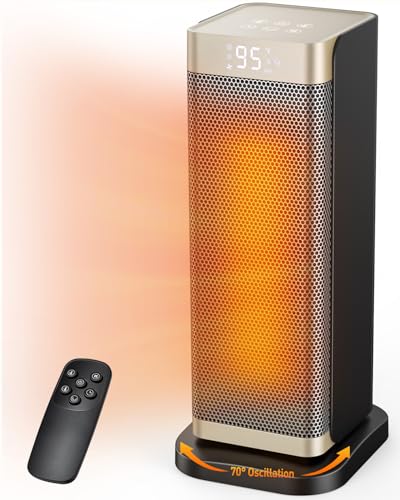
WINHL pairs a 1500W PTC ceramic element with a 70 degree wide angle oscillation, a remote, a thermostat and a 12 hour timer, and lists five modes. The wide sweep is the selling point: it moves warm air side to side so a corner of the room warms more evenly than with a fixed heater. The listing says warm air starts within seconds, which is typical for a PTC element.

The tradeoff is that oscillation reduces the intensity in any one direction, so the heat on your hands at a desk is less than a fixed heater pointed at you. Compared with the JIBUFI, it has similar oscillation and controls but one power level. Compared with the DREO, it is louder and less precise. It is a sound choice for a shared sitting area.

Place it where the sweep passes over seats and keep it 3 ft from curtains and bedding. Replace the remote battery when it weakens. Wipe the intake monthly.

What works

  • 70 degree oscillation spreads warm air across a corner
  • Remote, thermostat and 12 hour timer
  • Five heating modes
  • PTC ceramic heats quickly

Watch out for

  • Oscillation reduces heat in any one direction
  • One power level in the highlights
  • Louder and less precise than the DREO

Specs

Power
1500W PTC ceramic
Oscillation
70 degree wide angle
Controls
Remote, thermostat and 12 hour timer
Modes
Five heating modes
Heat
Warm air within seconds

Spec decoder

What the listing measurements really mean

The numbers brands lead with, translated into what they tell you about fit, comfort and wear at home.

PTC ceramic

A heating element that self regulates its temperature, making it a common safe choice for small heaters.

Watch forAll five listings use PTC ceramic at 1500W.

1500W

The maximum power draw of a portable heater on a standard household circuit.

Watch forEvery heater here is capped at 1500W, so none will heat a large room.

ETL certified

A safety listing from an independent laboratory showing the product has met a defined standard.

Watch forThe FNIOP lists ETL, but check the label.

Tip over protection

A switch that cuts power if the heater is knocked over.

Watch forThe DREO lists it, and any heater should have it.

dB

Decibels, a measure of sound level. Lower numbers are quieter.

Watch forThe DREO lists 34 dB, but measurement distance varies.

Methodology

How We Evaluated These Space Heaters Under $50

Power and control

We compared the power steps and thermostat ranges, from the JIBUFI's three levels to the OLIXIS 50 to 95 F range. We note that these are published specifications, not our measurements. We also compared how many power steps each listing offers.

Safety

We looked at the listed safety features, including tip over and overheat protection and the FNIOP's ETL claim. We treated safety as the first criterion and said plainly where a claim needs checking.

Noise and airflow

We read the noise figures and the oscillation ranges. The DREO lists 34 dB, and the JIBUFI and WINHL list 70 degree oscillation. We drew on owner feedback patterns about fan noise. Oscillating fans add moving parts that can wear.

Size and room fit

We considered the heights, from the 16.3 in FNIOP to the 24 in OLIXIS, and the likely rooms. None of these heaters can warm a large room.

Value and fit

We compared the price tiers inside the cap and what each heater offers. We did not republish ratings or review counts. Heaters with the most useful mix of control and safety ranked higher.

Decision guide

How to Choose the Right Space Heaters Under $50

By Room

SituationPickWhy
Bedroom at nightDREOQuiet and precise
Home office deskFNIOPCompact and certified
Shared living areaJIBUFI or WINHLWide oscillation
Tower in a cornerOLIXISTall with a fan mode

By Budget

TierPickWhat you get
Lower within capWINHL1500W with oscillation
Low to midFNIOPETL listed and compact
MidJIBUFIThree power steps
Top of the capDREO or OLIXISQuiet precision or four modes

Oscillating vs Fixed

Oscillating

The JIBUFI, WINHL and OLIXIS spread warmth, but reduce heat in any one direction and add noise.

Fixed

The DREO and FNIOP give more focused heat and less moving part wear.

Choose oscillation for shared rooms and fixed for a desk or a seat.

By Control

SituationPickWhy
Precise temperatureDREONTC thermostat
Remote from the sofaJIBUFI or WINHLRemote included
Fan only in summerOLIXISNatural air mode
Simple useFNIOPFew settings

For Safety Specifically

Look for

Tip over and overheat protection, a certification mark and a plug that goes straight into a wall outlet.

In this comparison

The FNIOP lists ETL, and the DREO lists overheat and tip over protection.

When to Spend More

Spend more if

You want an oil filled radiator, an infrared panel or a smart heater, which sit above this cap.

Save if

You need a small ceramic heater for a desk or bedroom.

Ownership

Maintenance schedule

The upkeep that decides whether a piece still looks good in year five.

TaskIntervalWhy it matters
Dust the grilleMonthlyDust blocks airflow and can cause overheating. Unplug the heater first. A soft brush attachment on a vacuum is the safest tool for this job.
Inspect the cordMonthlyCheck for heat marks and damage. Replace the heater if the cord is damaged. A cord that runs warm to the touch is a reason to stop using the heater.
Check tip over protectionAt the start of the seasonFollow the maker's guidance and replace a heater that does not shut off. Keep a note of the date so the check becomes a habit rather than an afterthought.
Store carefullyAfter the seasonKeep it dry and covered. Wrap the cord loosely. Heaters left in a damp garage can corrode, so a dry shelf is better.
Check the outletEach useThe plug should not feel hot. A hot outlet means a problem. Try a different outlet if it feels warm before blaming the heater.

FAQ

Frequently Asked Questions

Can I plug a heater into an extension cord?

No. A heater draws high current and should go directly into a wall outlet. Extension cords and power strips can overheat. Check the label on the circuit breaker if you are not sure.

How far from furniture should it be?

Keep it at least 3 ft from curtains, bedding and furniture. Follow the maker's manual. Soft furnishings are the usual cause of heater fires, so this rule matters.

Can I leave it on overnight?

Follow the manual. Many makers advise against unattended use. A timer and a thermostat help but do not replace caution. Many fire safety bodies say never to leave heaters running while you sleep or are away.

Will a 1500W heater warm my living room?

It will warm a small area. A large open room needs more than a portable heater provides. A small heater warms the person near it far better than it warms the whole room.

Is ceramic better than an oil filled radiator?

Ceramic heats quickly and is light. An oil filled radiator heats slowly and stays warm longer. Choose by use. Oil filled models are quieter and stay warm after switching off, but take longer to heat up.

Why does my heater trip the breaker?

It may share a circuit with another high draw device. Move it to another outlet or lower the power step. A tripped breaker is a warning, so do not simply reset it repeatedly.

Bottom line

The short version

Browse more space heaters under $50on Amazon →
Elena Hart, Lead Home Editor

About the author

Elena Hart

Lead Home Editor, SweetLivingRoom

Elena Hart leads SweetLivingRoom's buying guides, turning product dimensions, material specs and owner feedback into clear verdicts on sofas, rugs, lighting, storage and decor.

More from Elena →

Keep reading

Related guides